Overnight rate hits record low since March 2024
Overnight rate hits record low since March 2024
The central bank's net withdrawal of funds in previous weeks, along with the overnight interbank rate falling below 1 per cent per year, reflects the abundant short-term capital in the banking system.
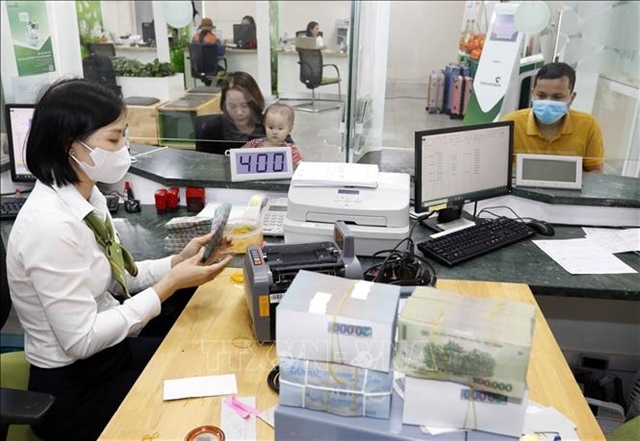
Interest rates for one-week, two-week and one-month terms remained significantly higher than overnight rates. — VNA/VNS Photo |
The overnight interest rate in the interbank market last week fell below one per cent per year, the lowest rate since March 2024, signalling a significant reduction in system liquidity pressure, particularly for very short-term maturities.
It decreased to 0.75 per cent on July 30. The rates for one-week and one-month maturities remained at 4.49 per cent per year and 6.4 per cent per year respectively on the same day.
After three consecutive weeks of net withdrawals, the State Bank of Vietnam (SBV) also injected VNĐ12.3 trillion in the past week.
The central bank's net withdrawal of funds in previous weeks, along with the overnight interbank rate falling below 1 per cent per year, reflects the abundant short-term capital in the banking system.
However, interest rates for one-week, two-week and one-month terms remained significantly higher than overnight rates, indicating that demand for capital at longer maturities has not changed significantly, and reflecting that medium- and long-term liquidity is not yet truly abundant.
Meanwhile, banks’ interest rates applied for individual and corporate depositors also showed no signs of cooling down. Many banks are still offering rates of 9 per cent per year or higher for six-month terms, while interest rates for certificates of deposit have also increased sharply at some banks.
Recent data from the central bank shows that as of July 13, 2026, the outstanding loans of the banking system reached nearly VNĐ20.1 quadrillion (US$761 billion), an increase of 7.86 per cent compared to the end of 2025.
Though the rising rate of raised capital has improved, the gap between credit and deposits has remained quite large, putting pressure on the banking system.
Notably, the SBV last week decided to increase the loan-to-deposit ratio (LDR) from 20 per cent to 50 per cent of the State Treasury's time deposit balance when calculating the loan-to-deposit ratio.
According to experts, this decision will help reduce liquidity pressure on banks, especially State-owned banks (Big4 group), which have received almost all of the large deposits from the State Treasury in recent times.
For joint-stock banks, the benefit will be lower because they do not possess a large amount of State Treasury deposits. However, this group can still benefit indirectly if liquidity pressure and deposit competition across the system decrease.
According to financial reports for 2025, the amount of money that the State Treasury deposited in the Big4 group as of December 31, 2025, was over VNĐ492.5 trillion.
- 14:28 03/08/2026