Investment, domestic demand to shape Việt Nam’s H2 growth: reports
Investment, domestic demand to shape Việt Nam’s H2 growth: reports
Việt Nam’s strong H1 sets a solid base for growth, but investment, consumption and external risks will determine how far that momentum carries into the second half of 2026.
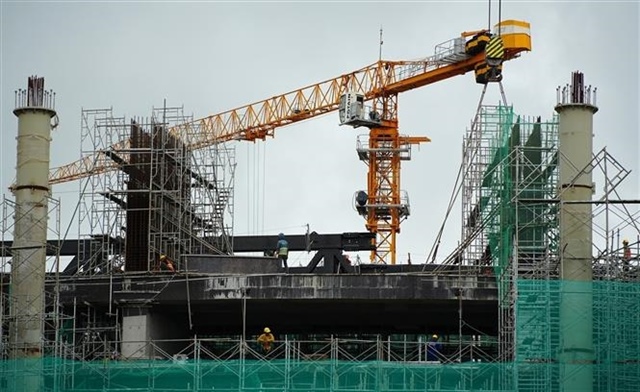
Construction of technical infrastructure works for the 2027 APEC Summit in Phú Quốc Special Administrative Zone, An Giang Province. — VNA/VNS Photo Lê Huy Hải |
Việt Nam enters the second half of 2026 on a strong growth footing, with investment and domestic consumption emerging as important supports as external trade faces greater uncertainty.
Recent analysis by EBC Financial Group and BMI, a unit of Fitch Solutions, suggests that the economy has room to maintain solid momentum, although inflation, currency and external trade risks could test its resilience.
EBC said the key challenge was no longer simply the pace of growth, but how effectively the resources behind it were being converted into productive capacity.
GDP grew 8.18 per cent in the first half of the year, while industrial production rose by 10.8 per cent and manufacturing and processing expanded by 11.4 per cent. Total social investment increased by 12.9 per cent, with asset accumulation rising by 15.2 per cent.
Registered foreign direct investment (FDI) reached US$34.65 billion in the first half, up 61 per cent year-on-year, while disbursed FDI rose by 11.2 per cent to $13.03 billion.
The gap between committed and realised capital highlights a key challenge for the months ahead: turning investment into factories, machinery, infrastructure and new production capacity.
“Committed capital must flow into factories and production to create economic value. Việt Nam’s growth in the second half of 2026 will increasingly be a story of execution,” said Sana Ur Rehman, senior market analyst at EBC Financial Group, in a note to media.
Việt Nam’s trade figures also point to the cost of rapid expansion.
In the first half, exports rose by 21 per cent to US$266.5 billion, but imports increased much faster, by 33.4 per cent to $283.2 billion, resulting in a trade deficit of nearly $16.7 billion.
The rise in imports was not necessarily negative because much of the increase reflected machinery, components and production materials, according to EBC. The key issue is how quickly these inputs can be converted into output and export revenue.
Rising costs are another pressure point. Consumer prices increased by 4.38 per cent on average in the first half, while credit growth of 7.41 per cent outpaced deposit growth of 5.02 per cent as of late June.
Public investment could provide another source of momentum in the second half. By the end of June, public investment disbursement had reached nearly VNĐ357 trillion, or 35.5 per cent of the annual plan assigned by the Prime Minister.
Faster disbursement could support demand in the short term, while investment in expressways, seaports, logistics, power and industrial infrastructure could lower operating costs and strengthen private-sector productive capacity over the longer term, according to the EBC report.
Domestic consumption offers another source of support.
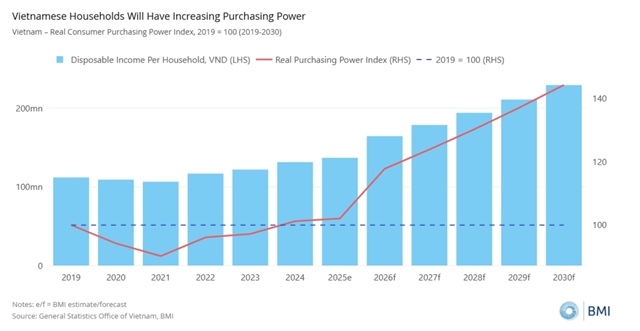
BMI expects unemployment to remain at about 2.1 per cent in both 2026 and 2027, supporting wage growth. It estimates average household purchasing power in 2026 will be 17.8 per cent higher than in 2019.
Construction of technical infrastructure works for the 2027 APEC Summit in Phú Quốc Special Administrative Zone, An Giang Province. — VNA/VNS Photo Lê Huy Hải |
Retail sales are already showing strong underlying demand. As of June, real retail sales were 37 per cent above the pre-pandemic level, with real growth averaging 8.2 per cent year-on-year. BMI also expects real household spending to grow 6.5 per cent this year to VNĐ3,873 trillion at 2010 prices.
A strong tourism market is another buffer. Robust tourist arrivals will help cushion households from weaker external demand, giving domestic consumption greater weight in the growth outlook.
Consumer strength, however, faces risks from household debt, đồng depreciation, higher energy costs and global trade disruptions, which could weaken purchasing power and push consumers towards value-oriented goods and services.
BMI forecasts inflation to average 4.7 per cent this year, driven partly by the global energy price shock, before easing to 3.4 per cent in 2027.
The combination creates a delicate balance for the second half. Investment needs financing, consumers need purchasing power, while inflation and exchange-rate pressures need to remain under control.
The broader test, therefore, is not simply whether Việt Nam can maintain high growth, but whether that growth can become more productive and resilient.
“The second half of the year will show how far Việt Nam can turn its current growth momentum into long-term economic capacity," Rehman said.
"When capital flows into projects that raise productivity, improve infrastructure and create greater value, growth can generate more room for the next stage.”
- 13:38 18/08/2026