Citi: Vietnam’s economy remains resilient in 2026
Citi: Vietnam’s economy remains resilient in 2026
Vietnam’s economy is expected to maintain solid momentum in the second half of 2026, according to Citi economists.
Vietnam’s GDP growth accelerated to 8.18 per cent on-year in the first half of 2026, from 7.63 per cent in the same period of 2025, although the oil-price shock affected construction, manufacturing and certain services. Citi nevertheless views Vietnam continuing to show relative resilience compared with several ASEAN peers.

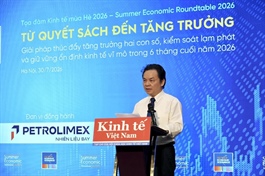
Thai Nguyet Minh, Citi Vietnam’s head of Markets |
Manufacturing conditions remained broadly supportive. On a seasonally adjusted basis, Vietnam’s manufacturing Purchasing Managers’ Index stayed above the 50-point expansion threshold through May, while new export orders held up better than in several regional economies.
Electronics remain the principal driver of export growth. Vietnam’s monthly electronics exports to the United States have roughly doubled compared with the end of 2024 levels, while the country’s share of US imports of computers and telecommunications equipment has increased significantly in recent years.
These market-share gains appear to be stabilising, while demand for personal computers, wireless devices and some consumer electronics is expected to weaken in 2026.
Textiles and footwear may face stronger headwinds as US discretionary consumption slows. By contrast, demand associated with AI, data centres and communications infrastructure should continue to support parts of the electronics and semiconductor supply chain.
“Vietnam continues to be one of the region’s leading growth economies, supported by industrial expansion, AI-related manufacturing, sustained FDI inflows, infrastructure investment and tourism recovery. While external headwinds have become more challenging, these structural drivers should continue to support the economy through near-term volatility and underpin Vietnam’s long-term growth outlook,” said Thai Nguyet Minh, Citi Vietnam’s head of Markets.
The Citi economist believes that despite the external risks, particularly from energy prices and softer global consumption, the Vietnamese economy continues to be supported by resilient manufacturing, public investment, tourism and Vietnam’s increasingly important role in regional and global supply chains.
Inflation remains a key risk. Inflation averaged 4.38 per cent during the first six months and stood at 4.69 per cent on-year. Domestic petrol prices in May were around 25 per cent higher than in February, although fiscal measures and the fuel-price stabilisation mechanism helped limit the increase.
The VND has remained relatively stable despite a weaker trade balance. The State Bank of Vietnam has continued to provide substantial liquidity support through open-market operations. Vietnam retains important policy buffers and strong medium-term fundamentals.
- 11:06 03/08/2026