Building bridges for Vietnamese start-ups
Building bridges for Vietnamese start-ups
Cross-border collaboration takes more than just introductions and business meetings. It requires matchmaking, trust, a shared vision and ongoing support to transform these dialogues into actual results.
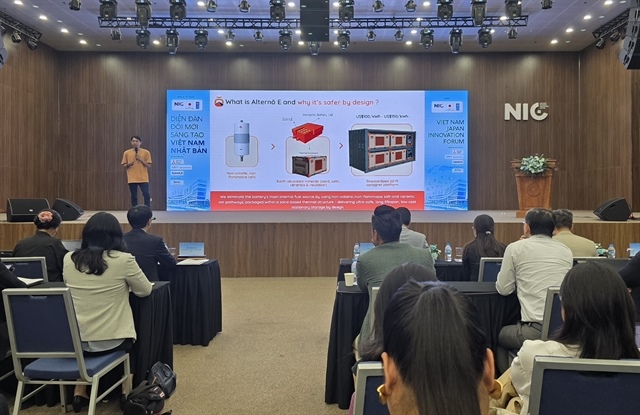
A representative from a start-up gives a presentation at the event on Thursday morning. — VNS Photo Ly Ly Cao |
Cooperation between Việt Nam and Japan is increasingly moving beyond technology exchange towards helping start-ups turn innovations into commercially viable products, secure investment and expand internationally, as the two countries deepen their partnership in science, technology and innovation.
The shift was highlighted at the 2026 Việt Nam-Japan Innovation Forum on Thursday, jointly organised by the National Innovation Centre (NIC), the Embassy of Japan in Việt Nam and the United Nations Development Programme (UNDP) in Việt Nam at NIC Hòa Lạc in Hà Nội.
NIC ScaleX Demo Day started off the event, part of a 13-week accelerator targeting start-ups with growth potential along the Việt Nam-Japan cooperation corridor.
The programme focuses particularly on healthcare, clean energy, agricultural technology, smart manufacturing and the Internet of Things (IoT).
More than 140 deep-tech and climate-tech start-ups entered the selection process, which was narrowed to 20 before 10 finalists were selected for the accelerator.
Beyond pitching, however, the programme is designed to address a more difficult question facing many Vietnamese technology companies: how to transform promising technology into products that can scale internationally.
Đỗ Lê Thu Ngọc, assistant resident representative and head of the Inclusive Growth Unit at UNDP Việt Nam, said participating start-ups had made significant progress, including refining their deep-tech and intellectual property strategies and establishing links with regional and industrial partners and foreign-invested manufacturers in Việt Nam, Japan and Germany.
"NIC ScaleX is not just an acceleration programme," she said. "It is really a platform to connect Việt Nam and Japan through innovation and shared growth."
Business connections under the broader project have resulted in 102 one-to-one meetings, eight joint meetings, seven signed agreements, 19 pilot projects and 13 fundraising opportunities, according to Ngọc.
Turning those initial connections into sustainable business relationships remains the next challenge.
"Cross-border collaboration takes more than just introductions and business meetings," Ngọc said. "It requires matchmaking, it requires trust, it requires a shared vision and ongoing support to transform these dialogues into actual results."
UNDP would continue supporting participating start-ups in turning pilot projects into fundraising opportunities and concrete commercial outcomes, she added.
For Japan, start-up cooperation has also become part of a broader economic relationship with Việt Nam.
First Secretary and Commercial Attaché at the Embassy of Japan in Việt Nam Makino Taro said the ScaleX companies were developing promising technologies across agri-tech, ESG, smart factories, healthcare, digital infrastructure and IoT.
He expressed hope that the networks developed through ScaleX would help start-ups understand business demand, launch projects and establish relationships with Vietnamese and Japanese investors and partners.
Japan has supported NIC's efforts to develop Việt Nam's start-up ecosystem, including ScaleX. Science, technology and innovation have become important pillars of bilateral cooperation, he added.
The Japanese government will continue working with Việt Nam to support start-ups and develop an enabling innovation environment.
Challenges discussed at the forum showed that entering an overseas market requires considerably more than developing sophisticated technology.

A representative from a start-up gives a presentation at the event on Thursday morning. — VNS Photo Ly Ly Cao |
During a panel discussion, international technology and innovation expert Claus Nehmzow said that European customers may feel more comfortable contracting with a Vietnamese technology company if it establishes a legal or commercial presence within the EU.
Recognising reference customers in markets such as Japan, South Korea and Singapore could also strengthen perceptions of quality when Vietnamese start-ups approach European clients.
Regulatory compliance is another critical requirement.
Rather than treating regulation as something to address after product development, start-ups were advised to integrate compliance requirements into their products, services and processes from the outset.
Working with partners experienced in markets like Japan and Europe could help companies navigate those requirements, while independent certification by recognised organisations can provide a seal of approval, demonstrating that technology has been tested and complies with relevant standards.
Even after securing a corporate pilot or proof of concept, start-ups can face another hurdle: converting an initial trial into a long-term commercial relationship.
Nguyễn Hữu Cường at AES Corporation pointed to complicated vendor onboarding procedures, particularly when working with large or State-owned enterprises. Requirements for several years of operating history and evidence of financial capacity can be difficult for young companies to satisfy, even when they possess promising technology.
For start-ups trying to overcome those barriers, differentiation becomes critical.
"You need to really find your niche and unique selling point just to enter," he said, arguing that start-ups need technologies or capabilities that large corporations cannot easily replicate internally.
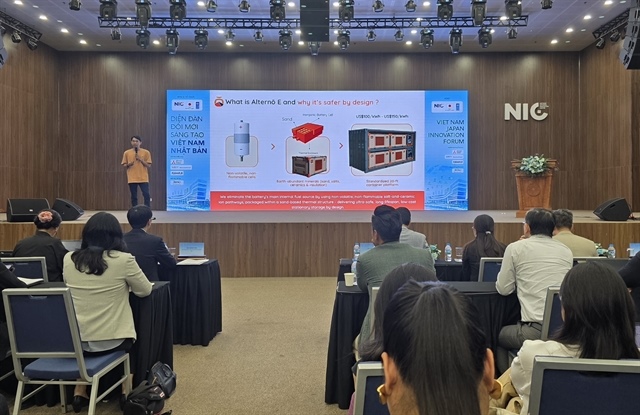
A representative from a start-up gives a presentation at the event on Thursday morning. — VNS Photo Ly Ly Cao |
The technologies showcased at Demo Day illustrated the type of industrial problems start-ups are attempting to solve.
Nguyễn Tân, client success manager at Alterno, introduced the company's thermal energy storage technology using sand.
The system converts surplus electricity, including electricity generated by rooftop solar systems when factories do not need it, into heat stored in sand.
That heat can later be used for industrial processes such as drying, hot water production and heating.
According to Tân, a standard system contains around five tonnes of sand that can be heated to 630 degrees Celsius, while the company's technology has already been deployed at factories in Việt Nam and applied in overseas projects.
Alterno is also developing a new system combining sand and molten salt to store electricity directly.
For Ngọc, technologies emerging from the start-up ecosystem should ultimately be measured by the problems they address.
"Innovation starts with empathy, and it must really serve sustainable and inclusive development," she said.
Technology start-ups, she added, are not simply building cool products, but addressing business and societal challenges ranging from climate change to inclusion, as deeper Việt Nam-Japan innovation cooperation seeks to provide the networks needed to take those solutions from pilot projects to commercial markets.
- 08:05 14/08/2026