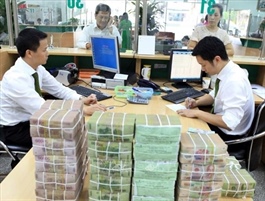
Banks take action to cut lending rates for SMEs as Việt Nam seeks faster growth
Banks take action to cut lending rates for SMEs as Việt Nam seeks faster growth
Official statistics show that by July 31, total outstanding credit in the economy had reached nearly VNĐ20.3 quadrillion, up 8.98 per cent from the end of 2025. Corporate borrowers accounted for more than VNĐ10.7 quadrillion, while loans to SMEs exceeded VNĐ4 quadrillion.

Production at BambooVina Production and Trading Co., Ltd, an SME in Thanh Hoá Province. The SBV has asked commercial lenders to launch preferential credit programmes for SMEs and growth-driving sectors from August. — VNA/VNS Photo Tuấn Anh |
Banks are stepping up efforts to cut borrowing costs for small and medium-sized enterprises (SMEs), with Agribank launching a VNĐ50 trillion (US$1.9 billion) preferential lending programme as the Government seeks to channel credit into production and business to support double-digit growth.
Agribank, one of the country’s largest State-owned lenders, will offer loans at interest rates at least 1 per cent below its average rates from this month through 2028, targeting SMEs as well as priority sectors, including agriculture, supporting industries, high-tech manufacturing, exports, digital economy, AI, semiconductors and green projects, according to the bank.
The move is part of a wider push by the State Bank of Vietnam (SBV) to make credit cheaper and more accessible to businesses seen as important to the next phase of growth.
The central bank has asked commercial lenders to launch preferential credit programmes for SMEs and growth-driving sectors from August, with preferential lending rates at least one percentage point below each bank’s average rate for the same maturity.
Four banks have so far registered programmes, with a combined scale of about VNĐ210 trillion, according to the SBV.
However, the banking sector is facing a difficulty: credit needs to expand fast enough to support growth, while banks are under pressure from rising funding demand, higher medium- and long-term financing requirements and the need to preserve financial stability.
At a Government meeting on August 10, SBV Deputy Governor Nguyễn Ngọc Cảnh said the central bank was targeting credit growth of around 15 per cent this year, with adjustments depending on economic conditions, inflation, macroeconomic stability and the safety of the banking system.
Demand for medium- and long-term capital was particularly strong for major national projects, while banks' funding remained largely short-term and was growing more slowly than credit. That mismatch was putting pressure on interest rates and creating maturity risks for the banking system, he said.
Official statistics show that by July 31, total outstanding credit in the economy had reached nearly VNĐ20.3 quadrillion, up 8.98 per cent from the end of 2025. Corporate borrowers accounted for more than VNĐ10.7 quadrillion, while loans to SMEs exceeded VNĐ4 quadrillion.
Yet businesses continue to report difficulties in accessing finance.
Đậu Anh Tuấn, deputy secretary-general of the Vietnam Chamber of Commerce and Industry (VCCI), said businesses were still struggling either to secure loans or to obtain financing at an affordable cost.
He added SMEs needed lower interest rates as well as longer-term, stable and predictable financing so they could plan production and investment.
There are also concerns about collateral requirements and banks' assessment methods, with many experts saying access to credit remains heavily dependent on property and other assets rather than cash flow and future business prospects.
Vice chairman of the Vietnam Young Entrepreneurs Association Lưu Công Thành said companies were not asking banks to lower credit standards, but wanted lenders to consider cash flow, orders, management capacity and technology alongside existing assets.
Push for changes

Production at BambooVina Production and Trading Co., Ltd, an SME in Thanh Hoá Province. The SBV has asked commercial lenders to launch preferential credit programmes for SMEs and growth-driving sectors from August. — VNA/VNS Photo Tuấn Anh |
At the meeting, Deputy Prime Minister Nguyễn Văn Thắng said Việt Nam could not achieve high growth if businesses lack capital, face high financing costs and have slow-moving cash flows. But expanding credit at any cost, lowering lending standards or increasing risks to the banking system would not deliver sustainable growth, he said.
The immediate priority would therefore be ensuring that credit reaches businesses capable of turning financing into new production capacity, higher productivity and investment.
“Capital must reach the right place, at the right time and for the right purpose at a reasonable cost,” he said.
The focus must be on lowering the actual cost of borrowing, tailoring loans to individual industries and business models, helping viable companies overcome temporary financial difficulties and removing regulatory bottlenecks that prevent credit from reaching productive projects, he added.
Thắng called on banks to cut operating and intermediary costs, accelerate digitalisation and improve productivity to create room for lower lending rates. Banks should make interest rates, fees and other borrowing costs more transparent so businesses can assess the actual cost of capital.
Lenders should tailor preferential loans to business cycles, including through appropriate maturities and repayment schedules, particularly for manufacturing, supporting industries, exports, high-tech agriculture, logistics, innovation, green transformation and supply chain businesses.
The deputy PM also called for a shift in banks' lending models.
Banks should stop applying a single assessment method to every type of business, as manufacturers, exporters, construction companies, technology firms and agricultural businesses have different cash-flow cycles and risk profiles, he said.
Instead, lenders should design products around industries, value chains, cash flows and risk levels, while making greater use of tax records, electronic invoices, payment account data and credit histories to improve credit assessments.
Collateral would remain important for managing risk, but should not be the sole factor determining whether a company can obtain credit, he noted.
“We need to gradually shift from asking what assets a business has to pledge as collateral to asking about its business plan, cash flow and ability to repay,” Thắng said, adding that this could widen access to credit for SMEs, innovative companies and businesses joining supply chains, which may have limited fixed assets but viable orders and future cash flows.
He also asked banks to give priority to viable businesses with markets, orders and repayment capacity that are experiencing temporary funding shortages to help them restructure cash flows and loans.
Problems related to land, investment, construction, planning, taxation, collateral and the legal status of projects, and which are preventing businesses from accessing loans, must be addressed promptly, he stressed.
Việt Nam is also seeking to reduce the economy's reliance on bank lending for medium- and long-term investment.
“Banks cannot and should not be the only source of capital for the economy,” the deputy PM said, urging efforts to develop the stock market, corporate bond market, investment funds and international capital channels to give businesses more options for raising funds.
Đào Minh Tú, vice chairman and secretary-general of the Vietnam Banks Association, said businesses' three main concerns were access to larger loans, lower interest rates and longer repayment periods.
But he said the banking system could not shoulder the economy's entire medium- and long-term funding needs, and that stronger capital markets were needed.
- 13:31 11/08/2026