Reforms key to Việt Nam's double-digit growth ambitions
Reforms key to Việt Nam's double-digit growth ambitions
For Việt Nam, achieving double-digit growth will be a crucial test of the country’s ability to transform its economic model and unlock new growth drivers.
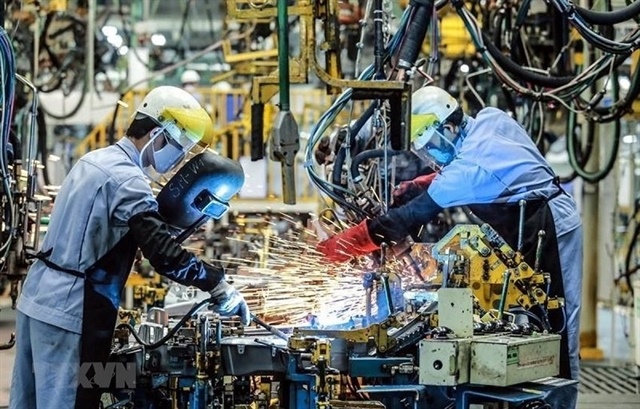
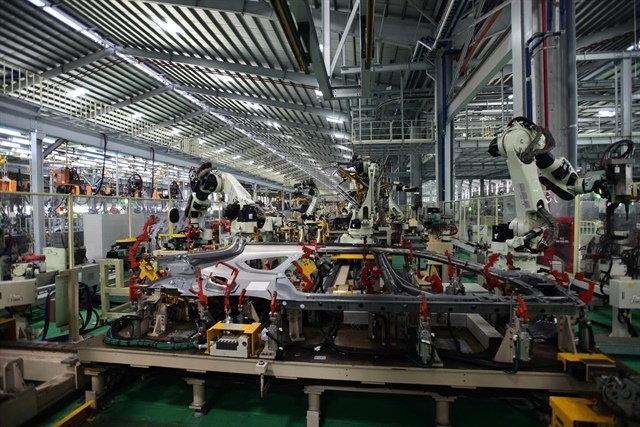
Automobile production at Toyota plant in Phú Thọ Province. Việt Nam's growth target is realistic, but will require a fundamental shift in its development model. — VNA/VNS Photo Danh Lam |
While international business groups and investors believe Việt Nam's goal of reaching double-digit economic growth is achievable, they say sweeping reforms in institutions, infrastructure, human capital and innovation will be critical for the country to unlock new growth drivers.
According to Bruno Jaspaert, chairman of the European Chamber of Commerce in Việt Nam (EuroCham), the country's growth target is realistic but will require a fundamental shift in its development model.
“Việt Nam needs to move beyond a low-cost growth model and focus on improving the efficiency of its entire economic ecosystem,” he said, pointing to the unprecedented pace of infrastructure development nationwide as evidence of the country's commitment to its long-term growth ambitions.
Jaspaert said Việt Nam was entering a historic window of opportunity as the foundations for a new phase of growth gradually take shape. At the same time, its commitment to achieving net-zero emissions by 2050 could help attract larger flows of green and sustainable investment.
A recent EuroCham survey found that 93 per cent of member companies would recommend Việt Nam as an investment destination, while an increasing number of international companies were choosing Việt Nam as a location for research and development centres and large-scale manufacturing facilities, reflecting strong confidence in the country's long-term economic prospects.
Việt Nam still has fiscal space to support strategic infrastructure investment, given its relatively low public debt levels, according to Jaspaert.
Innovation and technology are also expected to play a central role in raising productivity and supporting long-term growth.
Chairman of the Dutch Business Association in Việt Nam Wietse Mutters agreed, saying that high-quality investors increasingly prioritise policy stability and predictability over investment incentives alone.
Navendu Kumar, chairman of the Indian Business Chamber in Hà Nội, said Việt Nam should accelerate reforms to reduce transaction costs, improve governance and channel resources towards regions and sectors with the strongest capacity to absorb investment.
As labour force growth slows, sustaining double-digit expansion would increasingly depend on improving productivity, which would require greater investment in workforce skills, particularly in advanced manufacturing, semiconductors, artificial intelligence, digital technologies and green industries, he said.
Tan Quee Peng, president of the Singapore Chamber of Commerce in Việt Nam, said digital transformation and technology adoption would help improve labour productivity, enhance business efficiency and strengthen the participation of Vietnamese firms in global value chains.
Business leaders also called for stronger support for the private sector through improved access to finance, expanded business opportunities and policies that encourage long-term investment.
They say Việt Nam should make greater use of new-generation free trade agreements, diversify export markets and deepen international economic integration to reduce exposure to external shocks.
A test of transformation
Automobile production at Toyota plant in Phú Thọ Province. Việt Nam's growth target is realistic, but will require a fundamental shift in its development model. — VNA/VNS Photo Danh Lam |
In modern history, few economies have managed to sustain double-digit growth rates for extended periods. However, the experience of several Asian economies suggests such expansion is achievable under the right conditions.
The Republic of Korea recorded average growth of about 12.5 per cent between 1986 and 1988 during a period of rapid industrialisation, which helped transform the country into one of Asia's leading economies.
Singapore also achieved growth rates approaching 14 per cent during key phases of its economic development, transforming from a city-state with scarce resources into a global financial, trade and logistics hub.
Economists say these examples share several common characteristics, including export-oriented growth strategies, strong government support for industrial development and the ability to mobilise and allocate resources efficiently to accelerate economic transformation.
For Việt Nam, achieving double-digit growth will be a crucial test of the country’s ability to transform its economic model and unlock new growth drivers.
In four decades of economic reforms, Việt Nam has recorded growth above 9 per cent only twice, and has never achieved double-digit expansion.
The challenge has become even greater as the economy faces mounting external headwinds, including geopolitical tensions, conflicts in the Middle East and uncertainty surrounding US trade policies.
According to the Ministry of Finance, several key economic indicators remain below the levels needed to support double-digit growth this year.
Industrial production rose by 9 per cent in the first five months of 2026, below the annual target of 12-14 per cent, while real retail sales growth slowed to just over 6 per cent.
The country also recorded a trade deficit of US$13.81 billion during this period, which could weigh on growth if the trend persists.
Despite these challenges, the Government has reaffirmed its commitment to pursuing double-digit growth from 2026-2030, arguing that the target is essential for achieving the country's longer-term development goals.
Institutional reform will be the most critical factor in determining whether this goal can be achieved.
Prime Minister Lê Minh Hưng has described institutions as the foundation for unlocking new growth drivers.
Experts say that reducing regulatory bottlenecks and improving policy predictability will be critical to attracting long-term investment.
The Ministry of Finance estimates that Việt Nam would need an investment of VNĐ38.5 quadrillion over the next five years, equivalent to around 40 per cent of GDP, which requires greater mobilisation of private and foreign capital alongside public investment.
According to economists, the challenge for policymakers is to remove institutional bottlenecks and create a transparent and predictable business environment that encourages businesses and investors to commit capital for the long term.
Beyond mobilising resources, effective allocation will be equally important. Experts say improving the efficiency of public investment, which has been set at VNĐ8.22 quadrillion for the 2026-2030 period, and unlocking capital tied up in delayed or stalled projects will be critical to sustaining growth momentum.
- 07:39 07/07/2026