Việt Nam eyes sweeping reforms to tap marine economy for sustainable growth
Việt Nam eyes sweeping reforms to tap marine economy for sustainable growth
Experts urged a pivot to a green, resilient model rather than reliance on raw extraction. Fisheries should gradually move from wild catch to industrial-scale aquaculture. Marine tourism should focus on high-quality eco and resort offerings tied to conservation.
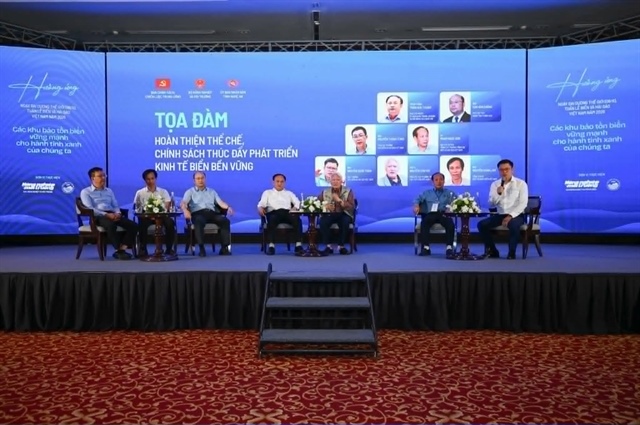
Officials and experts at the workshop on Friday. — VNS Photo Tố Như |
Việt Nam is urging sweeping reforms to unlock its vast marine resources and drive sustainable growth, officials and experts told a national workshop on Friday.
More than eight years after the Party Central Committee's Resolution No 36-NQ/TW on a sustainable marine economy was introduced, marine industries have expanded and are contributing more to GDP. Seaports and coastal infrastructure have been upgraded, while tourism, shipping, oil and gas, and fisheries continue to grow. Emerging areas such as offshore renewables and hi-tech mariculture are opening new frontiers.
“We have seen clear progress in awareness, policy and results,” Deputy Minister of Agriculture and Environment Đặng Ngọc Điệp said. “But the sea’s potential is still underused.”
Việt Nam has a sea area of more than 1 million square kilometres and 3,260 kilometres of coastline, yet officials say the sector’s contribution does not match its advantages. Overlapping regulations and fragmented state management remain major bottlenecks, complicating investment and project rollout.
Điệp said revising the Law on Marine and Island Resources and Environment is an opportunity to modernise governance on integrated and unified lines. He also pointed to untapped opportunities in deep-sea minerals, offshore wind and high-end marine and island tourism, provided policy frameworks attract private capital.
Vũ Mạnh Hùng, who heads the Department of Sectoral Economy at the Party Central Committee's Policy and Strategy Commission, said growth quality is uneven, resource efficiency is low and regional linkages and infrastructure lag demand. Many projects are delayed, while science, technology and innovation have yet to become true engines.
As Việt Nam targets faster growth, speakers called for a shift from a narrow “marine economy” lens to a “marine-based national development” approach, with cross-sector, inter-regional governance and accelerated digital transformation.
Institutional reform is the priority, they said: align and simplify laws and policies, and create robust coordination mechanisms across ministries and regions. Investment should be steered towards high added-value segments such as offshore renewables, maritime logistics, marine biotech, advanced mariculture and modern maritime services.
Experts urged a pivot to a green, resilient model rather than reliance on raw extraction. Fisheries should gradually move from wild catch to industrial-scale aquaculture. Marine tourism should focus on high-quality eco and resort offerings tied to conservation.
Environmental safeguards must advance in step with growth. Delegates called for tighter control of land-based pollution, stronger action on ocean plastics, investment in modern monitoring, and restoration of mangroves, coral reefs and seagrass to bolster climate resilience.
Upgrading hard infrastructure is seen as critical. Priorities include modern ports, logistics and coastal transport to strengthen regional connectivity and global integration. Smart, climate-adaptive coastal cities could become new growth poles.
Human capital and technology are decisive, speakers said, urging expanded training in marine tech, renewables and resource management, and greater use of AI, digital tools and remote sensing to improve efficiency and sustainability.
They also stressed closer international cooperation alongside defense and security imperatives. Engaging regional and global mechanisms can unlock finance, technology and best practices while supporting maritime sovereignty and a stable environment for development.
Removing institutional, planning and funding chokepoints will be key to turning potential into performance, and to making the marine economy a true engine of sustainable national growth in the years ahead.
- 20:52 05/06/2026