Nationwide E10 rollout creates multi-million-dollar ethanol market
Nationwide E10 rollout creates multi-million-dollar ethanol market
The nationwide rollout of E10 biofuel gasoline is creating a significant market for domestically produced ethanol, boosting demand for cassava and agricultural by-products.
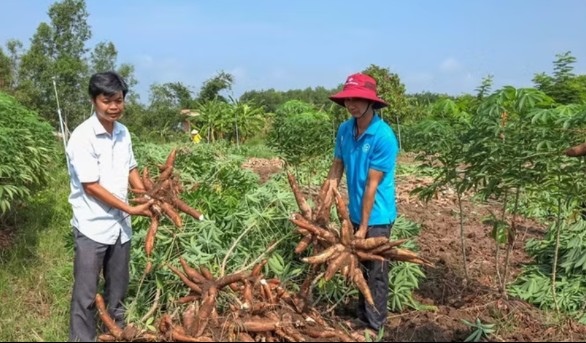
Farmers in Tây Ninh Province harvest cassava. The nationwide rollout of E10 biofuel gasoline is creating significant market demand for domestically produced ethanol. — VNA/VNS Photo |
Under the Government’s Resolution 29/2026/NQ-CP, which came into effect on May 16 and set up a pilot programme to distribute E10 petrol through June 2028, the Ministry of Agriculture and Environment will develop mechanisms for expanding feedstock production for biofuels and assessing emissions reduction from biofuel use.
According to Nguyễn Quốc Mạnh, deputy director of the ministry’s Department of Crop Production and Plant Protection, the ministry aims to improve yield and expand processing rather than increasing cultivation areas.
Việt Nam currently has a large crop production base, including about 7.12 million hectares of rice, 871,000 hectares of maize, 517,000 hectares of cassava, 185,000 hectares of sugarcane, 1.3 million hectares of fruit trees, 2.2 million hectares of industrial crops and around one million hectares of vegetables.
The plantation generates abundant by-products that can serve as potential feedstock for biofuel production.
As E10 petrol, a blend of 90 per cent conventional gasoline and 10 per cent ethanol, is introduced nationwide, ethanol demand is expected to increase significantly.
By the end of 2025, Việt Nam had about 517,000ha of cassava, with annual output reaching 10.5 million tonnes. The majority of this area, around 251,000ha, is located in the south-central coast and Central Highlands. Meanwhile the northern midlands region has 112,000ha and the southeastern region has 95,000ha of land for cassava cultivation.
Cassava is a highly efficient, starch-rich crop used to produce ethanol.
The ministry aims to develop the cassava industry sustainably by raising yields rather than expanding growing areas, in line with the national cassava development plan through 2030.
Cassava-growing areas will be maintained at between 480,000 and 510,000ha by 2030, while fresh cassava output is projected to reach up to 12.5 million tonnes annually.
Around 85 per cent of cassava production is expected to be used for deep-processing industries, including starch, ethanol, monosodium glutamate and other industrial products.
The ministry is also encouraging investment in new processing plants and upgrades to existing facilities, with a focus on advanced technologies that improve value addition, maximise by-product use and reduce environmental impacts.
Expanding ethanol production from cassava and sugarcane is expected to provide a more stable outlet for agricultural products and support rural livelihoods.
Aside from cassava, Việt Nam has a wide range of crops and agricultural by-products that could be used as feedstock for ethanol production.
Mạnh said the coordination between relevant ministries must be enhanced in developing sustainable feedstock areas, while ethanol producers should strengthen links with farmers through purchase contracts and investments in transport infrastructure, irrigation systems, storage facilities and mechanised harvesting.
"The most important factor is ensuring that farmers producing feedstock for biofuels have stable incomes and higher economic returns than alternative crops. Only then can sustainable feedstock regions be successfully developed," he said.
Industry estimates suggest that once E10 petrol is fully adopted nationwide, ethanol demand could reach around one million cubic metres annually, creating a market worth approximately VNĐ20 trillion (US$760 million) and generating more than VNĐ10 trillion in revenue for agricultural feedstock producers.
Current domestic ethanol production stands at only about 25,000cu.m per month.
Việt Nam currently has four operating ethanol plants located in Đồng Nai, Đà Nẵng and Quảng Ngãi, while two others are undergoing restructuring and upgrades.
The expansion of E10 petrol could also help reduce the sector's heavy reliance on exports of raw cassava products.
Việt Nam earned $1.26 billion from cassava and cassava-product exports in 2025, making it the world's third-largest cassava exporter. However, the industry remains largely dependent on exports of unprocessed products.
Export volumes rose by more than 52 per cent last year, but export value increased by only about 10 per cent, highlighting the sector's relatively low added value.
Experts said the nationwide adoption of E10 could provide a sizeable domestic market for cassava-based ethanol, helping diversify demand and encourage greater investment in processing capacity.
- 07:03 22/06/2026