ESG must be translated into tangible action
ESG must be translated into tangible action
Environmental, social and governance (ESG) is a long-term journey that requires businesses to start early, take concrete actions, and continuously improve over time, rather than waiting for a perfect starting point.
Speaking with VIR at the Vietnam ESG Investor Conference 2026, held in Ho Chi Minh City on May 26-27, Craig Martin, chairman of Dynam Capital, said ESG should go beyond slogans and be translated into tangible actions.
“Businesses should embrace the mindset that ‘execution beats perfection’, taking action and delivering implementation matters more than trying to achieve perfection in the early stages,” Martin said.
According to him, most sectors in Vietnam are currently benefiting from ESG-aligned capital flows. However, each country needs to leverage its own strengths and integrate ESG into the core foundations of its economy.
“For Vietnam, agriculture and industry continue to play pivotal roles, particularly in the country’s journey towards achieving net-zero emissions by 2050,” he said.

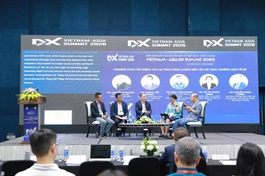
Craig Martin, chairman of Dynam Capital (fourth from left) at the event |
In selecting strategic partners, Dynam Capital prioritises companies with strong execution capabilities and a willingness to improve over time. Martin noted that governance remains the most critical pillar in ESG assessment, especially transparency, investor relations, and the ability to engage with shareholders.
“We monitor environmental and social factors, but governance remains the biggest focus. If a company stops engaging with investors, that becomes a warning sign, and we may consider divestment,” he said.
According to Martin, even fundamental elements such as an English-language website, professional investor relations activities, properly organised annual general meetings, and transparent business plans reflect a company’s level of ESG readiness.
“We do not expect perfection, but we do expect commitment to change and continuous progress. For us, that is what defines a good company,” he added.
At Dynam Capital, companies are evaluated based on multiple ESG criteria, including transparent governance, emissions management, and responsibilities towards employees and communities. Among these, climate transition is becoming increasingly important amid surging energy demand driven by AI, data centres, and cloud computing.
However, Martin stressed that to realise its digital economy ambitions, Vietnam must prioritise investment in power infrastructure and ensure the stability of the national grid.
“Companies that are transparent, proactive in ESG disclosure, and well-prepared from an early stage will have a significant advantage in attracting international capital and enhancing long-term growth capacity,” he noted.
In addition, he said businesses need to invest more in ESG human resources, establish dedicated ESG committees, and introduce clear board-level commitments backed by implementation resources and transparent monitoring mechanisms.
In companies that perform well, ESG goes beyond statements and is integrated into KPIs and executive compensation policies.
“When targets are time-bound, measurable, and linked to accountability, ESG truly becomes a core part of corporate operations,” he said.
Meanwhile, John Grimes, founder and CEO of the Renewable Energy Council Asia Pacific, highlighted positive signals from Vietnam in the energy transition process.
“Vietnam increasingly recognises that renewable energy not only enhances economic competitiveness, but also strengthens national energy security and independence,” he said.
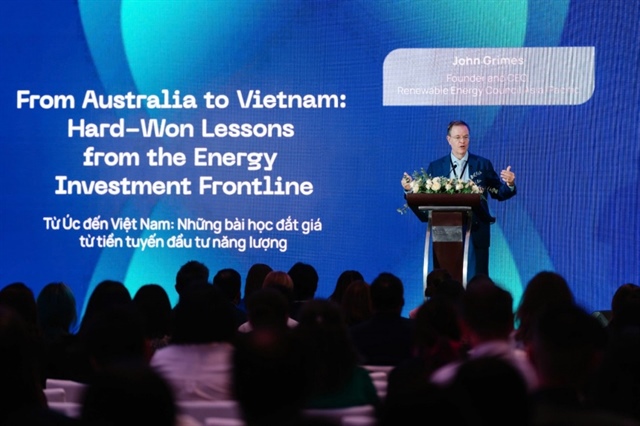
John Grimes, founder and CEO of the Renewable Energy Council Asia Pacific |
According to Grimes, if Vietnam can develop domestic manufacturing capabilities for solar panels, electric vehicles, and battery storage systems while deploying them within the local economy, this would create a major advantage in clean energy costs.
He noted that the solar power boom during 2019-2020 demonstrated enormous market demand for lower-cost energy sources. However, Vietnam also realised that its power grid and system operations need upgrading to adapt to a more decentralised and flexible energy model.
Australia has undergone a similar transition and now experiences periods where up to half of electricity generation comes from renewable energy. Grimes believes cooperation between Australia and Vietnam in energy system coordination and operations could deliver significant value to both economies.
He also pointed out that many globally used solar technologies such as PERC, TOPCon, and back-contact cells originated in Australia, particularly from research conducted at the University of New South Wales.
“Based on that experience, there is now a significant opportunity to connect Australia’s leading scientists and technology companies with Vietnam’s industrial sector, helping Vietnam access cutting-edge technologies in areas such as microgrids, solar energy, and energy storage,” he said.
According to Grimes, one of the most critical factors in attracting international capital is policy stability. Frequent policy changes can create uncertainty among investors.
At the same time, projects must be structured in a way that both protects national interests and ensures sufficient financial viability to engage global investors.
“This could include risk guarantee mechanisms involving organisations such as the ADB, or financial instruments designed to reduce investor risks,” he said.
Grimes also suggested that Vietnam could consider implementing pilot projects before rolling out policies across the broader market, as this would create an effective learning environment and help build investor confidence through demonstrated results, including financial performance.
“This is how you turn an idea from theory into practical conviction,” he said.
Sharing a similar view, Martin said the first critical factor is policy stability, which is essential for developing financially bankable power purchase agreements.
Alongside this is the need to further develop capital markets to support the energy transition.
“Vietnam will require hundreds of billions of dollars in investment for grid infrastructure and power generation capacity. However, the domestic bond market remains relatively small, while renewable energy projects require long-term financing of 15-20 years rather than short-term bank loans of five to seven years,” he said.
According to Martin, Vietnam needs to deepen its bond market and expand risk mitigation mechanisms involving institutions such as the International Finance Corporation, Asian Development Bank, and GuarantCo to lower project financing costs.
Countries including Australia, the Netherlands, and the UK are increasingly encouraging blended finance models, where investors are willing to take on higher risks in the early stages to pave the way for lower-cost capital once projects become more stable.
“All these elements must work together, from policy frameworks and capital markets to project quality and international knowledge-sharing, to accelerate Vietnam’s energy transition,” Martin said.
Vietnam ESG Investor Conference 2026, co-organised by Raise Partners and Ivy+Partners, brought together more than 250 domestic and international delegates to discuss a common message emerging from the investment community: ESG has become a key benchmark for assessing corporate capabilities and a prerequisite for accessing long-term capital in Vietnam.
- 09:00 01/06/2026