Energy conservation, electricity saving remain country's key strategic priorities
Energy conservation, electricity saving remain country's key strategic priorities
The Ministry of Industry and Trade is drafting the first proposal for the establishment of a Fund for Economical and Efficient Use of Energy.
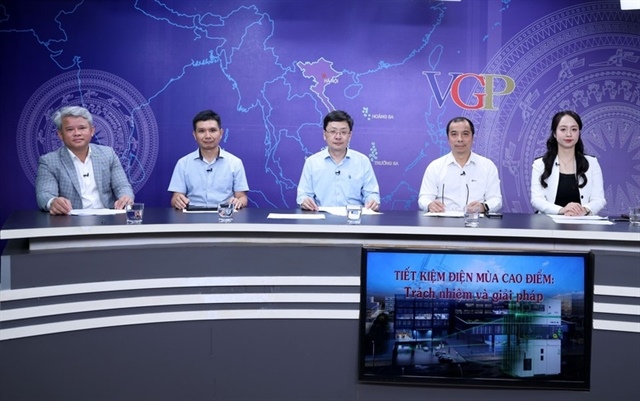
Đặng Hải Dũng (centre), Deputy Director General of the Department of Innovation, Green Transition and Industrial Promotion and other participants at the roundtable discussion on Monday morning. — Photo https://baochinhphu.vn |
Energy conservation and, in particular, saving electricity, will remain key strategic priorities in the years ahead.
That was the message from Đặng Hải Dũng, Deputy Director General of the Department of Innovation, Green Transition and Industrial Promotion under the Ministry of Industry and Trade, at a roundtable discussion titled 'Saving Electricity During Peak Demand Season: Responsibilities and Solutions', organised by the Government electronic information portal on Monday morning.
The discussion was organised as a series of new electricity consumption records set since late May has highlighted the mounting pressure on the country’s national power system as extreme heat becomes increasingly frequent under the impact of climate change.
The potential return of El Niño in the coming months is expected not only to drive up electricity demand but also to threaten power supply, particularly from hydropower sources. At the same time, global developments continue to disrupt fuel supply chains, including petroleum products that are critical for electricity generation.
Against this backdrop, ensuring an adequate power supply to support economic growth, meet the needs of households and businesses, and achieve sustainable development goals has become more urgent than ever.
Dũng said in practice, Việt Nam had pursued energy-saving policies since 2011 and enacted the Law on Economic and Efficient Use of Energy for the first time in 2010.
Last year, the National Assembly passed amendments to the law, further reinforcing energy conservation and electricity-saving measures as central components of the country’s future economic development strategy.
While the original 2010 legislation primarily focused on encouraging and promoting energy efficiency, the revised law, which takes effect in 2025, strengthens energy management requirements in production, business operations and consumption, according to Dũng.
Following the law, a series of policy documents, including Resolution No. 70 and recent Government directives, have sought to tighten discipline in energy production, consumption and utilisation.
The Government requires all relevant entities, from State agencies to private enterprises, to develop plans and establish key performance indicators (KPIs) and targets related to efficient energy use and energy consumption norms in production activities.
Energy consumption within the public sector will also be subject to stricter oversight and control.
Measures
In the coming period, the Ministry of Industry and Trade will roll out measures aimed at optimising the national power system and maximising the use of solar-generated electricity.
The ministry is also developing programmes to support businesses in identifying opportunities for technological upgrades and energy-saving improvements.
Through State-supported energy audits, enterprises are encouraged to identify wasteful practices and uncover energy-saving potential.
Authorities are also establishing expert networks, referred to as 'energy management networks' and 'energy consultancy networks', which will connect energy-consuming businesses with technology providers and solution suppliers.
The initiative aims to help enterprises seeking to improve efficiency or comply with regulations gain access to advanced technologies, tools and investment solutions for energy conservation.
In addition, the ministry is drafting the first proposal for the establishment of a Fund for Economic and Efficient Use of Energy.
Hà Đăng Sơn, Chairman of the Centre for Energy and Green Growth Research, said that since the Law on Economic and Efficient Use of Energy came into force in 2010, the Ministry of Industry and Trade and Vietnam Electricity (EVN) had implemented numerous awareness-raising programmes for communities and businesses on energy conservation and electricity saving.
The Prime Minister also issued annual directives promoting electricity-saving measures.
Overall, most businesses now possess a strong awareness of electricity conservation because of its direct impact on operating costs, profitability and production quality, according to Sơn.
However, awareness remains limited among residential consumers, who account for roughly 30 per cent of total electricity demand.
Many people still believe that if they can afford to pay for electricity, they are entitled to use as much as they wish, without fully recognising the impact of excessive consumption on the wider power system.
In addition, the nature of the electricity sector and the current pricing mechanism often make it difficult for consumers to understand why higher consumption results in disproportionately higher costs.
Serving sustainable development
According to Ngô Sơn Hải, EVN’s Deputy General Director, saving electricity not only reduces costs for consumers but also contributes to safeguarding energy security and promoting sustainable development.
Given the current pace of electricity demand growth, the national power system needs an additional 4,000-5,000 MW of generating capacity each year.
In the context, electricity conservation plays a particularly important role in reducing investment pressure on the power sector.
For example, adding 1,000 MW of capacity from offshore wind or LNG-fired power projects typically requires three to four years to become operational after all procedures are completed.
By contrast, reducing electricity consumption by around 2 per cent would have an equivalent effect, cutting the need for approximately 1,000 MW of new capacity.
This demonstrates that energy conservation is a faster, more effective and considerably less costly solution.
Advising households on efficient electricity use during the hot season, EVN officials noted that air conditioners are the largest electricity-consuming appliances in most homes.
Consumers are therefore encouraged to set air conditioning units at around 26 degrees Celsius, keep doors and windows closed while operating them, and carry out regular maintenance to ensure optimal performance.
Households should also avoid using multiple high-power appliances simultaneously during peak demand periods, typically between 6pm and 10pm or 11pm.
In addition, both households and businesses are encouraged to invest in high-energy-efficiency equipment.
EVN currently provides a range of online tools that help users calculate electricity consumption, assess energy efficiency and conduct energy audits, enabling them to identify suitable electricity-saving solutions.
To further support customers, EVN has established a nationwide network comprising five regional power corporations, customer service centres and dedicated hotlines operating around the clock to provide advice and address enquiries related to efficient and economical electricity use.
- 07:10 23/06/2026