Cambodia’s trade volume tops $30 billion in Jan-May period
Cambodia’s trade volume tops $30 billion in Jan-May period
Economists note that the strong growth in both exports and imports reflects sustained industrial activity and rising domestic demand, even as managing the trade deficit and increasing value-added exports remain key policy priorities.
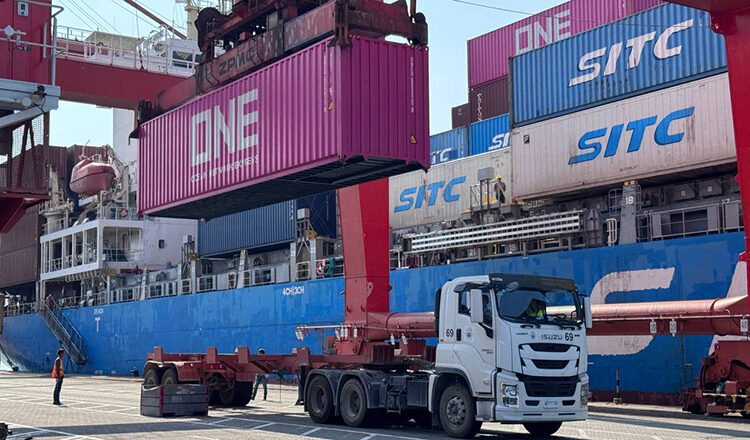
Cambodia’s total international merchandise trade volume reached $30.08 billion during the first five months of 2026, an increase of 18.9 percent compared to the same period last year, according to provisional data released by the General Department of Customs and Excise (GDCE), yesterday.
The figures show that Cambodia exported goods worth $14.04 billion between January and May 2026, up 19 percent year-on-year, while imports rose 18.9 percent to $16.04 billion. The country recorded a trade deficit of $1.99 billion during the period, slightly wider than the $1.68 billion deficit recorded in the corresponding period of 2025.
The United States remained Cambodia’s largest export destination, accounting for more than $5.73 billion in exports, a sharp increase of 31.5 percent from a year earlier. Imports from the United States totalled just $231 million, resulting in a substantial trade surplus of $5.5 billion in Cambodia’s favour. The US market continued to absorb large volumes of garments, footwear, travel goods, bicycles, furniture and other manufactured products made in Cambodia.
China retained its position as Cambodia’s largest trading partner overall, with bilateral trade reaching $9.39 billion during the five-month period. However, Cambodia’s exports to China stood at $753 million compared with imports of $8.64 billion, producing a trade deficit of nearly $7.9 billion. Chinese imports mainly consist of raw materials, machinery, industrial equipment, construction materials and consumer goods that support Cambodia’s manufacturing and infrastructure sectors.
Vietnam ranked as Cambodia’s third-largest trading partner, with total trade reaching $4.11 billion. Cambodia exported $2.32 billion worth of goods to Vietnam while importing $1.78 billion, generating a trade surplus of $544 million. Agricultural commodities, processed foods and intermediate industrial products continued to drive cross-border commerce between the neighbouring countries.
Japan, Singapore and the Republic of Korea also remained among Cambodia’s key trading partners. Trade with Japan expanded by 17.2 percent, while commerce with Singapore surged by more than 242 percent, reflecting growing regional supply-chain integration and investment-related imports.
Among European markets, Spain, the Netherlands, France and Belgium recorded strong growth in imports from Cambodia, highlighting the continued importance of the European Union as a destination for Cambodian exports. Exports to Spain rose 13.5 percent to nearly $470 million, while shipments to the Netherlands increased 14.2 percent to more than $408 million.
Economists note that the strong growth in both exports and imports reflects sustained industrial activity and rising domestic demand. Cambodia’s manufacturing sector, particularly garments, footwear, travel goods, electronics and bicycle production, has benefitted from diversification efforts and increasing foreign direct investment. Meanwhile, higher imports of machinery, raw materials and production inputs suggest continued expansion of export-oriented industries.
Economist Duch Darin told Khmer Times that the first five months’ trade data come as a positive sign for Cambodian economic growth, given global economic uncertainty.
“This increase in trade shows higher external demand for Cambodian goods. Moreover, the continued increase in FDI helps expand production capacity for exports and job creation. An increase in both exports and the level of FDI helps the economy to be more resilient amid global uncertainty,” he maintained.
The latest trade data reinforces the government’s strategy of broadening export markets through regional and bilateral trade agreements, including the Regional Comprehensive Economic Partnership (RCEP), the Cambodia-China Free Trade Agreement, and other initiatives aimed at enhancing competitiveness and attracting investment.
In 2025, Cambodia’s trade with RCEP was estimated to be about $40.2 billion, a year-on-year increase of more than 16 percent, underscoring the pact’s growing importance to the Kingdom’s economy.
RCEP in 2025 accounted for roughly 61 percent of Cambodia’s total trade, making it the country’s largest trading bloc. This reflects Cambodia’s increasing reliance on regional markets, particularly major partners such as China, Vietnam, Malaysia, Japan and Singapore.
At the heart of RCEP’s impact is its sweeping reduction of tariffs and simplification of trade rules. The agreement, which includes all ASEAN member states plus five key Asia-Pacific partners (China, Japan, South Korea, Australia and New Zealand), has created a unified framework that lowers trade barriers and improves market access.
With global demand showing signs of recovery and new investments flowing into manufacturing and agro-processing industries, Cambodia is expected to maintain solid trade growth momentum throughout this year too, although managing the trade deficit and increasing value-added exports remain key policy priorities.
- 07:59 11/06/2026