Banks should be encouraged to play bigger role in derivatives market: experts
Banks should be encouraged to play bigger role in derivatives market: experts
Besides, the over-the-counter derivatives market offered by commercial banks has also expanded gradually.

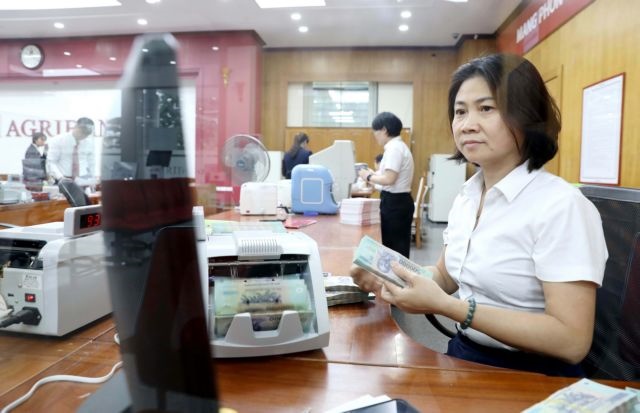
A banker counts US dollars. Many banks have already developed derivatives products including futures, options and swaps, together with cash management and financial risk advisory services. — VNA/VNS Photo Trần Việt |
Vietnamese banks should be encouraged to expand their role from traditional lenders to providers of integrated risk management solutions as the country's commodity derivatives market develops and demand for price hedging tools grows rapidly among businesses, experts have said.
According to the Ministry of Industry and Trade, Việt Nam's commodity derivatives market has witnessed significant development in recent years, with trading volume through the Mercantile Exchange of Việt Nam (MXV) reaching around 1.54 million contracts by the end of 2025, worth more than VNĐ1.9 quadrillion (US$73 billion).
Besides this, the over-the-counter (OTC) derivatives market offered by commercial banks has also expanded gradually.
There are around 10 to 12 banks currently providing commodity price hedging products to corporate clients, making banks a key gateway for domestic businesses seeking access to international derivatives markets.
Many lenders have already developed derivatives products, including futures, options and swaps, together with cash management and financial risk advisory services.
Major banks such as Vietcombank, BIDV and Techcombank have identified foreign exchange, cash management, trade finance and supply chain finance as strategic growth areas, with these services contributing an increasing share of non-interest income.
The Việt Nam Chamber of Commerce and Industry (VCCI) said commercial banks are playing a growing role not only as product providers but also as facilitators, helping domestic businesses access hedging tools amid heightened volatility in global commodity and financial markets.
However, VCCI noted that one of the biggest challenges remains the legal framework for derivatives transactions.
Currently, the Ministry of Industry and Trade is drafting a development plan for the commodity derivatives market for the 2026-30 period.
The VCCI said it is necessary to clarify the relationship between exchange-traded transactions conducted through MXV and OTC transactions provided by commercial banks.
Regulators should also define how OTC transactions will be supervised as the market expands, including whether certain transactions should eventually migrate to centralised trading platforms and how reporting, clearing and risk management mechanisms should be designed, VCCI said.
Striking the right balance will be crucial, VCCI said, stressing that excessive emphasis on centralised trading could reduce the flexibility that OTC products currently offer businesses with specific hedging needs, while insufficient oversight could undermine market transparency and stability.
Experts have also proposed allowing bank guarantees, warehouse receipts and government bonds to be accepted as collateral instead of cash for margin requirements, helping businesses reduce capital pressure while creating opportunities for banks to develop new financial services linked to commodity hedging activities.
Growing demand
Recent shocks in energy prices, rising input costs, higher logistics expenses and exchange-rate volatility have increased pressure on importers and exporters, highlighting the need for more sophisticated risk management tools, analysts said.
Trần Hữu Linh, director general of the Domestic Markets Department under the Ministry of Industry and Trade, said demand for price risk management now extends far beyond traditional agricultural sectors such as coffee, pepper, rubber and rice.
“The need for hedging solutions is also growing in energy, animal feed, industrial materials, metals and logistics,” Linh said, adding that the trend could create opportunities for commercial banks to develop complementary financial services.
Economic expert Đinh Thế Hiển said banks now have significant opportunities to broaden their role beyond traditional lending and trade finance as businesses seek more comprehensive risk management solutions.
An exporter of coffee or an importer of raw materials today needs not only capital but also solutions to manage commodity price risks, exchange-rate fluctuations, cash flows and liquidity, Hiển said, adding that this creates demand for more integrated financial risk management services.
International payments, foreign exchange services, trade finance and cash management services offered by banks could become important components of a broader corporate risk management ecosystem during the 2026-30 period, if the commodity derivatives market development plan is designed in a way that supports both exchange-traded and OTC markets, experts said.
- 07:23 18/06/2026