Vietnam positioned to lead Southeast Asia’s wind power race
Vietnam positioned to lead Southeast Asia’s wind power race
Vietnam’s offshore wind ambitions are creating opportunities not only for clean power generation, but also for the emergence of an entirely new industrial ecosystem spanning manufacturing, logistics and energy services, according to experts from both domestic and international companies.
|
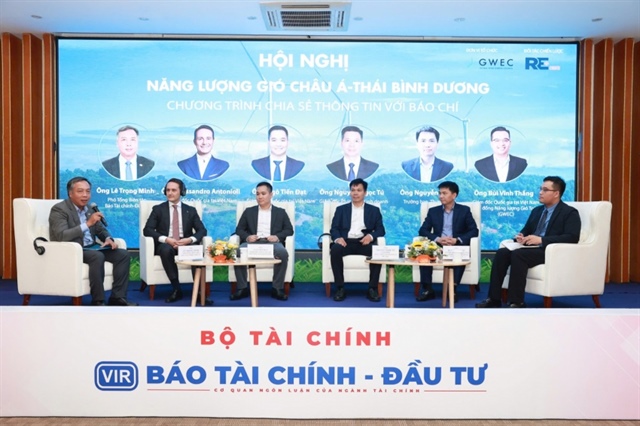
At the media briefing on APAC Wind Energy Summit 2026, which took place at VIR's headquarters on May 26, experts from across the wind power value chain highlighted Vietnam’s growing competitiveness in both onshore and offshore wind (OSW) development, while stressing the importance of stable policies and long-term project visibility.
Bui Vinh Thang, country manager of GWEC (Global Wind Energy Council) said that Vietnam could become a regional leader in wind power outside of China and India if it achieves the targets outlined in the national Power Development Plan VIII (PDP8). Under PDP8, Vietnam aims to develop around 26-38 GW of onshore wind power and approximately 6 GW of OSW power by 2030.
“Looking across Asia-Pacific, excluding China and India, Vietnam can be considered a leading country in both onshore and OSW,” he said.
He noted that Vietnam possesses OSW potential estimated at roughly 600 GW, with relatively shallow continental shelves allowing for fixed-bottom OSW projects, which are generally cheaper than floating wind farms required in markets such as South Korea, Japan, and Taiwan.
“The majority of Vietnam’s OSW potential is suitable for fixed-bottom foundations, helping lower investment costs compared to countries that rely on floating platforms,” he added and stressed that Vietnam’s double-digit electricity demand growth makes wind power increasingly important within the country’s future energy mix.
Alessandro Antonioli, country representative in Vietnam, Copenhagen Infrastructure Partners (CIP), said Vietnam stands out in the region because of its high wind speeds, stable wind conditions and long coastline. “I am a big fan of Vietnam,” Antonioli said, noting that he had previously worked in Japan, Taiwan and Australia before taking up his current role in Vietnam.
He added that Vietnam’s growing economy and manufacturing expansion are creating rising demand for stable, affordable and sustainable electricity.
“The shift of manufacturing supply chains from Europe and the US to Vietnam requires access to green energy,” he said. “This is both a challenge and an opportunity if the country can maintain supportive policies, a clear commercial framework and stronger local supply chains.”
Antonioli also pointed to the country’s existing offshore oil and gas industry as a major advantage for OSW development. “We already have excellent companies here with decades of offshore oil and gas experience. That is an incredible advantage,” he said.
Ngo Tien Dat, country manager, Suzlon Group - a global renewable energy solutions provider, said Vietnam’s fast-growing economy and young workforce were among the reasons why India-based Suzlon Energy chose Vietnam as its first regional hub in Southeast Asia.
“Suzlon sees Vietnam as a highly promising market in the APAC region,” Dat said. “Vietnam has a young, dynamic and capable workforce. That is why we selected Vietnam as our first hub to serve Southeast Asia and neighbouring countries.”
He added that the company hopes to work with local partners to further develop Vietnam’s wind energy sector and contribute to the country’s economic growth.
Meanwhile, Nguyen Ngoc Tu, director of Business and Project Development, IPC Engineering & Construction JSC (IPC E&C), said Vietnam already possesses many of the conditions necessary to accelerate renewable energy development. IPC E&C has participated in the installation of more than 2,000 MW of wind and solar power projects in Vietnam and overseas markets such as the Philippines.
“Electricity infrastructure must stay ahead of GDP and population growth,” Tu said. “The global green transition is inevitable, and Vietnam is moving in the right direction.”
For domestic companies, strengthening competitiveness in the OSW supply chain will require greater investment, coordination and policy support, according to Nguyen Tuan, Head Commercial, Petrovietnam Technical Services Corporation (PTSC). He said Vietnamese firms such as PTSC and IPC E&C are already participating in the global OSW supply chain through projects serving customers in Europe and Taiwan.
“When PTSC manufactures OSW foundations for European or Taiwanese clients, we do not work alone,” he said. “We bring along nearly 100 Vietnamese companies to participate in the supply chain.”
He stressed that local companies must continue investing in infrastructure, equipment, marketing and customer services to improve efficiency and reduce costs.
At the same time, he called for stronger government support mechanisms and, most importantly, a stable long-term project pipeline. “The most important thing is a stable pipeline,” Tuan said. “If the government can provide a predictable annual development plan in terms of megawatts, companies will have the confidence to make large-scale investments.”
As part of its longer-term strategy, PTSC is pursuing both OSW project investment and renewable energy supply chain development. The company is currently involved in plans to export OSW electricity from Vietnam to Singapore through a cross-border power project.
At the same time, PTSC is expanding fabrication yards in Vung Tau and investing in specialised vessels and heavy-lifting equipment to support OSW construction.
Tuan also revealed that PTSC is working with government agencies to encourage the establishment of inter-regional renewable energy industrial and service centres under PDP8, including hubs in northern and southern Vietnam. “These centres will not only support renewable energy, but also green hydrogen and green ammonia in the future,” he said.
| The APAC Wind Energy Summit 2026, the leading regional commercial event for the wind power industry, will take place from June 9-11, at the National Convention Centre in Hanoi. The event is organised by the Global Wind Energy Council (GWEC).
Under the theme “Wind Powering Prosperity Across Asia-Pacific: Building Electrified Economies Through Wind Scale-Up and Supply Chain Expansion,” the three-day summit will feature two days of conference sessions and exhibitions, alongside dedicated networking activities, receptions and side events designed to foster strategic business connections across the industry. The summit is expected to pull in more than 1,000 participants, including policymakers, industry leaders, project developers, investors and supply chain stakeholders from across the Asia-Pacific region and beyond. The event aims to create a high-level platform where focused discussions can generate future commercial partnerships and investment opportunities. |
- 18:00 26/05/2026