Việt Nam eyes green aviation fuel boom
Việt Nam eyes green aviation fuel boom
Việt Nam has huge potential to become a hub for sustainable aviation fuel (SAF) production in Southeast Asia amid global race to cut carbon emissions, though experts urges stronger policy support for the country to fully tap the opportunity.
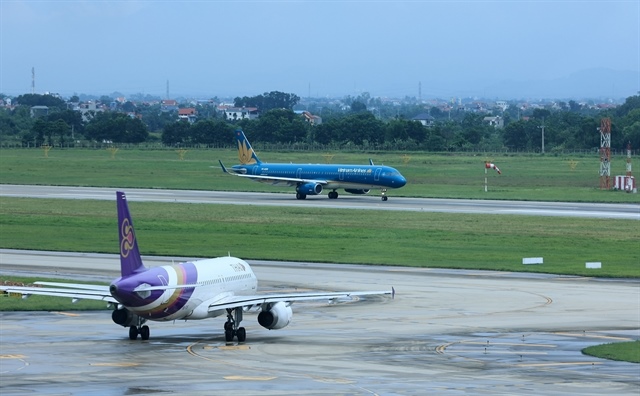
Aircraft at Nội Bài International Airport. The transition to SAF is becoming increasingly essential for the aviation sector’s decarbonisation goals and exposing major challenges in scaling up production capacity for SAF. — VNA/VNS Photo Quốc Khánh |
Việt Nam has significant potential to become a sustainable aviation fuel (SAF) production hub in Southeast Asia, as the global aviation industry races to cut carbon emissions, though experts say stronger policy support will be needed for the country to fully seize the opportunity.
The transition to SAF is becoming increasingly critical to the aviation sector’s decarbonisation goals, while also exposing major challenges in scaling up global production capacity.
Official statistics show the global aviation industry currently consumes around 380 million tonnes of fuel annually, while SAF output remains below 2 million tonnes, accounting for only about 0.5 per cent of total consumption.
Fabrice Espinosa, founder and CEO of the Asia Sustainable Aviation Fuel Association (ASAFA), said SAF would need to account for 60-70 per cent of aviation fuel use by 2050 if the industry is to achieve net-zero carbon emissions.
That means SAF production would need to expand by more than 100 times over the next two decades, he said, describing the transition as a large-scale industrial transformation rather than a simple energy substitution.
If ASEAN countries achieve their target of 5 per cent SAF usage by 2030, the region would require between 8 million and 10 million tonnes of SAF annually, creating a potential market worth up to US$25 billion a year.
Espinosa said the race to develop SAF supply chains was already under way, creating major opportunities for emerging economies that can move quickly and position themselves early in the market.
He added that Việt Nam holds several advantages in joining the emerging global SAF supply chain, including abundant biomass resources, refining capacity, infrastructure and a strategic location in the Asia-Pacific region.
“Việt Nam has a major opportunity to join the sustainable aviation fuel market and become a key player in the ecosystem,” he said.
First efforts
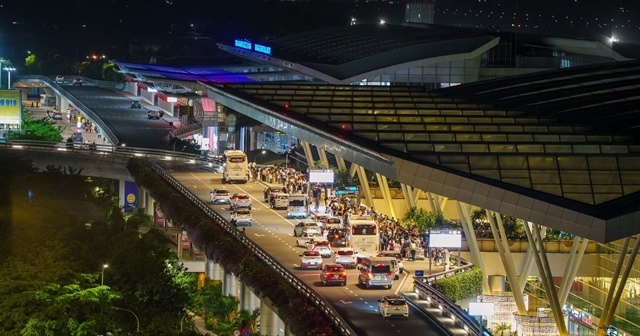
Aircraft at Nội Bài International Airport. The transition to SAF is becoming increasingly essential for the aviation sector’s decarbonisation goals and exposing major challenges in scaling up production capacity for SAF. — VNA/VNS Photo Quốc Khánh |
Việt Nam has already taken early steps towards deploying sustainable aviation fuel (SAF). In October 2024, the country carried out its first domestic flights using SAF, followed in June 2025 by Nghi Sơn Refinery shipping its first commercial SAF batch.
Around the same period, aviation fuel supplier Skypec began refuelling Vietnam Airlines flights with SAF at Đà Nẵng International Airport.
Hồ Quang Bửu, vice chairman of the Đà Nẵng People’s Committee, said the pioneering test flights showed different parts of Việt Nam’s SAF value chain had started connecting effectively.
“From production and supply networks to commercial operations, the process has shown initial feasibility in practice,” he said.
Alongside fuel conversion, optimising airport infrastructure and operations is also seen as a key part of building a sustainable aviation ecosystem.
Lê Hoài Nam, deputy director of Đà Nẵng International Airport, said the airport is implementing a green A-CDM model aimed at minimising aircraft engine idling time on the ground.
“Optimising flight routes and air traffic management can deliver immediate efficiency gains,” Nam said. “We are also redesigning runway operations into a one-way circular system to reduce CO2 bottlenecks, paving the way for Đà Nẵng to become a green airport in the future.”
Policy push needed
Đào Duy Anh, deputy director of the Agency for Innovation, Green Transition and Industry Promotion under the Ministry of Industry and Trade, said developing domestic biofuel capacity and strengthening energy self-sufficiency would help stabilise the economy.
He said Việt Nam already has core policies on fuel transition but still requires coordinated measures to develop raw material supplies, master technology, build distribution systems and expand SAF use among domestic airlines before supplying international carriers operating at Vietnamese airports.
Đỗ Hồng Cẩm, deputy director of the Civil Aviation Authority of Việt Nam under the Ministry of Construction, said the global SAF market is expanding rapidly and is expected to reach $40 billion by 2034, up from $2.7 billion in 2025.
However, SAF still accounts for less than 1 per cent of total global aviation fuel consumption, while projected output by 2026 is expected to reach only around 0.8 per cent, highlighting the gap between policy ambitions and actual implementation capacity, he said.
Cẩm said international experience showed SAF development still faces major bottlenecks, including high costs, limited supply, capital-intensive investment requirements and a lack of long-term purchase agreements.
“Developing sustainable aviation fuel always requires strong institutional and policy support,” he said.
Việt Nam should introduce a mandatory fuel blending roadmap, establish stronger financial incentives for the carbon market, create stable demand through long-term contracts between airlines and producers and develop domestic supply chains linked to the country’s biomass advantages, Cẩm said.
- 06:57 11/05/2026