Vietnam’s aviation authority pushes shift to greener operations
Vietnam’s aviation authority pushes shift to greener operations
The Civil Aviation Authority of Vietnam has instructed aviation stakeholders to study alternative fuels and gradually deploy sustainable aviation fuel, aiming to reduce greenhouse gas emissions and accelerate the sector’s energy transition.
|
In April, the Civil Aviation Authority of Vietnam (CAAV) issued a directive to its affiliated units on strengthening energy efficiency and advancing the transition towards sustainable development.
In line with Resolution No.70-NQ/TW (dated 2025) of the Politburo on ensuring national energy security to 2030, with a vision to 2045, the authority has called on airport operators to step up awareness efforts and encourage businesses to proactively develop plans to convert ground vehicles to electric and green energy use.
This transition will follow the roadmap set out in Decision No. 876/QD-TTg dated July 2022, with the goal of reducing emissions and improving energy efficiency across the aviation sector.
Specifically, during 2027-2030, aviation units are required to study the use of alternative fuels to partially replace conventional jet fuel, while also completing data systems on energy use and fuel consumption.
From 2035, the sector aims to use at least 10 per cent sustainable fuel on selected short-haul flights. At the same time, all newly invested passenger and ground service vehicles at airports will operate on electricity or green energy.
By 2040, all vehicles operating within air-side areas are expected to transition to electric and green energy, except for certain specialised equipment. Looking ahead to 2050, the aviation industry targets 100 per cent use of sustainable fuels for aircraft, combined with carbon offset measures, in pursuit of net-zero emissions.
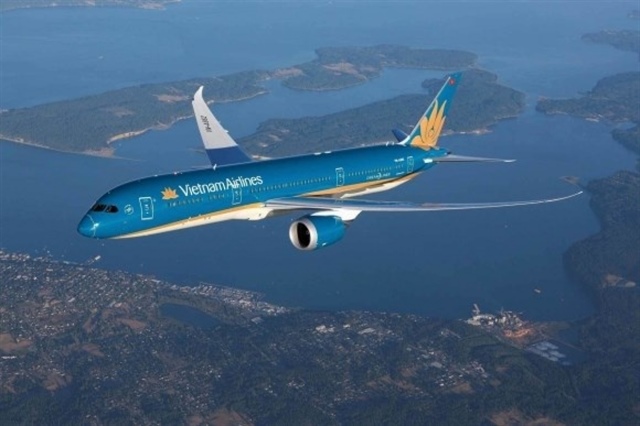
Earlier, Vietnam Airlines became the first domestic carrier to adopt sustainable aviation fuel (SAF) on flights departing from Europe. Since early-2025, all of its flights from European airports have used SAF at a minimum blend of 2 per cent. This ratio is expected to increase to 6 per cent by 2030, 20 per cent by 2035, and 70 per cent by 2050.
Beyond international routes, the airline has also begun deploying SAF on selected domestic flights, demonstrating its commitment to emissions reduction and the development of green aviation in Vietnam.
Dinh Van Tuan, deputy CEO of Vietnam Airlines said, “Vietnam Airlines is proud to be the first Vietnamese carrier to apply SAF, a fuel that can reduce up to 80 per cent of greenhouse gas emissions over its lifecycle. This is not only a technological advancement, but also a reaffirmation of our commitment to supporting Vietnam’s net-zero target by 2050.”
This airline is gradually expanding SAF usage across both domestic and international routes, while working with partners to develop local supply, thereby reducing costs and enhancing supply security.
However, scaling up sustainable fuel use remains challenging due to high costs. SAF is currently priced at two to three times higher than conventional jet fuel, and at times has been five to six times more expensive. It is estimated that SAF adoption could increase Vietnam Airlines’ operating costs on Europe-bound routes by approximately $4.8 million per year.
In addition, the airline is implementing a range of measures to cut CO₂ emissions, including operating next-generation aircraft, optimising flight routes and schedules, reducing payload weight, and applying digital technologies to monitor and control fuel consumption.
At the same time, Vietnam Airlines is accelerating digital transformation in its operations, viewing it as a key component of its environmental, social, and governance strategy to enhance efficiency and long-term resilience.
Under Resolution No.70-NQ/TW, Vietnam aims by 2030 to ensure national energy security, meet socioeconomic development needs, and reduce greenhouse gas emissions by 15-35 per cent compared to business-as-usual scenarios.
Looking towards 2045, the country’s energy sector is expected to develop sustainably, use resources efficiently, and reach advanced levels within the region.
- 15:09 21/04/2026