Organic growth comes at a cost in Việt Nam
Organic growth comes at a cost in Việt Nam
In Việt Nam, organic production has attracted significant attention to deliver safer, higher-quality food and increase the value of farm produce. However, the scale of organic production in Việt Nam remains modest.
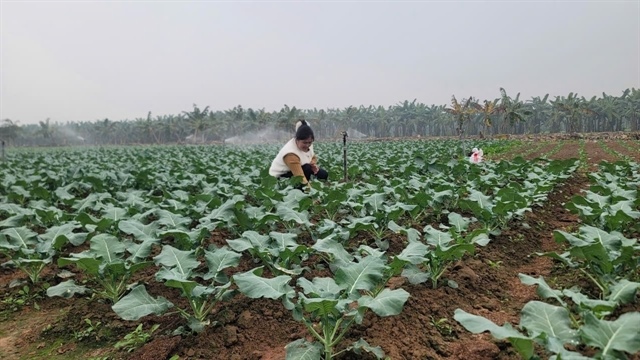
A vegetable farm of the Minh Châu Cooperative in Hà Nội. Rising consumer demand for environmentally friendly and safe food is creating significant opportunities for organic farm produce. — VNA/VNS Photo Phương Anh |
Rising demand for safe, eco-friendly food is boosting organic agriculture, but fragmented production, high costs and unclear standards continue to constrain the sector in Việt Nam.
The global organic food market has expanded rapidly in recent years as consumers grow more concerned about food safety and environmental sustainability.
A report by Research and Markets forecasts the market will grow at a compound annual rate of 11.18 per cent between 2025 and 2033, rising from US$254.42 billion in 2025 to $593.98 billion.
In Việt Nam, organic farming has gained attention as a way to deliver safer, higher-quality food and increase the value of agricultural produce. However, overall production remains modest.
Data from the Ministry of Agriculture and Environment (MAE) show that by 2025 the country had around 174,000ha of organic farmland, accounting for about 1.4 per cent of total agricultural land.
While this marked an increase of roughly 47 per cent compared with 2016 and placed Việt Nam among the fastest-growing countries in organic farming, it still represented only about 0.18 per cent of the global total.
Production remained largely small-scale and scattered, making it difficult to build concentrated farming zones and stable supply chains. As a result, distribution channels were limited and organic products often struggled to stand out in the market.
Nguyễn Văn Thành, director of an organic-certified farm in Nghệ An Province, said the domestic market still lacked a clearly defined niche for organic products, while many consumers remained reluctant to pay higher prices for certified goods.
According to Tạ Văn Tường, deputy director of the Hà Nội Department of Agriculture and Environment, organic farming typically involves higher production costs than conventional methods. The absence of chemical fertilisers and synthetic pesticides often leads to lower yields, higher labour demands and greater risks, pushing up prices and limiting accessibility.
Farmers also face knowledge gaps, while the transition to organic production can take several years and requires sustained financial and technical support.
Barriers persist
According to Trương Kim Hoa, owner of a farm in Yên Xuân, Hà Nội, although national standards exist, certification remains costly and complex, with a shortage of independent and reputable certifying bodies.
Limited market transparency adds to the challenge, making it difficult to distinguish genuine organic products from falsely labelled goods and undermining consumer confidence.
Recent cases of vegetables with unclear origins being labelled as VietGAP certification have further heightened public caution towards products marketed as organic, according to consumer Phan Ngọc Linh in Hà Nội.
Confusion over definitions is another barrier. Many producers fail to distinguish between goods produced using organic principles and those formally certified as organic.
Under current regulations, only products that fully meet standards and are certified by accredited organisations under Decree 109/2018/NĐ-CP on organic agriculture can be labelled as organic.
Deputy Minister Trần Thành Nam of the MAE said it was essential to clearly distinguish certified organic products from those produced following organic principles.
Confusion between the two could mislead consumers and distort data on the development of organic agriculture in different localities, he said.
Building trust
A vegetable farm of the Minh Châu Cooperative in Hà Nội. Rising consumer demand for environmentally friendly and safe food is creating significant opportunities for organic farm produce. — VNA/VNS Photo Phương Anh |
According to Hà Phúc Mịch, president of the Vietnam Organic Agriculture Association, supply chains for organic products have yet to take shape in the country due to limited and unstable supply throughout the year.
Lê Quốc Thanh, director of the National Agricultural Extension Centre, said organic farming in Việt Nam had shown signs of expanding in response to market trends rather than being grounded in core values.
It was necessary to review the existing standards system and clearly define different levels of organic production to avoid confusion caused by the widespread use of the term, Thanh said.
Trịnh Thị Nguyên, director of the Đồng Phú Organic Agricultural Cooperative in Hoà Phú Commune, Hà Nội, said more concrete and coordinated policy support was needed to ensure the sustainable development of organic agriculture.
The key priorities should focus on planning concentrated organic production zones with support for capital and land access, strengthening product branding and encouraging businesses to develop organic-based fertilisers, biological plant protection products and organic livestock feed, she said.
In addition, trade promotion must be enhanced to help businesses access markets, negotiate export contracts and expand domestic distribution channels to gradually scale up the organic market, she added.
Experts say that for organic products to secure a strong foothold in the market, coordinated efforts are needed, from improving standards, certification and traceability systems to developing large-scale production areas that ensure stable supply.
Investment in processing technology, storage, packaging and distribution systems, as well as stronger publicity about the value of organic agriculture, will also play a crucial role.
Statistics from the MAE show that more than 60 per cent of provinces and cities nationwide have issued plans or programmes to promote the development of organic farming.
There are about 17,200 organic producers, nearly 600 processing facilities, more than 60 exporting companies and around 40 importers participating in the organic value chain nationwide.
Rising demand for safe and environmentally friendly food may be driving organic agriculture forward, but without clearer standards, stronger certification and better-connected supply chains, the sector risks falling short of its potential. Turning momentum into sustainable growth will depend on how effectively these structural constraints are addressed.
- 08:26 04/04/2026