VN takes strong actions to boost social housing supply
VN takes strong actions to boost social housing supply
Deputy Minister of Construction Nguyễn Văn Sinh said upcoming social housing projects will be placed in 'green line' for administrative procedures which allows the parallel implementation of multiple procedures in order to reduce processing time and compliance costs for developers by at least half.
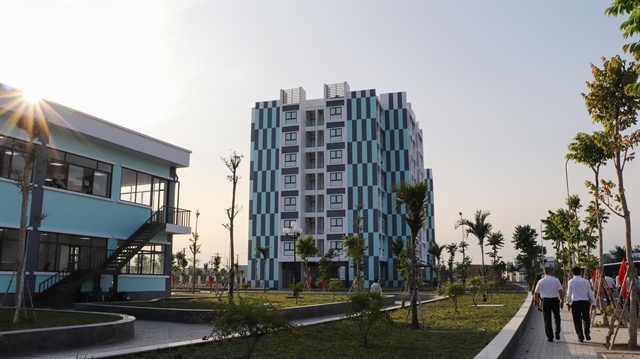
A social housing project in Cần Thơ City. Việt Nam will slash at least 50 per cent of the time and compliance costs while prioritise credits for social housing projects to boost supply for low-income earners. — VNA/VNS Photo Hồng Thái |
Việt Nam plans to cut at least half the time and compliance costs for social housing projects while prioritising credit for developments aimed at low-income earners, officials said at a conference on Thursday.
Deputy Minister of Construction Nguyễn Văn Sinh said upcoming social housing projects will be placed in a 'green line' for administrative procedures, allowing multiple processes to be carried out in parallel in order to reduce processing time and compliance costs for developers by at least 50 per cent.
Progress will be reported to the Prime Minister monthly and quarterly to ensure timely policy adjustments.
The move aims to accelerate the Government’s programme to develop one million social housing units two years earlier than planned.
Statistics from the Ministry of Construction show that more than 600 social housing projects with a total of 701,247 apartments are currently under development nationwide, equivalent to about 70 per cent of the target. In 2025 alone, more than 103,100 social housing units were completed, exceeding the annual target of 100,000 units and doubling the result recorded during the 2023–24 period.
This year, the Government has set a goal of developing about 158,700 social housing units. However, projects currently under development already total nearly 215,000 units, exceeding the plan for the year. In February alone, 28 projects were launched with a total of around 21,000 apartments.
The Ministry of Construction said the focus would be on improving policy frameworks, removing bottlenecks in project procedures and strengthening coordination with local governments to accelerate progress.
Provinces and cities across the country have been asked to integrate social housing targets into their annual socio-economic development plans and prepare cleared land with convenient locations and synchronised infrastructure for new projects.
The ministry will also study special mechanisms to attract developers with strong financial capacity and available land funds to participate in social housing development.
Credit prioritised
Speaking at the conference, Deputy Governor of the State Bank of Vietnam Nguyễn Ngọc Cảnh said the banking sector has prioritised directing capital flows to affordable housing and housing for low-income earners.
He cited statistics showing that outstanding loans for social housing currently total about VNĐ41 trillion (US$1.6 billion), including more than VNĐ25 trillion from the Vietnam Bank for Social Policies and over VNĐ16 trillion from commercial banks.
Banks have committed to continue allocating funding for social housing projects in the coming years, estimated to total around VNĐ120 trillion over the next five years.
To encourage lending for social housing projects, the State Bank has allowed such loans to be excluded from banks’ annual credit growth limits while maintaining stable policy interest rates to help reduce lending costs.
Current lending rates stand at about 6.1 per cent per year for social housing developers and around 5.6 per cent for buyers, considered preferential compared with market rates.
Hoàng Văn Cường, a member of the National Assembly's Economic and Financial Committee, said social housing must be integrated within urban structures rather than pushed to the outskirts.
He also emphasised the importance of infrastructure investment for social housing projects and a dedicated financial fund for social housing development.
Policy thinking should also shift towards ensuring housing access for low-income earners rather than focusing solely on home ownership, Cường said, adding that priority should be given to long-term social rental housing.
- 07:50 13/03/2026