Real estate price jumps re-affirm TOD’s importance
Real estate price jumps re-affirm TOD’s importance
With an average price jump of US$200-250 per square metre within one year for metro-adjacent real estate, the Transit-Oriented Development (TOD) model has emerged as one of the most important urban planning trends of the 21st century, a report from JLL said.
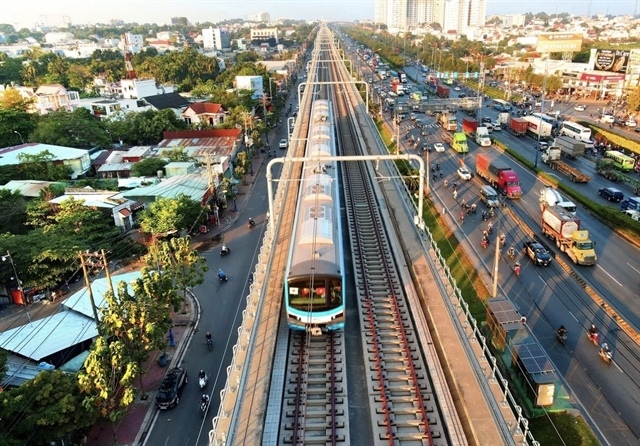
A metro line in HCM City. The Transit-Oriented Development (TOD) model has emerged as one of the most important urban planning trends of the 21st century. — Photo Courtesy of thuvienphapluat.vn |
This price increase corresponds to an impressive annual growth rate of 8 per cent for metro-adjacent real estate, double the 4 per cent market average growth recorded in HCM City in 2025. This difference suggests the value proposition that TOD projects bring compared to traditional real estate development.
In Hà Nội, this difference is even more pronounced.
Projects near metro stations recorded a 19 per cent price increase compared to the market average of only 12 per cent in 2022, according to JLL.
The exceptional growth rate of 19 per cent is particularly impressive in light of the challenging environment faced by the real estate market over this period.
TOD is not simply about building residential areas near train stations or bus stops, but is fundamentally a comprehensive planning philosophy aimed at creating compact, walkable, and highly connected neighborhoods. This is a smart solution to address major challenges of urban environments: traffic congestion, environmental pollution, and the shortage of high-quality living spaces.
The TOD model has been successfully implemented in many major cities worldwide and has brought clear benefits in reducing dependence on private vehicles, reducing carbon emissions, and increasing economic productivity.
Accordingly to Chua Yang Liang, Head of Research, JLL Southeast Asia, the term "Transit-Oriented Development" was officially coined by American urban designer Peter Calthorpe in 1993 in his landmark work "The Next American Metropolis".
Calthorpe proposed this model as a structured and scientific response to the car-dependent urban sprawl spreading across America.
"For two and a half decades from 1990 to 2015, HCM City’s real estate market confined itself within a tight radius. Development rarely ventured beyond Ring Road 2, clustering within 10-kilometres of the city central. This growth pattern followed organic expansion along the existing infrastructure, primarily the road network, while transit-oriented projects remained absent," said Trang Lê, country head of JLL Vietnam.
Initially, the concept of TOD – which emphasises urban development connected to public transportation stations within a 1km walking distance – gained limited traction in Việt Nam. Residents in Việt Nam’s major cities historically prioritised connectivity to city centres using personal vehicles rather than public transport.
However, this perspective has undergone a significant transformation in recent years, coinciding with the completion of long-delayed metro projects that began operations in November 2021 in Hà Nội and December 2024 in HCM City.
Over the decade of metro line construction, both of Việt Nam's largest cities recorded vibrant real estate market activity with numerous projects appearing along these urban rail lines, Ms. Trang emphasised.
The construction of the city's first metro line from 2015 to 2024 marked an important historical turning point.
All stakeholders - from developers, homebuyers to government agencies - began recognising the powerful transformative potential of the TOD model.
From 2025 onwards, the Vietnamese Government embraced TOD as a solution to reduce density in inner urban areas.
In the upcoming years, TOD’s application in Việt Nam will extend far beyond rail systems. The model works equally well with road-based public transport like Bus Rapid Transit (BRT) lines. At its core, TOD aims to create compact, walkable, mixed-use communities centred around high-quality public transport hubs, regardless of the underlying technology, Trang Lê emphasised.
Most TOD projects being planned in HCM City and Hà Nội are in suburban areas with significant land reserves. These projects are intended for high density, mixed use large-scale development. Therefore, developers need to carefully consider the appropriate mix between residential and commercial components.
These urban areas need to be supplemented by strategic amenities capable of attracting and retaining pedestrian traffic coming from the transit stations into their projects, rather than focusing exclusively on serving the needs of the residents.
According to JLL, the ultimate success of integrated TOD urban areas will depend on the ability to create truly unique vibrant communities that harmoniously balance investment in physical infrastructure with community activation that would make cities more sustainable, equitable and livable.
This challenge will shape and determine the next chapter of urban transformation in Vietnam, JLL experts concluded.
- 08:52 25/02/2026