Việt Nam’s cashew industry faces raw material supply challenges
Việt Nam’s cashew industry faces raw material supply challenges
While businesses are forced to import raw cashews at high prices, farmers in the country’s key cashew-growing regions continue to face unstable livelihoods.
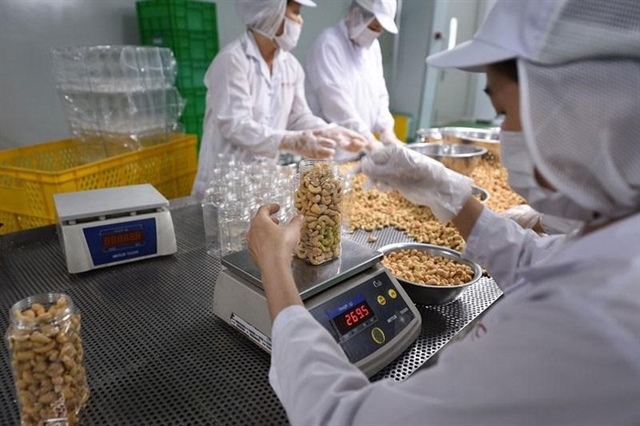
Packaging cashew nuts. — Photo sggp.org.vn |
As Việt Nam’s cashew industry enters the 2026 raw material procurement season, cracks are emerging in its billion-dollar supply chain, exposing mounting pressures on both exporters and farmers.
While businesses are forced to import raw cashews at higher prices, farmers in key growing regions continue to face unstable livelihoods.
The challenge for the industry is not only to maintain its global lead in processing and exporting cashew kernels but also to improve farmers’ incomes.
According to the Vietnam Cashew Association, Việt Nam is the world’s largest importer of raw cashews and accounts for up to 80 per cent of global cashew kernel exports.
Last year, industry players imported more than 3.12 million tonnes of raw cashews worth over US$4.67 billion, underlining the sector’s heavy reliance on external supply.
This dependence is becoming a bottleneck as the global raw material market grows more volatile.
Most imported raw cashews come from African countries, where new policies increasingly aim to retain materials for domestic processing.
Some countries have introduced export bans at the start of the harvest season, set minimum export prices or raised taxes and fees on raw cashew exports.
According to Vinacas, these changes are making imports more difficult and costly for Vietnamese businesses, reducing production and business efficiency.
Beyond trade policies, the industry also faces geopolitical challenges. Conflicts in the Middle East and other regions continue to disrupt supply chains, driving up logistics, fuel and transportation costs.
Meanwhile, demand in major markets such as the US, Europe and the Middle East shows signs of weakening due to economic difficulties.
Despite these challenges, the industry still targets exports of around 800,000 tonnes of cashew kernels worth $5 billion this year.
This is an ambitious goal given market volatility, especially as input costs are rising faster than output prices.
One major issue is competition among businesses to secure raw materials early in the season, pushing prices higher.
The biggest risk was not supply shortages but market sentiment, said Cao Thúc Uy, director of Cao Phát Company Limited.
He noted that reliable reports showed global raw cashew supply remained relatively stable, with this year’s output expected to be similar to last year's figure at around 5 million tonnes.
In fact, newly planted cashew areas in Africa and Cambodia have begun yielding harvests, contributing to steady growth in global supply over the past decade.
However, fears of shortages persist, prompting companies to rush into early purchases, unintentionally driving up prices.
At the same time, tensions in the Middle East have increased energy risks and inflation, leading consumers in many countries to tighten spending, which may limit demand growth for cashew kernels.
Businesses therefore need to be cautious and avoid rushing into high-priced purchases, he said.
Sharing this view, Phùng Văn Sâm, CEO of Viet Nam Hanfimex Group Joint Stock Company, said market anxiety had distorted the raw cashew market.
Companies fear rising prices and supply shortages, leading them to buy early even when unnecessary. The root cause is a lack of reliable and updated information on supply and demand, he said.
Nguyễn Minh Họa, vice chairman of Vinacas, affirmed that global raw cashew supply was not as scarce as widely perceived and Việt Nam remained the world’s leading processor.
The key is for businesses to coordinate and play a role in regulating the supply chain, he said.
Greater transparency and reduced speculative buying would help stabilise prices and protect the industry’s overall interests, he added.
The association has encouraged companies to invest more in deep processing and develop higher value-added products to diversify markets and customer segments, a strategy seen as key to strengthening Việt Nam’s position in the global value chain.
Improving productivity
While processors rely heavily on imports, domestic raw material areas remain underdeveloped.
A recent Vinacas survey in key cashew-growing areas of Đồng Nai Province showed that many ageing plantations suffer from weather impacts, leading to significant yield declines.
In Long Hà Commune, farmers said prolonged heat followed by unseasonal rains during the flowering period earlier this year caused flowers to dry out and fail to set fruit.
Output in the area is estimated to have dropped by about 30 per cent compared to last year.
Similarly, in Phú Nghĩa Commune, many cashew farms, especially older ones, have sparse yields.
Farmer Điểu Voi said that after just a few unseasonal rains, most cashew flowers dried up, leaving a fruit set rate of only around 20 per cent.
Rising production costs are adding further pressure. According to farmer Lê Quốc Doanh, older cashew varieties require intensive care, including multiple fertilisation cycles and pruning, to reach yields of 2 tonnes per hectare. He added that after expenses, profits were very low and heavily affected by weather conditions.
In this context, improving varieties and farming techniques is seen as a fundamental solution.
Hoàng Văn Tần, a farmer in Long Hà Commune, has developed a new high-yield cashew variety called BP-102 through grafting experiments on old rootstocks.
The BP-102 variety is now being adopted by some farmers in Đồng Nai to replace older, less productive trees. According to local growers, the new variety offers better yields and greater resilience under adverse weather conditions.
Vinacas noted that Đồng Nai has highly suitable soil conditions for cashew cultivation and Vietnamese cashews are widely recognised for their quality.
However, replanting remains limited and the shift to improved varieties is slow. Higher returns from crops such as coffee, pepper and durian have led many farmers to replace cashew trees.
In addition, some ethnic minority farmers lack capital and are concerned about risks associated with replanting.
In the long term, developing domestic raw material areas remains key to reducing dependence on imports.
Achieving this will require support from government agencies and local authorities in planning and managing cultivation areas, as well as providin effective agricultural extension services for farmers.
When productivity and quality improve, cashew cultivation can become not only a poverty reduction tool but also a sustainable source of long-term economic growth for local communities.
- 08:39 30/03/2026