Digital and Green Transition: Driving agricultural growth amid ongoing constraints
Digital and Green Transition: Driving agricultural growth amid ongoing constraints
The Agriculture and Environment Magazine held a workshop titled “Digital–Green Transformation: A driver for enterprise development in the new era” on Monday.
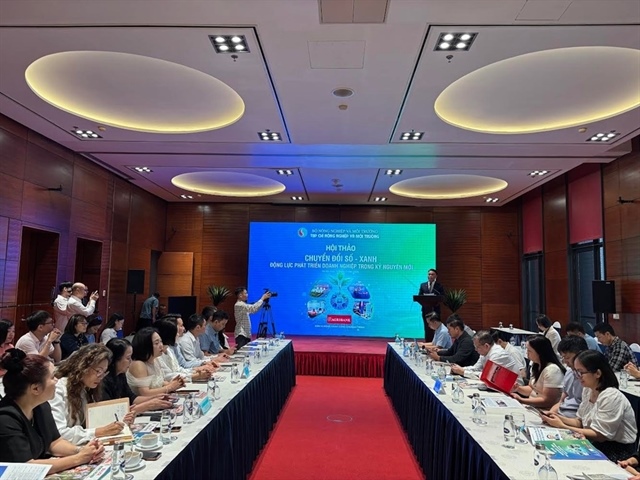
Overview of the workshop. — Photo bnews.vn |
Amid intensifying climate change and increasingly stringent sustainable development standards, digital transformation combined with green transformation is becoming an inevitable trend in the agricultural sector.
Although expected to create breakthroughs in productivity, quality, and competitiveness, this process still faces many “bottlenecks,” from costs and data to the risk of “greenwashing,” requiring not only technological innovation but also a shift in development mindset.
The Agriculture and Environment Magazine held a workshop titled “Digital–Green Transformation: A driver for enterprise development in the new era” on Monday.
In his opening remarks, Đào Xuân Hưng, Editor-in-Chief of Agriculture and Environment Magazine, stated that digital and green transformation not only helped businesses improve productivity and promote the application of science and technology but also enhance innovation capacity and optimise governance.
“Digital and green transformation also expand development space through e-commerce, market connectivity, deeper participation in global value chains, while moving toward a circular economy, efficient resource use, emission reduction, and compliance with international standards,” he said.
According to Phạm Anh Tuấn, director of the Vietnam Institute of Agricultural Engineering and Post Harvest Technology, the agricultural sector was currently facing “dual pressure” from climate change and market competition.
In addition, internal limitations such as fragmented production, high post-harvest losses, and low added value are creating an urgent need to innovate development models.
In this context, digital and green transformation are identified as systemic solutions. Digital transformation, based on data, automation, and connectivity, helps improve productivity and better control the entire production chain, from cultivation to storage and processing.
Meanwhile, green transformation aims to reduce emissions, develop a circular economy, and build a sustainable agricultural ecosystem.
In Việt Nam, many technologies have been applied, such as IoT for environmental monitoring, drones for spraying, AI for disease prediction, and platforms for traceability and agricultural e-commerce.
At the same time, green transformation is being promoted through low-emission farming models, reduced chemical use, optimised water resources, and regenerative agriculture.
The circular economy is becoming more evident as by-products are reused as inputs for new production cycles, combined with technologies such as biochar, enzymes, and biodegradable materials.
Notably, post-harvest and processing technologies play an important role in reducing losses and increasing the value of agricultural products.
Solutions such as smart packaging, cold chain monitoring, and energy-efficient drying technologies are being implemented to meet domestic and international market requirements.
However, Tuấn said that the transformation process still faced many barriers. “High investment costs, lack of high-quality human resources, fragmented data, and small-scale production are major challenges,” he noted.
To promote this process, experts suggest completing policy frameworks that integrate digital and green transformation; developing preferential green credit mechanisms; building carbon markets in agriculture; and standardising traceability and emission assessment systems.
In addition, increasing investment in research and development of core technologies such as AI, IoT, and big data; building a national agricultural digital data platform; developing synchronised digital infrastructure down to production areas; and forming a digital ecosystem to support agricultural management and transactions are also key solutions.
From a business perspective, Hà Phan Kim Nguyệt, CEO of Upgreen Vietnam, noted that one emerging issue was the gap between “green claims” and “green actions.”
While more than 76 per cent of businesses had begun integrating environmental factors, many still lacked data and measurement systems, leading to the risk of “greenwashing,” which undermined market trust.
Solutions should focus on two pillars, according to Nguyệt. First is circular design to restructure product life cycles, from selecting sustainable materials to ensuring recyclability. Second is digital traceability through technologies such as QR codes, NFC, or blockchain to ensure transparency of environmental data.
This combination helps businesses move from “sustainable marketing” to “proving sustainability” where data on emissions or recycled materials could be verified.
Practical models show that combining recycled materials with digital technology can create dual value, reducing environmental impact while enhancing competitive advantage, especially as ESG standards become more stringent.
According to experts, green transformation is not just about changing technology but about transforming mindset—from products to systems, from linear to circular, and from commitments to verifiable data.
In addition, human resources are identified as a key factor. Promoting linkages among stakeholders, building agricultural innovation centres, and strengthening international cooperation will help form leading enterprises in each sector.
Opinions at the workshop agreed that, if implemented synchronously, digital transformation combined with green transformation would not only help Việt Nam’s agriculture adapt to climate change but also create breakthroughs in productivity, quality, and competitiveness in the global market.
- 07:11 31/03/2026