Small businesses can begin ESG journey with simple actions
Small businesses can begin ESG journey with simple actions
Small businesses do not need to adopt ESG (environmental, social and governance) practices in a highly complex way from the outset, but can begin with actions suited to their scale, speakers said at a conference held in HCM City on May 22.
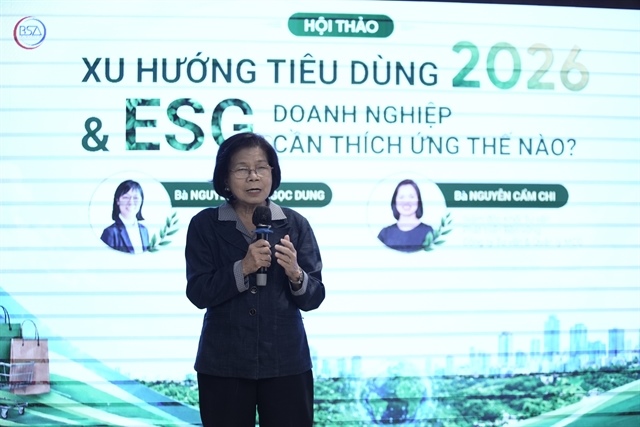
Vũ Kim Hạnh, chairwoman of the High-Quality Vietnamese Goods Business Association, speaks at the conference “Consumer Trends 2026 and ESG: How Should Businesses Adapt?” in HCM City on May 22. — Photo courtesy of the organisers |
Organised by the High-Quality Vietnamese Goods Association and the Business Studies and Assistance Centre, the conference aimed to help businesses stay updated on emerging consumer trends while gaining a deeper understanding of ESG requirements in international markets and their practical implementation in Việt Nam.
It also offered solutions to help businesses adapt as sustainable development becomes a new benchmark in global trade.
According to speakers, major markets such as the EU, the US, and Japan are continuously raising ESG requirements through regulations including the Corporate Sustainability Reporting Directive, the Carbon Border Adjustment Mechanism, and stricter standards on supply chain transparency and social responsibility. These changes are compelling businesses to adopt greener, more transparent, and more sustainable growth models.
At the same time, consumer trends in 2026 show that buyers are increasingly prioritising brands that demonstrate responsibility toward the environment, communities, and society. ESG is therefore no longer just a “ticket” for export, but is becoming a key factor in competitiveness and customer engagement.
Speaking at the seminar, Vũ Kim Hạnh, chairwoman of the High-Quality Vietnamese Goods Business Association, said: “Sustainable development is no longer optional, but an inevitable requirement for businesses seeking to participate in the global market.”
According to Nguyễn Cẩm Chi, director of Sustainability Consulting at MCG Management Consulting, many Vietnamese enterprises, especially SMEs, still feel hesitant about ESG. However, the biggest barrier is not cost or technology, but misunderstanding the true nature of ESG.
Many businesses view ESG as “an expensive game” requiring international certifications such as EcoVadis or Travelife, or internationally standardised reports before they can join global supply chains.
In reality, major partners often begin with more basic requirements, such as anti-bribery policies, monitoring electricity, water and waste, ensuring labour conditions, maintaining internal feedback mechanisms, and operating transparently.
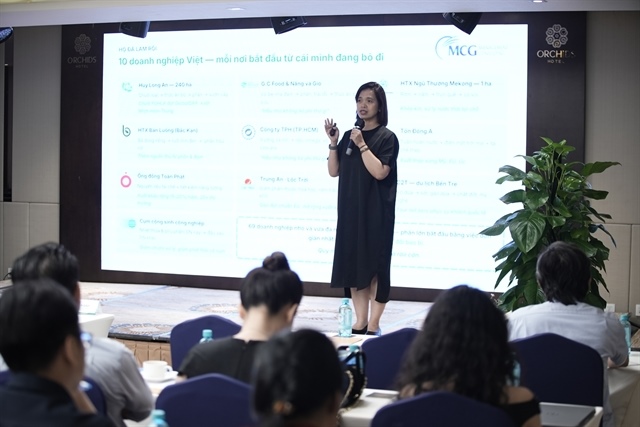
Vũ Kim Hạnh, chairwoman of the High-Quality Vietnamese Goods Business Association, speaks at the conference “Consumer Trends 2026 and ESG: How Should Businesses Adapt?” in HCM City on May 22. — Photo courtesy of the organisers |
Many companies spend hundreds of millions of đồng pursuing costly ESG certifications that bring little practical impact.
Instead of following certification trends, businesses should clearly define their objectives and understand what customers actually require, Chi said.
Chi identified four major barriers facing SMEs in ESG implementation: limited budgets, uncertainty about where to start, lack of dedicated personnel, and difficulty sustaining implementation efforts. However, she noted the advantages SMEs possess that large corporations often lack, including faster decision-making and the ability to directly connect ESG outcomes with business performance.
She suggested SMEs adopt a three-step approach when beginning ESG implementation: reviewing which resources, materials or processes are being wasted; developing measurable plans linked to costs and benefits; and identifying risks alongside opportunities.
In reality, small businesses that have successfully embraced green transformation and won over consumers often started with small, practical initiatives tied directly to business efficiency before gradually expanding and sustaining their efforts.
Nguyễn Cao Ngọc Dung from NielsenIQ, a global consumer intelligence and market research company, presented data highlighting challenges facing Việt Nam’s fast-moving consumer goods sector.
According to Dung, the FMCG sector recorded growth of around 1.7 per cent in 2025, while actual sales volume fell by 1.1 per cent, indicating that growth mainly came from higher prices rather than stronger consumer demand.
A NielsenIQ survey also shows consumers are becoming more cautious with spending. While around 43 per cent of respondents said they tightened spending in 2025, the figure rose to 57 per cent in 2026.
Consumers are prioritising essential goods, cutting back on luxury spending, and cooking at home more often to save costs. Many are also searching for promotions on online platforms or postponing purchases of non-essential products.
Despite tighter spending, Vietnamese consumers remain open to new products. NielsenIQ found that 92 per cent of consumers would be willing to try new brands or products if they meet their needs and offer interesting experiences. Over the past year, around 18,000 new FMCG products were launched, contributing significantly to industry growth.
Beyond price, consumers are increasingly focused on quality and health. About 86 per cent of Vietnamese consumers said they would prioritise quality over price, while low-sugar, health-oriented, nutritional, and personalised products were gaining popularity.
Dung noted that businesses must not only optimise pricing but also better understand consumer behaviour and develop product strategies tailored to different market segments and regions.
- 16:53 23/05/2026