Temporary relief for food imports as businesses urge overhaul of regulations
Temporary relief for food imports as businesses urge overhaul of regulations
The government’s Resolution No.09/2026/NQ-CP has given businesses short-term breathing space by clearing stalled food shipments, yet deeper reforms are still needed to prevent a repeat of costly port congestion.
|
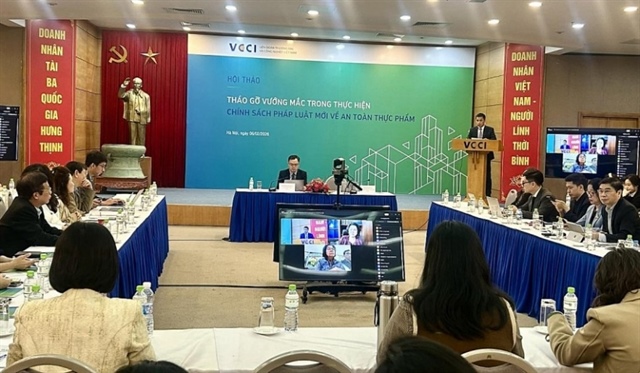
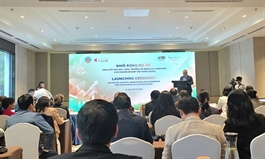
At a Hanoi workshop on new food safety policies and regulations on February 6, Dau Anh Tuan, deputy secretary general of the Vietnam Chamber of Commerce and Industry (VCCI), said that Resolution No.09/2026/NQ-CP was appreciated by business community for suspending the effect and adjusting the application period of Decree No.46/2026/ND-CP and Resolution 66.13/2026/ND-CP until April 15. This had enabled businesses to escape danger at a time when supply chains faced the risk of disruption.
“The decision to temporarily suspend Decree 46 and Resolution 66 has helped enterprises significantly reduce warehousing and storage costs, while also avoiding the risk of raw material shortages during the peak period serving the 2026 Lunar New Year,” Tuan said.
According to a preliminary survey by four industry associations, before Resolution 09 took effect, around 123,400 tonnes of imported packaged food, raw materials, packaging and food additives were congested at ports and border gates. Previously, nearly 300,000 tonnes of agricultural produce and fresh food had faced similar bottlenecks.
At the workshop, representatives of business associations stressed that Resolution 09 is only a temporary solution. The deadline of April 15 is not far off, while the core shortcomings of the policy framework remain unaddressed.
The business community believes that Decree 46 and Resolution 66 have significantly expanded pre-clearance inspection requirements, leading to overlapping and cumbersome procedures.
According to the Association for Transparent Food (AFT), Decree 46 expands the scope of state inspection in an indiscriminate manner. Aside from imported finished products, raw materials, additives and packaging used for internal production are also subject to pre-clearance inspection, together with conformity declaration requirements.
AFT cited a case in which a shipment imported from India, already holding full organic certification and with a stable export history to Vietnam, was still required to obtain an additional food safety certificate issued by the exporting country’s competent authority, as well as undergo testing at designated domestic laboratories. In practice, many testing laboratories lack clear guidance, while the inspection criteria required by the Ministry of Health are complex and differ from international standards.
Huynh Quang Tuan from the European Chamber of Commerce in Vietnam said that the level of state inspection under Decree 46 had increased multiple times, from document-based checks to document checks combined with sampling and testing, and even inspections of raw materials and packaging. The process has expanded from two stages to three, while the number of qualified testing facilities has declined.
“The consequence is a sharp increase in customs clearance time. For fruit, vegetables and fresh food, a delay of just nine to ten days can mean the loss of an entire shipment,” he said.
“This causes a paradox: most recent cases involving counterfeit or substandard goods have not originated from imported products, yet imports are currently subject to the heaviest pre-clearance controls.”
In addition to Decree 46, Resolution 66 on product self-declaration registration has also been criticised for generating additional procedures, excluding international testing laboratories, and creating complex and overlapping documentation requirements. This is particularly evident for nutritional products for children under 36 months of age, which must obtain two separate market circulation licences.
In many localities, enforcement has been inconsistent. Valid dossiers have been required to be resubmitted, while regulations on labelling changes and advertising are applied differently, disrupting production plans, product launches and generating substantial additional costs for businesses.
Based on these realities, AFT, and foreign business associations have jointly recommended that the government extend the implementation deadline of Decree 46 to at least June, while allowing the current inspection mechanism to remain in place during the transitional period.
These associations proposed amending Decree 46 to simplify state inspection procedures to a single step, and exempting food additives, processing aids, tools and imported packaging used for internal production from conformity declaration requirements.
Businesses also suggested recognising international certifications such as HACCP, ISO 22000, and FSSC 22000 in place of certificates of eligibility for food safety conditions, to avoid unnecessary barriers and align with international practices.
The associations also proposed classifying product self-declaration registration based on risk levels, reducing overlaps, particularly for children’s products; allowing self-declaration dossiers that remain valid to continue being processed during a 12-month transitional period; and issuing unified nationwide guidance to prevent inconsistent local interpretation.
In the longer term, EuroCham recommended amending the Law on Food Safety first, followed by the issuance of new guiding decrees, maintaining the application of Decree No.15/2018/ND-CP during the transition, and strengthening post-clearance inspection.
- 09:00 07/02/2026