Resolution 68: Private economic sector affirms principal driver of growth, innovation
Resolution 68: Private economic sector affirms principal driver of growth, innovation
By 2030, Việt Nam aims to have 2 million active enterprises, at least 20 large firms participating in global value chains, private sector growth of 10–12 per cent annually, and contributions of 55–58 per cent of GDP.

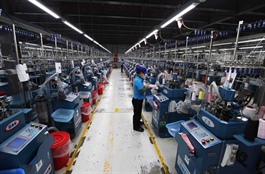
Workers at Maxport Limited Vietnam Co., Ltd in Nam Định Province. — VNA/VNS Photo |
After 40 years of renewal, vivid practical evidence has enabled the Communist Party of Việt Nam to affirm the private sector as one of the most important driving forces of the national economy and a pioneering force in the development of science, technology and innovation.
Beyond its substantial contribution to gross domestic product (GDP), the sector has emerged as a principal engine of economic growth, job creation, budget revenues and innovation promotion.
Throughout Việt Nam’s process of renewal, integration and development, the private sector has grown steadily and consolidated its position as a key pillar of the economy. According to the National Statistics Office under the Ministry of Finance, the private sector currently contributes around 42.3 per cent of GDP and accounts for more than 85 per cent of operating enterprises nationwide. It is the most dynamic segment of the economy, leading efforts to expand investment, explore markets, adopt new technologies and modernise governance models.
Notably, the private sector provides employment for approximately 83.7 per cent of informal workers and more than 45 per cent of the total workforce. A growing number of private enterprises have successfully expanded into regional and global markets, building recognised brands and competitive capabilities, thereby enhancing Việt Nam’s international standing and reputation.
In addition, the sector has played a pioneering role in restructuring the economy and promoting industrialisation and modernisation. Prominent Vietnamese private groups including Vingroup, THACO, FPT, Masan, Vietjet, Vinamilk and TH have expanded regionally and globally, reflecting the innovative and creative spirit and aspiration of Vietnamese entrepreneurs.
The private sector has also helped diversify development resources, ease pressure on the state budget, and mobilise social capital through private investment in infrastructure, education, health care and technology.
Professor, Dr. Trần Thọ Đạt, Chairman of the Scientific and Training Council of the National Economics University and a member of the National Financial and Monetary Policy Advisory Council, noted that Resolution No. 68-NQ/TW’s designation of the private sector as the most important driving force both recognises its substantial contributions and underscores its strategic role in the new development phase, particularly amid rapid technological change, innovation and digital transformation.
Despite positive progress, several targets remain unmet. The country aimed to have 1.5 million enterprises by 2025; yet the current figure stands at nearly one million, alongside more than five million household businesses. The ratio of enterprises per 1,000 people remains modest at around 9.4, lower than in some regional peers, indicating that both the scale and quality of the private sector have yet to fully match its potential.
According to Dr. Mạc Quốc Anh, Vice Chairman and Secretary General of the Hanoi Association of Small- and Medium-Sized Enterprises, while the Party and State have introduced numerous supportive policies, some measures have not been sufficiently targeted or effectively implemented. Most private firms are micro, small or medium-sized, with limited financial capacity, management expertise, technological capability and innovation performance, resulting in modest productivity and competitiveness. Institutional bottlenecks, complex procedures, high compliance costs and lingering bias against private enterprises have also constrained confidence and investment.
To further strengthen the private sector’s leading role, the Party and State have intensified reforms to address institutional and administrative barriers, including access to land and credit. Resolution No. 68-NQ/TW, issued by the Politburo on May 4, 2025, is regarded as a landmark policy reaffirming the Party’s consistent commitment to private sector development as a national strategy.
The resolution envisions a balanced economic structure based on three mutually reinforcing pillars: the state sector as the stabilising foundation; the private sector as the dynamic, innovative spearhead; and foreign direct investment as a source of capital, technology and global connectivity. Breakthroughs are required in institutional reform, resource access, market linkages and human capital development to enable the private sector to fulfil its mission.
Achieving these goals will require continued bold reforms and greater determination from private enterprises and entrepreneurs to enhance governance, innovation and responsible business culture, ensuring that the private sector truly leads Việt Nam’s journey towards sustainable and internationally integrated development.
- 08:00 09/02/2026