Tasting success not a far cry for Cambodia’s salt industry
Tasting success not a far cry for Cambodia’s salt industry
Of all the ingredients, salt is indispensable. Aeons ago, as someone aptly said, a civilised life is impossible without salt. Despite its deep roots and continued relevance, the salt industry remains one of Cambodia’s most overlooked sectors. It failed to attract any attention from policymakers and financiers. The salt sector stands at a crossroads between marginalisation and transformation. Salt production in Kampot and Kep — the only two provinces in the Kingdom that produce salt — dates back over 1,300 years. For many communities in these two provinces, salt production is not only a source of income but also a cultural practice, reflecting centuries of traditional knowledge and local identity. Of late, the salt production sector has been incorporated in the Royal Government’s master plan to develop coastal provinces into a multi-purpose and comprehensive economic corridor. This framework identifies Kampot province as a hub for ‘sea salt manufacturing’ and ‘agro-processing’, encouraging the industry to move beyond raw material extraction toward value-added processing and distribution. While the authorities have grand plans on paper, in practice, they remain ineffective. That approach needs to be changed now to perk up the flavour.
The salt industry holds significant economic, historical and social importance in Cambodia, supporting coastal livelihoods, preserving cultural heritage and contributing directly to national food security.
Despite its deep roots and continued relevance, it remains one of the country’s most overlooked sectors in policy planning and investment priorities, receiving limited support from both the government and private investors.
Often perceived as low-value or even symbolic of emptiness, salt has struggled to attract sustained attention from policymakers and financiers. This perception persists despite its essential role in daily consumption, rural income generation and coastal economic resilience.
As global consumers increasingly seek traceable, high-quality and locally produced food products, Cambodia’s salt sector stands at a crossroads between continued marginalisation and meaningful transformation.
Cambodia’s salt production remained largely family-based until World War II, with generations relying on manual labour, inherited skills and traditional techniques. Families passed down knowledge of harvesting, drying and storing salt, sustaining both livelihoods and local cultural practices.
Salt production in Kampot and Kep provinces dates back over 1,300 years. Historical records by Zhou Daguan, a Chinese envoy who visited the Khmer Empire in 1296, describe the production and trade of salt, highlighting its long-standing economic and cultural significance.
During the 1970s and 1980s, the Cambodian government formally permitted ownership of salt-production land, reshaping production relationships, encouraging private investment and laying the groundwork for modernisation.
After the Khmer Rouge regime, the People’s Republic of Kampuchea in 1986 allowed citizens to form solidarity groups to restore abandoned salt fields, helping rebuild rural livelihoods and stabilise coastal communities.
For many communities in Kampot and Kep provinces, salt production is not only a source of income but also a cultural practice passed down through generations, reflecting centuries of traditional knowledge and local identity.
Thousands of families depend on seasonal salt production as their primary source of income, especially in remote coastal areas where few alternative employment opportunities exist.
Beyond economic support, salt harvesting also preserves local traditions and strengthens social ties within these communities. Families often work collectively, sharing labour, tools and knowledge, reinforcing a sense of identity tied to the land and sea.
Salt fields are not merely production sites but cultural landscapes shaped by generations of collective effort. However, the sustainability of these livelihoods is increasingly under pressure. Climate variability, rising production costs and limited access to finance threaten both income stability and intergenerational continuity.
The industry faces persistent challenges such as limited access to tools, capital and modern infrastructure, combined with weak technical skills, climate variability and entirely manual production methods, continues to constrain output. Production is often inconsistent, lacking branding, registration or formal market integration.
Additionally, imported salt pressures local producers, who must meet higher quality and safety standards while competing with cheaper alternatives. Consumer awareness remains low, and traditional producers struggle to differentiate their products in both domestic and international markets.
Despite the challenges, Thaung Enterprise, a family-owned traditional salt production in Kampot province, has transformed into a leading supplier nationwide, while exporting a variety of products globally, competing with regional countries.
Speaking to Khmer Times, Thyda Thaung, Founder and Managing Director of Thaung Enterprise, said the company’s salt production reflects a deep connection between farmers, local communities, tradition and sustainability, expressing hope that locally produced salt can support Cambodia’s broader economic development and international promotion.
Thyda explained that while the enterprise is not yet able to work with all salt producers nationwide, it currently partners with around 40 producers, involving more than 100 salt harvesters, providing them with stable market access and improved income opportunities.
She highlighted that annual production currently ranges between 5,000 and 9,000 tonnes, with plans to gradually expand capacity in the coming years if demand grows and operational conditions improve.
However, Thyda noted that purchasing activity has slowed recently due to a surge in imported salt entering the Kingdom, which has intensified competition and placed additional pressure on local producers struggling to maintain sales volumes and stable pricing.
She emphasised that despite the enterprise’s contributions to community development and livelihoods, locally produced salt faces significant market challenges, as higher production costs and strict compliance with quality standards result in prices that are less competitive than imported salt.
Thyda pointed out that consumer perception remains a key obstacle, as many consumers believe all salt products are the same, without recognising differences in quality, production methods and compliance, making it difficult to promote locally produced salt.
On land conservation, she underlined that salt farming in Cambodia is legally permitted in only two provinces—Kampot and Kep—highlighting the importance of protecting these limited areas to ensure the long-term sustainability of the salt industry.
“Salt is an essential resource, not only for food,” Thyda said, adding that sustainable industry growth requires protecting coastal salt-farming land, controlling land prices and strengthening producers’ market access to maintain competitiveness and support the local salt industry.
During a recent press tour, Khmer Times interviewed Bun Narin, CEO of Thaung Enterprise and President of the Association of Geographical Indication Kampot-Kep Salt Producers (AGIKSP), who shared insights into the enterprise’s transformation from a family-based operation into a formal business and the wider implications for Cambodia’s salt industry.
Narin explained that the journey toward formalisation was intended not only to grow the business but also to inspire students and young entrepreneurs by demonstrating how traditional livelihoods can evolve into sustainable enterprises.
He highlighted both the opportunities and difficulties involved in transitioning from informal, family-run salt production to a structured small enterprise. “Established in 2016 and officially launched in 2017, Thaung Enterprise operates as a salt production and processing company offering a diverse product portfolio,” he said
These include Geographical Indication (GI) Kampot-Kep salt products such as coarse salt, flower of salt, flaky salt, grilled salt and aromatic coarse and fleur salts, serving both domestic and international markets, he added.
He noted that the long-term vision is to become Cambodia’s leading producer of high-quality, naturally crafted sea salt that reflects the heritage, promotes environmentally sustainable practices and delivers trusted value to local and global consumers.
Narin said, “This vision aligns with broader efforts to reposition Cambodian salt as a premium, value-added product rather than a basic commodity.”
“We have exported our products to Japan, the European Union, including Switzerland, Germany and the Czech Republic, as well as Korea and the USA, with indirect exports to France and Canada,” he added, underscoring the growing international recognition of Kampot and Kep salt.
He encouraged other family-owned salt producers to formalise into small enterprises, noting benefits such as improved product quality and consistency, better compliance with GI regulations, stronger trust among buyers and distributors, and expanded access to domestic and international markets. “Formalisation is essential for long-term competitiveness,” he said.
However, Narin acknowledged that consumer demand has evolved, with increasing expectations for higher quality, safer packaging and traceability. Informal production limited access to investors and buyers, while standards such as HACCP, food safety certification and traceability systems are becoming prerequisites for market entry.
He also stressed that the transition is far from easy, as producers often face low capital levels, unstable cash flow, difficulties in scaling traditional production methods, weather-related risks affecting volume and quality, inconsistent outputs, weak branding and resistance to changing long-standing mindsets.
According to him, key turning points in the transition include documenting production processes and costs, introducing basic standard operating procedures, improving salt-drying and cleaning techniques, joining the Protected Geographical Indication (PGI) system, and seeking technical support from NGOs, universities, and training programmes.
Product development is another critical factor. He advised producers to diversify into higher-value products such as flower of salt, flaky salt and fine salt, create aromatic salts through infusions, and improve hygiene, packaging and branding to meet the expectations of chefs, tourists and niche markets.
Digital transformation also plays an increasing role. Narin highlighted the use of social media for marketing and customer engagement, simple digital tools for inventory and finance management, and online platforms to connect with international buyers and enhance traceability.
To expand market access, he encouraged producers to supply local shops and distributors, build partnerships with restaurants and chefs, target tourists and GI-related events, and use online channels to attract international buyers, as well as business-to-business (B2B) and small-scale export opportunities.
Narin emphasised the importance of building strong partnerships by participating in exhibitions, collaborating with universities, engaging actively with PGI associations, strengthening networks with processors and factories, and maintaining consistency to build long-term trust in Cambodian salt products.
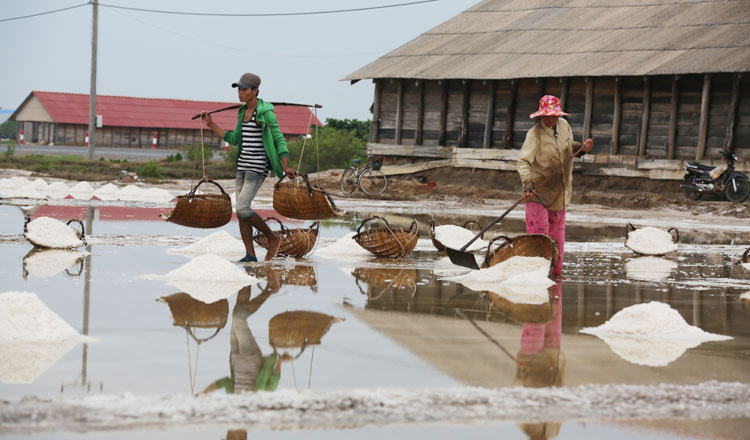
During the press tour, a salt producer in Kampot told Khmer Times about the traditional process of producing salt from seawater, which typically begins around September, when seawater levels rise and can flow naturally into salt fields without the need for pumping.
He explained that the salt fields are designed with shallow ponds and small channels arranged in five to seven stepped sections, allowing seawater to gradually evaporate as it moves through each level. “This staged process concentrates the salt content before the water is stored for further evaporation,” he said.
“After approximately one month, the seawater dries, and salt crystals begin to form on the surface. If weather conditions remain favourable, producers can harvest salt several times, as crystals continue to grow during the dry period.”
However, the producer emphasised that heavy rainfall can delay harvesting and reduce salt quality, which is why most salt cultivation takes place toward the end of the year, when rainfall is lower and conditions are more stable.
The salt industry faced multiple challenges that must be addressed to fully capitalise on growing consumer interest in local and high-quality products, including climate-related risks, traditional manual production methods, limited capital, weak branding, and rising competition from imported salt.
Key obstacles included limited access to capital and modern tools, inconsistent production methods, weather-dependent yields, lack of branding, weak market integration and competition from cheaper imported salt.
Informal, family-based production also restricted producers’ ability to comply with quality and safety standards, such as the Hazard Analysis and Critical Control Points (HACCP), food traceability and GI regulations, limiting both domestic and international market access.
To overcome these challenges, producers should focus on formalising operations while maintaining traditional methods that ensure quality and authenticity. Documenting production processes, costs and standard operating procedures is a critical first step, enabling better quality control, traceability and investor confidence.
Investment in improved drying, cleaning and packaging methods will enhance product consistency and meet the rising expectations of domestic and international consumers.
Product diversification is another effective strategy. Offering varieties such as flower of salt, flaky salt, fine salt and aromatic salts can attract niche markets, including chefs, tourists and health-conscious consumers.
Branding, storytelling and highlighting the unique Kampot and Kep heritage can create added value and justify premium pricing compared to imported alternatives.
Digital tools and platforms also offer opportunities to expand market access. Social media marketing, online sales channels, and simple digital inventory or finance systems can improve customer engagement, traceability, and visibility to B2B and export buyers.
Collaboration with restaurants, hotels, distributors, universities, and trade associations can further strengthen market linkages, build trust, and promote the sector’s sustainability.
By addressing operational, market, and branding challenges while leveraging rising interest in local products, Cambodia’s salt industry can transform into a modern, competitive, and culturally significant sector, supporting coastal communities, preserving heritage, and increasing national and international recognition.
It may be noted that enterprises operating in the salt production sector function within the strategic context of the Royal Government’s master plan to develop coastal provinces into a multi-purpose and comprehensive economic corridor.
This planning framework explicitly identifies Kampot province as a hub for ‘sea salt manufacturing’ and ‘agro-processing’, encouraging the industry to move beyond raw material extraction toward value-added processing and distribution.
Furthermore, the master plan highlights the unique potential of salt fields, advocating for their preservation as ‘productive landscapes’ while promoting their integration into the ‘agro-tourism’ sector to create educational and recreational experiences for visitors.
This dual approach aimed to consolidate Kampot’s position as a quality agriculture base that supports both the industrial supply chain and the tourism economy.
- 08:17 02/02/2026