Food prices climb ahead of Tết, squeezing households
Food prices climb ahead of Tết, squeezing households
Food prices in HCM City have risen earlier and faster than usual ahead of Tết (Lunar New Year), adding pressure on household budgets and testing government efforts to stabilise the market during the country’s most important holiday season.
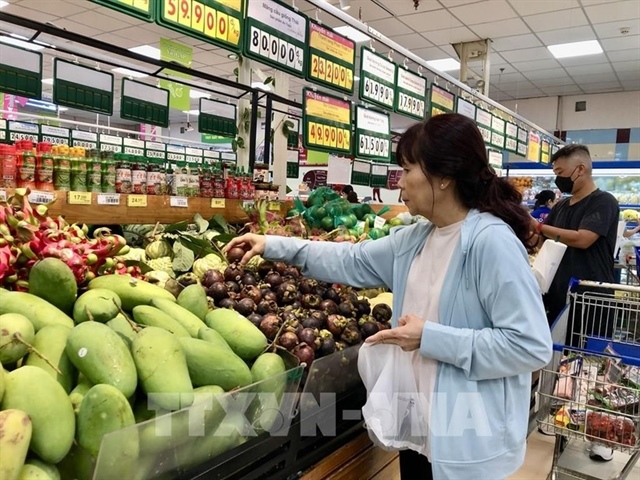
Consumers shop for fruit at a supermarket in HCM City as food prices and other essentials rise earlier and faster than usual ahead of Tết. — VNA/VNS Photo |
Food prices in HCM City have risen earlier and faster than usual ahead of Tết (Lunar New Year), adding pressure on household budgets and testing government efforts to stabilise the market during the country’s most important holiday season.
Prices of pork, a staple of traditional Tết meals, have surged by 20-25 per cent from a year earlier, while dried seafood such as shrimp and squid has also jumped sharply.
Together, the increases have pushed food spending in Việt Nam’s largest city up by an estimated 10-15 per cent, according to consumers, traders and industry representatives.
Nguyễn Thị Yến Nga, a resident of An Nhơn Ward, said she decided to buy dried shrimp and dried squid early this year to avoid the usual pre-holiday rush, but found prices had already climbed.
“At the same time last year, dried squid of 16 pieces per kg cost around VNĐ1.2 million. Now it’s about VNĐ1.5 million,” she told Việt Nam News and Law. “Dried shrimp prices are also up around 20 per cent, so I had to buy less than planned.”
Other households report similar adjustments. Trần Thị Thuỳ, who lives in Khánh Hội Ward, said her family expects total Tết spending to rise by 10-15 per cent this year, even after cutting non-essential expenses. “Food is something you can’t really reduce during Tết,” she said.
Tết, which falls on February 17 this year, marks the Lunar New Year and is Việt Nam’s most significant holiday. Government offices and many businesses close for at least five to seven days, while some factories and private companies extend the break. The holiday centres on family reunions, ancestral worship and home-cooked meals, making food purchases both culturally important and difficult to scale back.
Market surveys at traditional wet markets and modern retail chains show that prices for many goods began rising from early January, earlier than in previous years. Fresh food and dried products used directly for Tết celebrations have seen the strongest increases.
Pork has been the main driver of food inflation. At several markets in HCM City, pork jowl is selling for VNĐ220,000-230,000 (US$9-9.40) per kg, while premium pork ribs cost VNĐ200,000-210,000 per kg, around 20-25 per cent higher than a year ago. Belly pork and other commonly used cuts have risen by 10-15 per cent, pushing up daily meal costs for many families.
Seafood prices have also climbed as supply tightens. Medium-sized black tiger shrimp now sell for about VNĐ200,000 per kg, up from roughly VNĐ160,000 a year earlier. Other shrimp varieties have risen by around 10 per cent, while several types of marine fish, including tuna, mackerel and cobia, have recorded double-digit price increases.
Stronger demand, tighter supply
Traders attribute the early price rises to a mix of stronger demand and constrained supply.
At Xóm Mới Market in Gò Vấp Ward, pork vendors said wholesale pig prices have been increasing almost daily as Tết demand picks up earlier than usual, while supply has yet to fully recover.
Companies participating in the city’s price stabilisation programme say they are under mounting pressure from higher input costs but are working to limit price increases.
Phan Văn Dũng, deputy general director of food producer Vissan, said live pig prices have risen to VNĐ69,000-70,000 per kg, compared with the stabilised price of VNĐ64,000 applied in November.
Vissan is seeking approval from local authorities to adjust retail prices before the peak holiday period. Even after adjustments, Dũng said, the company’s prices would remain 3-5 per cent lower than prevailing market levels under the stabilisation programme.
Prices of processed foods, however, will be kept unchanged before and after Tết thanks to early stockpiling of raw materials.
From an industry perspective, Nguyễn Kim Đoán, vice chairman of the Đồng Nai Livestock Association, said the current price surge reflects a localised supply shortage.
When live pig prices fell sharply in mid-2025, many small farmers reduced herd sizes or exited production, creating a supply gap toward the end of the year, he added.
Restocking after African swine fever outbreaks has also been uneven, with smaller producers remaining cautious due to high costs for feed, veterinary services and disease prevention. Prolonged flooding in central Việt Nam late last year further disrupted supply.
As of November, Việt Nam’s total pig herd had grown by only about 0.3 per cent from a year earlier, insufficient to meet the earlier-than-usual surge in Tết demand. As a result, industry representatives expect pork prices to remain elevated through the holiday unless additional supply is released from large producers or frozen reserves.
In HCM City, despite a local herd of more than 1.3 million pigs and daily supplies of over 750 tonnes of meat, the city still imports around 40-45 per cent of slaughter pigs from other provinces, making the market particularly sensitive to price swings during the year-end peak.
- 08:09 03/02/2026