Sustainability key to repositioning Việt Nam’s wood industry in global supply chains
Sustainability key to repositioning Việt Nam’s wood industry in global supply chains
Proactive compliance with legal timber sourcing and sustainability standards is essential not only for business survival, but also for repositioning Việt Nam’s wood industry towards greater transparency, responsibility and higher value creation in global supply chains, speakers said at a seminar in HCM City on January 29.

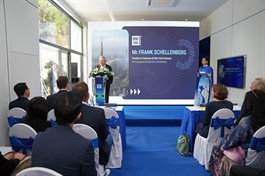
Võ Quang Hà, Chairman of the HCM City Structure Architecture Wood Association, speaks at the Forest Talk & Link seminar themed “Wood Consumption, Climate Change and Deforestation-Free Requirements” in HCM City on January 29. — VNA/VNS Photo |
Speaking at the Forest Talk & Link seminar themed “Wood Consumption, Climate Change and Deforestation-Free Requirements”, Võ Quang Hà, Chairman of the HCM City Structure Architecture Wood Association (SAWA), said Việt Nam exported more than US$17 billion worth of wood and wood products in 2025, ranking among the world’s leading furniture exporters.
However, an estimated $4–5 billion in export revenue still derives from low-value wood chips and pellets, underscoring the sector’s significant untapped potential for value-added growth.
Developing large-timber plantations was identified as a key solution. Compared with short-rotation harvesting for chips or basic panels, large-diameter timber delivers higher economic returns, supports deep processing, and enables longer-term carbon storage. Longer rotation cycles also align more closely with global climate goals and emerging “deforestation-free” market requirements, Hà said.
Beyond furniture manufacturing, he highlighted growing opportunities for engineered wood products in construction. Globally, engineered timber is increasingly used in multi-storey buildings due to its renewable nature and significantly lower embodied carbon compared with steel or concrete. With appropriate standards, technology and investment, Việt Nam’s plantation forests are well positioned to supply this market.
Tô Xuân Phúc, Executive Director of Forest Trends’ Forest Products Trade Policy Programme, noted that global wood markets are rapidly shifting from voluntary sustainability commitments to mandatory regulatory requirements.
In the 1990s and early 2000s, voluntary certification schemes such as the Forest Stewardship Council (FSC) and the Programme for the Endorsement of Forest Certification (PEFC) were the main tools for demonstrating sustainable forest management. Since then, major consumer markets have introduced binding regulations to combat illegal logging, including the EU’s FLEGT Voluntary Partnership Agreement, the US Lacey Act, and Australia’s Illegal Logging Prohibition Act.
Since the 2010s, market expectations have continued to rise. Legal compliance is now considered a baseline requirement, while buyers increasingly demand deforestation-free supply chains, respect for community and labour rights, transparency, and contributions to emissions reduction and climate action. Many multinational corporations have committed to sourcing only sustainable wood products with fully traceable supply chains.
|
Võ Quang Hà, Chairman of the HCM City Structure Architecture Wood Association, speaks at the Forest Talk & Link seminar themed “Wood Consumption, Climate Change and Deforestation-Free Requirements” in HCM City on January 29. — VNA/VNS Photo |
While Việt Nam’s key export markets impose varying levels of sustainability requirements, the overall trend is clearly towards stricter enforcement, Phúc said.
He added that with more than 1.1 million forest-growing households, fragmented landholdings and complex supply chains, challenges such as limited traceability, land disputes, and insufficient certification remain.
To address these issues, he called for a more holistic approach that links sustainable forest management with improved livelihoods for forest growers. Expanding FSC- and PEFC-certified forest areas, enhancing supply-chain transparency, and reducing reliance on high-risk imported timber are critical to maintaining export competitiveness, he added.
Public policy also plays a pivotal role. Government procurement policies that prioritise legal and sustainable wood products could help mitigate trade risks, stimulate domestic demand, and stabilise incomes for forest households.
At the same time, the private sector is expected to take a more proactive role by investing in sustainable raw-material zones and strengthening partnerships with smallholder forest growers.
From the construction perspective, Lưu Thị Hồng, Deputy Director of the Institute for Building Materials under the Ministry of Construction, said global markets are increasingly favouring renewable, low-carbon and traceable materials – criteria that sustainably sourced wood fully meets.
To capitalise on this opportunity, Việt Nam needs to develop a coherent set of technical standards for construction timber, she said.
Nguyễn Quang Hiệp, Director of the Institute for Building Materials, said the Ministry of Construction is developing a new sectoral plan that, for the first time, includes policies to promote wood as a building material. Authorities will study the experience of countries with long traditions of using timber in construction to refine Việt Nam’s standards system, making it easier for investors and designers to adopt wood in building projects.
From practical design experience, Nguyễn Mạnh Bình San, Vice Chairman of SAWA, underscored the role of architects in shaping wood consumption.
Organised by SAWA and Forest Trends, the seminar marked the launch of the Forest Talk & Link series, which aims to encourage a shift from natural forest timber to plantation wood and alternative materials. Planned as an ongoing platform throughout 2026, the initiative seeks to contribute to forest protection and biodiversity conservation, improve forest growers’ livelihoods, and advance low-emission solutions aligned with Việt Nam’s and global sustainable development goals.
- 20:10 30/01/2026