Construction firms poised for growth on public investment and capital market support
Construction firms poised for growth on public investment and capital market support
Building firms posted strong profit growth in 2025 and are entering the new year with expanding projects, supported by record public investment and signs of private sector recovery.
2025 marked a strong breakout for construction companies, particularly infrastructure contractors.
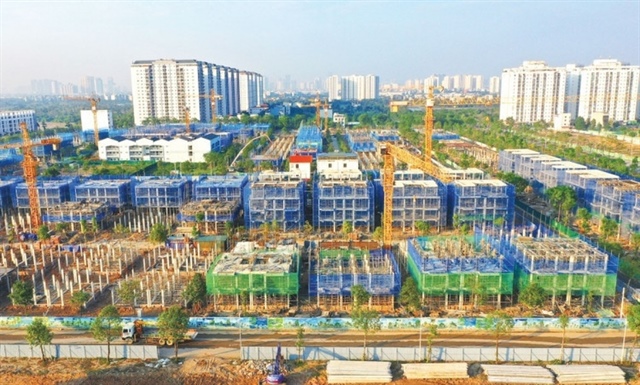
Infrastructure builders enter 2026 with strong earnings and expanding project backlogs. Photo: baodauthau.vn |
Supported by public investment and the recovery of the real estate market, the construction sector is entering a new growth cycle in 2026, driven by a robust project pipeline and double-digit growth expectations in newly signed contract values.
Deo Ca Transport Infrastructure Investment JSC, a major contractor in central Vietnam, recorded consolidated revenue of more than $151.6 million in 2025, up 15 per cent on-year. The company’s after-tax profit approximated $27.2 million, showing a 37 per cent jump.
Among its business segments, operations and maintenance continued to play a core role, generating around $91.8 million, up 16 per cent on-year and accounting for over 60 per cent of total revenue.
Construction and installation activities contributed approximately $52.8 million, marking a 15 per cent increase.
During the year, the company completed several key projects, including the full opening of the Dong Dang-Tra Linh Expressway, delivering the Quang Ngai-Hoai Nhon expressway eight months ahead of schedule, and completing the coastal road project connecting Lien Chieu Port three months early.
By the end of 2025, Vietnam Construction and Import-Export Joint Stock Corporation (Vinaconex) reported a record net profit of $165.2 million, 3.7 times higher than in 2024.
This was largely driven by financial income of more than $143.4 million, generated from divestments, most notably the sale of its stake in Vinaconex Investment and Tourism Development JSC, the developer of Cat Ba Amatina resort in the northern port city of Haiphong.
In the first month of 2026 , Vinaconex participated in joint ventures that won four transportation infrastructure packages with a total contract value exceeding $57.8 million.
These included Package 9 for construction and equipment installation under the Lien Khuong International Airport’s runway and taxiway rehabilitation initiative, valued at $33.8 million, and Package XL12 for the construction of lighting, signalling and traffic safety systems in Thu Duc city under Component Project 1 of Ho Chi Minh City’s Ring Road 3, valued at $9.6 million, among others.
Several other major infrastructure builders also reported strong profits in 2025, including Lizen JSC with after-tax profit reaching $6 million, up 25 per cent on-year; FECON Corporation with $3.8 million, up 220 per cent; Dat Phuong Group posting $17.8 million, up 46.2 per cent; and Construction JSC No. 47 with $2.1 million, 14.3 times higher than one year ago, to name but a few.
In the civil construction segment, Phuc Hung Holdings Construction JSC reaped net profit of $900,000 in 2025, almost five times higher on-year. Ricons Construction Investment JSC posted profit of $15.1 million, up 137 per cent, while Xuan Mai Investment and Construction JSC earned $1.1 million, over 3.5 times that of 2024.
Assessing the construction pipeline for 2026, Dang Trong Duc, CEO of Phuc Hung Holdings, noted that the public investment capital plan remaining at a record level of approximately $43.2 billion demonstrates the government’s strong commitment to boosting growth through infrastructure development.
“Strategic transportation projects, along with urban infrastructure, healthcare, education and energy developments, are set to be rolled out simultaneously, creating a stable, large-scale and industry-leading source of work,” he said.
At the same time, the civil and industrial construction segment is showing a clear recovery, supported by signs of a warming real estate market, particularly in urban housing, social housing, and integrated commercial, service and hotel complexes. Factory and industrial park projects linked to global supply chain shifts are also displaying positive prospects.
“The combination of public investment and the civil-industrial realty market is creating an unprecedented depth of project supply, enabling the construction sector not only to grow in volume but also to diversify across segments and venture models,” Duc said.
Over a longer cycle, recent calculations by FiinGroup indicate that public investment disbursement for 2026-2030 is estimated at $340 billion, roughly four times the average of previous phases.
This capital will be primarily allocated to inter-regional transportation infrastructure projects, supporting medium- and long-term growth while also serving as catalytic capital to engage private investment flows.
According to financial information and analytics major FiinGroup, private sector investment accounted for more than half of total social investment capital in 2025, but its recovery remains relatively slow, with growth of only 8.4 per cent during the year.
As a result, the private sector has yet to gain sufficient momentum to act as a central growth engine, particularly as room for further credit expansion is constrained by systemic risk considerations.
Against this backdrop, to support building firms in seizing opportunities and sustaining growth, it is essential to further develop the capital market, especially the corporate bond market.
At the same time, investor confidence needs to be strengthened through the standardisation of bond valuation practices and the implementation of clearer solutions to shorten the time of settlement when companies lose their ability to meet debt obligations.
- 11:38 11/02/2026