Vĩnh Long identifies new growth drivers
Vĩnh Long identifies new growth drivers
Vĩnh Long Province aims for economic growth of 10 per cent this year and per capita income of VNĐ96.62 million (US$3,676).
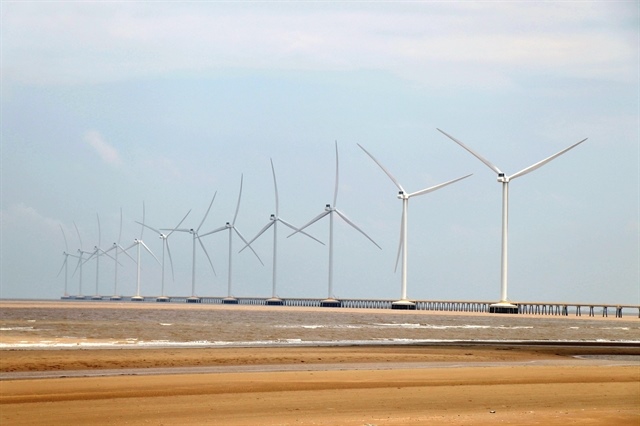
Wind turbines operate along the coastline of Trường Long Hòa Ward in Vĩnh Long Province. — VNA/VNS Photo Chương Đài |
Vĩnh Long Province aims for economic growth of 10 per cent this year and per capita income of VNĐ96.62 million (US$3,676).
The Cửu Long (Mekong) Delta province also targets the digital economy to contribute about 8.05 per cent of output, budget revenues of VNĐ22.6 trillion (US$860 million) and total investment of around VNĐ79 trillion ($3 billion).
Situated in the heart of the delta, Vĩnh Long links regional provinces with the southeast.
The province has a strong agricultural base, extensive farming and aquaculture areas and major products with significant development potential.
With its 130km coastline, it has advantages in terms of developing wind power and maritime logistics.
To realise this year’s targets, the province has identified strategic pillars including policies, infrastructure, human resources and science and technology.
It is promoting a shift in the growth model, improving labour productivity, product quality and overall competitiveness.
Alongside traditional drivers such as investment, exports and consumption, the province is fostering new engines based on science, technology, innovation, digital and green transformation, and the circular economy.
Its adjusted planning for 2021–2030 is expected to open new development space and steer restructuring towards sustainability.
Trần Trí Quang, chairman of the province People’s Committee, said the key objective is to achieve growth of 10 per cent.
The target is challenging but feasible if the province effectively mobilises its “potential, advantages and the combined strength of the entire political system,” he said.
In agriculture, the province targets growth of at least 3 per cent, focusing on concentrated farming, high-tech production, value chains, and products under the national “One Commune – One Product” programme.
It will expand rice cultivation under the Ministry of Agriculture and Environment’s project on sustainable development of one million hectares of high-quality, low-emission rice associated with green growth in the delta by 2030.

Wind turbines operate along the coastline of Trường Long Hòa Ward in Vĩnh Long Province. — VNA/VNS Photo Chương Đài |
In industry and construction, renewable energy remains a key driver.
Eight wind power plants are scheduled to come into operation this year, raising total wind capacity to more than 329 MW.
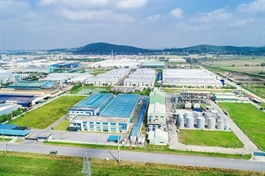
The province is also focusing on attracting investment in the Phú Thuận Industrial Park and completing and putting new industrial clusters into operation.
Progress is being accelerated on key infrastructure projects such as the Đình Khao Bridge, the coastal corridor road and road axes linking national highways.
In services, the province is supporting businesses with effectively exploiting free trade agreements, promoting digital trade and expanding export markets.
It targets exports of $4.1 billion this year.
Tourism continues to be an important economic sector, with a target of 9.8 million visitors and revenues of around VNĐ9.4 trillion ($358 million), nearly 18 per cent up from 2025.
Trần Quốc Tuấn, director of the province's Department of Industry and Trade, said to achieve growth of 17.1 per cent in industry and construction, the province is pursuing three key measures: boosting renewable energy through wind power projects, preparing clean land and site clearance to attract investment and helping firms expand export markets.
Trần Văn Lâu, secretary of the provincial Party Committee, said 2026 is a pivotal year in shaping major development directions for a new period.
The province would focus on building an efficient, effective and impactful two-tier local government system, stepping up administrative reform, removing bottlenecks for businesses, accelerating disbursement of public spending, and adopting technology to drive comprehensive digital transformation, he said.
He urged all levels and sectors to prioritise wind and renewable energy, public investment, transport infrastructure, industry, industrial zones and clusters, trade, services, tourism, exports, deep processing, mineral exploitation, and information infrastructure.
In agriculture, forestry and fisheries, the focus should be on green growth models, high-tech production and deep processing, he said.
Industry and construction must urgently implement planning for industrial parks and clusters, economic zones, seaports, and logistics across the province, he added.
In 2025, Vĩnh Long recorded many positive socio-economic results, with growth estimated at 5.84 per cent and relatively balanced development across all three sectors.
Agriculture remained stable, industry recovered, and trade, services and tourism posted solid growth.
Per capita income rose to VNĐ82.24 million ($3,127) and budget revenues to VNĐ22.45 trillion ($855 million), or 104.93 per cent of the target.
- 09:36 29/01/2026