UOB raises Việt Nam’s 2026 GDP growth forecast to 7.5 per cent
UOB raises Việt Nam’s 2026 GDP growth forecast to 7.5 per cent
In 2025, Việt Nam’s GDP grew by 8.02 per cent, beating UOB’s forecast of 7.7 per cent but still falling short of the Government’s target of 8.3–8.5 per cent.
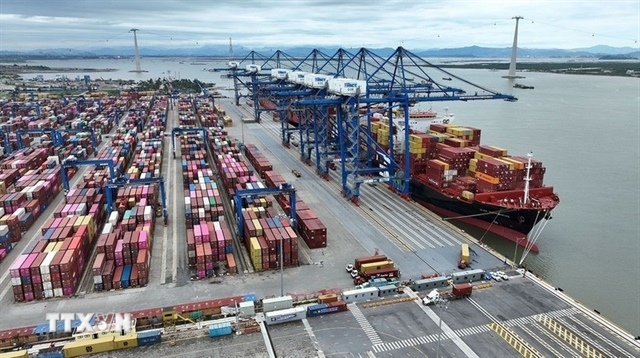
Containers at the Lạch Huyện Port in Hải Phòng. VNA/VNS Photo |
Singapore-based United Overseas Bank (UOB) has raised its forecast for Việt Nam’s GDP growth in 2026 to 7.5 per cent from a previous estimate of 7 per cent, citing the country’s stronger-than-expected economic performance in 2025.
According to UOB’s latest Việt Nam economic outlook report, the country’s real GDP expanded by 8.46 per cent year-on-year in the fourth quarter of 2025, accelerating from 8.25 per cent in the third quarter. The robust performance was largely driven by resilient export activity and steady manufacturing despite the adverse impact of US tariffs.
The fourth-quarter growth rate significantly exceeded Bloomberg’s forecast of 7.7 per cent as well as UOB’s earlier projection of 7.2 per cent, marking the fastest quarterly expansion since 2009, excluding the volatile period caused by the COVID-19 pandemic.
In 2025, Việt Nam’s GDP grew by some 8 per cent, beating UOB’s forecast of 7.7 per cent but still falling short of the Government’s target of 8.3–8.5 per cent, which would have needed an extraordinary boost in the final quarter.
Exports continued to be the main engine of growth. In the fourth quarter of 2025, export turnover rose 19 per cent year-on-year, while full-year exports increased 17 per cent, despite tariff-related headwinds. The processing and manufacturing sector also posted solid gains, expanding 11.3 per cent in the fourth quarter, compared to 10 per cent a year earlier, lifting full-year growth in the sector to 10.5 per cent.
Suan Teck Kin, Executive Director in Global Economics and Markets Research at UOB, said Việt Nam’s economy demonstrated remarkable resilience in 2025. With GDP growth reaching 8 per cent, Việt Nam enters 2026 on a strong footing, prompting the bank to upgrade its GDP growth forecast to 7.5 per cent from 7 per cent previously.
However, UOB also cautioned about several downside risks to the outlook, including a high base effect, the possibility of export growth moderating after a period of rapid expansion, and prolonged uncertainty surrounding US tariff policies.
Việt Nam is considered a highly open economy and, therefore, vulnerable to external trade shocks. Exports of goods and services currently account for around 83 per cent of GDP, the second-highest in ASEAN, after Singapore. The US remains Việt Nam’s largest export market, accounting for about 30 per cent of total exports in 2024, followed by China (15 per cent) and the Republic of Korea (6 per cent). Key export items to the US include electronics, phones and components, furniture, footwear and garments, which together made up nearly 80 per cent of Việt Nam’s exports to that market.
On the monetary policy front, the UOB expert believes that given the strong growth performance in 2025 and favourable prospects for 2026, the State Bank of Vietnam has limited room for further policy easing. Inflationary pressures persist, with average inflation in 2025 at 3.2 per cent and core inflation at 3.3 per cent, driven mainly by higher healthcare and education costs.
Exchange rate developments also warrant attention. In 2025, the Vietnamese đồng depreciated 3.1 per cent against the US dollar, the third-largest decline in Asia after the Indian rupee and Indonesian rupiah. Against this backdrop, UOB expects the central bank to keep the refinancing rate unchanged at 4.5 per cent throughout 2026 to safeguard macroeconomic stability.
- 16:04 10/01/2026