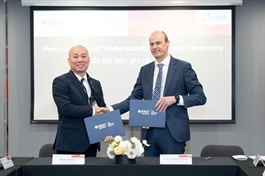
Spring Fair 2026: Trade promotion offices create multidimensional trading space
Spring Fair 2026: Trade promotion offices create multidimensional trading space
The overall success of the fair would not be possible without the proactive, early, and in-depth role played by Việt Nam’s trade promotion offices overseas.
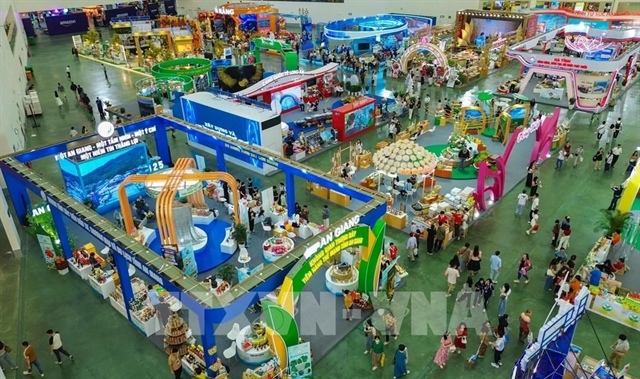
The National Spring Fair 2026 will take place at the Vietnam Exposition Center from February 2 to 8. VNA/VNS Photo |
More than the opening act of the Lunar New Year shopping season, the National Spring Fair 2026 is being positioned as a strategic meeting point where domestic and international trade promotion flows converge ahead of the Lunar New Year shopping season.
The event brings together the efforts of Việt Nam’s overseas trade promotion office network and the ambitions of domestic enterprises seeking to expand into global markets.
Scheduled for February 2–8 at the Vietnam Exposition Centre in Đông Anh, Hà Nội, the National Spring Fair 2026 goes well beyond a conventional seasonal shopping exhibition.
With its large scale, well-organised zoning and coordinated participation by ministries, sectors, local authorities and the business community, the fair is expected to generate a vibrant trading atmosphere from the first days of the year, while clearly showcasing Việt Nam’s production capacity, creativity and consumption landscape.
Notably, the fair’s success would not be possible without the proactive, early and in-depth involvement of Việt Nam’s trade promotion offices overseas.
From mid-January, these offices simultaneously launched information dissemination, promotion, matchmaking and invitations to foreign partners, identifying the fair as a key touchpoint for international businesses to directly access Việt Nam’s market, production capacity and investment environment.
From Japan, Quyền Thị Thúy Hà, head of the Việt Nam Trade Promotion Office branch in Osaka, said that immediately after official information about the fair was released, the office drew up concrete plans to invite and organise delegations of Japanese enterprises to Việt Nam to exhibit and explore cooperation opportunities.
Experience in recent years shows that trade promotion through fairs and exhibitions has become an effective channel, contributing to the stable and substantive development of Việt Nam–Japan bilateral trade.
Vietnamese goods currently account for only about three to five per cent of Japan’s total import-export turnover, indicating considerable untapped potential, according to Hà.
In particular, sectors such as processing and manufacturing, electronics, automobiles, household appliances and food products still offer ample room for Vietnamese enterprises to expand their presence.
For textiles and footwear, the effective use of free trade agreements such as the Comprehensive and Progressive Agreement for Trans-Pacific Partnership and the Regional Comprehensive Economic Partnership gives Vietnamese goods a clear advantage in rules of origin thanks to regional material sources, enhancing competitiveness in the Japanese market.
At the same time, cooperation frameworks and trade agreements involving both countries are creating spillover effects across supply chains in electronics, automotive and textile industries in Việt Nam.
RCEP partners currently supply up to 66 per cent of Việt Nam’s total import value of electronic components and parts, helping enterprises reduce input costs, lower prices and strengthen their competitive edge when exporting to Japan.
On this basis, the Việt Nam Trade Promotion Office in Osaka has been actively inviting Japanese enterprises in sectors where Việt Nam has strong demand and high cooperation potential to take part in Spring Fair 2026, opening up breakthrough opportunities for trade and investment linkages.
In the US, Đỗ Ngọc Hưng, trade counsellor and head of the Việt Nam Trade Promotion Agency in the country, said the four Việt Nam trade promotion offices there were closely coordinating to promote and invite US enterprises to attend the fair.
This is seen as a concrete effort to bring Việt Nam’s investment environment, production capacity and people closer to the US business community, while laying foundations for long-term and substantive cooperation.
The selection of participating US enterprises is being carried out with focus and selectivity, prioritising quality over quantity and concentrating on sectors with strong compatibility in demand and capability such as textiles, footwear, wood products and handicrafts, according to Hưng.
The overarching goal is to bring genuinely potential partners to Việt Nam, not merely to visit or exhibit, but to form concrete and sustainable business connections after the fair.
Alongside overseas promotion efforts, domestic enterprises also place high expectations on Spring Fair 2026.
Many see it as a vital platform to showcase production capabilities and products, seek partners and expand export markets, especially as the need to raise value added and build Vietnamese brands becomes increasingly pressing.
Đặng Thị Tươi, director of external relations at CT Group, said the group planned to introduce a series of core technologies developed in-house, ranging from unmanned aerial vehicles, semiconductors, artificial intelligence and quantum computing to solutions in new energy, green digital currency and carbon credit exchanges.
The spring fair would not be merely an exhibition space but also an opportunity for Vietnamese enterprises to affirm a shift in development mindset, from outsourcing to mastering technology, design and value chains under the hallmark of Made by Việt Nam, she said.
Sharing the same expectations, Nguyễn Bá Đoàn, sales director of the Viet Han High-Tech Manufacturing Plant, said businesses were not only looking to promote products but also hoped for concrete orders that could drive production expansion, enhance competitiveness and support the economy’s high-growth ambitions.
- 07:47 27/01/2026