Seafood exports rise sharply despite global uncertainty
Seafood exports rise sharply despite global uncertainty
Despite a challenging global environment, seafood exports topped US$11.3 billion in 2025, a 13 per cent rise from 2024 and in excess of the target, according to the Việt Nam Association of Seafood Exporters and Producers.
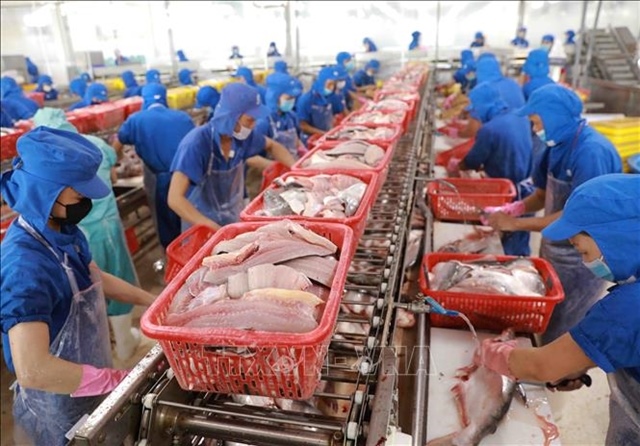
A tra fish processing plant in Đồng Tháp Province. Việt Nam’s seafood exports exceeded $11.3 billion in 2025, a 13 per cent increase from the previous year. — VNA/VNS Photo |
In terms of product structure, the sector recorded relatively balanced growth across major export categories, albeit with shrimp as usual accounting for the biggest share of $4.65 billion after an increase of 20 per cent.
Lobster exports more than doubled to $817 million.
Pangasius ranked second at $2.19 billion, an 8 per cent increase.
Other marine fishes accounted for $2.16 billion, a 12 per cent rise.
Tuna exports declined due to prolonged shortages of raw materials and increasingly stringent IUU (illegal, unreported and unregulated) fishing regulations.
Mainland China and Hong Kong (China) remained the largest markets, with combined exports rising by 29 per cent to $2.45 billion.
Exports to the US were worth $1.9 billion, a modest increase of 3 per cent, while shipments to the EU rose by 12.5 per cent to $1.2 billion.
The Comprehensive and Progressive Agreement for Trans-Pacific Partnership (CPTPP) continued to be a major growth driver.
Exports to CPTPP member countries were worth $3.07 billion, up 22 per cent, supported by steady demand in key markets such as Japan, Canada and Australia.
According to VASEP, 2025 was one of the most challenging years for the seafood industry, marked by reciprocal tariffs, anti-dumping duties, high production costs, and increasingly strict technical barriers.
But despite this, its exports posted stronger-than-expected gains, driven by three key factors.
First, global market instability increased demand for food stockpiling, increasing seafood imports by many countries.
Second, the proactiveness and flexibility of Việt Nam’s seafood businesses played a crucial role as enterprises identified tax-related and technical-barrier risks early, allowing them to adjust production and delivery plans and move to other export markets.
Third, the benefits of free trade agreements, including the EU–Việt Nam FTA, CPTPP and the Regional Comprehensive Economic Partnership, continued to materialise, helping seafood exports gain momentum in partner markets and offset declines or slower growth in several major markets.
VASEP deputy general secretary Lê Hằng said a key highlight of seafood exports in 2025 was the agility of businesses in seizing opportunities and responding to market sentiment amid uncertainties related to US tariffs and technical barriers, leading to clear adjustments in their export market structure.
In addition, after a prolonged period of sharp declines and low prices, the market entered a phase of supply shortages, pushing prices and demand higher.
Looking ahead to 2026 VASEP forecast continued volatility and uncertainty, saying US tariff, trade and technical policies could prompt exporters worldwide to remain cautious and further shift markets.
This trend is expected to intensify competition in markets such as the EU, China, ASEAN and the Middle East, according to VASEP.
Meanwhile, the IUU “yellow card” remains a key bottleneck that must be resolved to further expand access to EU markets.
- 13:54 13/01/2026