Public investment is reshaping real estate’s role in Vietnam
Public investment is reshaping real estate’s role in Vietnam
Large-scale public investment is redefining land values and investment priorities across Vietnam, reinforcing real estate’s role as a core long-term asset rather than a short-term speculative play.
|

At the seminar 'Investment Compass 2026: Capital Flow in Focus', held on January 20, economist Ngo Tri Long said real estate will continue to play a pivotal role in the economy this year, as it is regarded as a 'two-in-one' asset, serving both consumption needs and long-term investment purposes.
“Housing is a distinctive asset class that meets essential human needs while also functioning as a store of value,” Long said. “Unlike equities, which depend directly on corporate performance, or gold, which is heavily influenced by market sentiment and global macroeconomic volatility, real estate benefits from a natural demand base. As long as products are aligned with genuine needs for living and working, underlying demand will remain resilient.”
This year, public investment is set to accelerate, particularly in transport infrastructure and urban development, against the backdrop of the National Assembly’s double-digit economic growth target.
New infrastructure not only reduces travel time and costs but also enhances labour productivity and the functional value of land and housing. He said that in urban economics, this process creates land value uplift, helping to explain why capital is expected to continue flowing strongly into the real estate market.
However, Long noted that capital flows will not be evenly spread. Instead, they will increasingly gravitate towards quality, guided by new standards.
“Investors are prioritising assets that meet three core criteria: sound legal status, genuine demand and real cash flow,” he said. “While real estate remains attractive for its ability to translate infrastructure development and economic growth into tangible value, only assets that meet the benchmarks of a true financial investment merit long-term holding.”
Nguyen Van Dinh, vice chairman of the Vietnam Real Estate Association, observed that when policies to stimulate production and business activity fall short of creating a strong economic impulse, capital tends to shift towards investment channels as a means of preserving and growing asset value. Among these, real estate continues to stand out for its capacity to deliver 'dual returns', combining capital appreciation with stable income from leasing or commercial use.
He emphasised that the logic of capital markets is straightforward: money flows to where returns are most attractive. “In practice, the three traditional channels, gold, equities and real estate, remain highly appealing. Once signs of a price upswing emerge, markets quickly become active, capital pours in and price levels rise on profit expectations,” Dinh said.
Despite all being perceived as safe havens, each channel has distinct characteristics. Gold and equities offer greater liquidity and lower entry thresholds, while real estate requires a stronger financial base and the effective use of credit leverage.
From a return perspective, Dinh argued that real estate has a clear edge, as gold generates gains only when prices rise, and equity dividends are often modest compared with bank deposit rates in many periods.
As a result, real estate has long been viewed as a reliable long-term investment. Historical trends over several decades show that property values tend to move upward, particularly during 2025-2026, when rising land costs and new regulatory frameworks are exerting upward pressure on prices. This further reinforces real estate’s role as a core pillar in Vietnamese investors’ asset accumulation strategies.
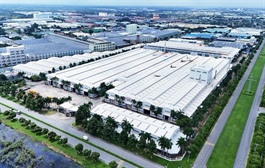
The year 2026 is also expected to mark a phase in which the property market directly benefits from legal reforms and intensified public investment. With around VND1 quadrillion ($40 billion) earmarked for infrastructure disbursement, momentum is extending beyond major cities to emerging economic regions, notably the Mekong Delta.
“The coordinated development of urban infrastructure, industrial zones and tourism services is becoming a catalyst for related real estate segments,” Dinh said.
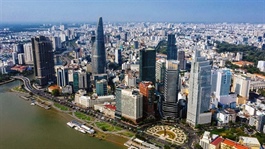
The period from late 2025 into early 2026 is also witnessing a major turning point, driven by breakthroughs in transport infrastructure, including metro lines and rail connections linking growth hubs in big cities. These developments are expanding development space and reshaping capital flows.
Tran Dinh Thien, a member of the Prime Minister’s Economic Advisory Group, cautioned that capital inflows into real estate will not be one-directional, noting that rising demand for capital will put upward pressure on interest rates. “This acts as a natural filter, restraining speculative capital due to higher financial costs and risks,” he said.
He noted that public investment is increasingly being channelled into large-scale infrastructure rather than asset speculation, helping domestic corporations integrate more deeply into value chains while generating positive spillovers for the stock market and overall economic competitiveness. “Promoting Vietnamese enterprises through key national projects is a strategic move to strengthen the foundations of sustainable growth,” Thien said.
He added that the government’s firm commitment to social housing development, with participation from more than 20 major corporations, is expected to significantly expand supply, helping to stabilise prices, ease pressure on genuine homebuyers, and reduce the risk of market overheating.
In the longer term, Thien said public investment will remain a critical macroeconomic stabilisation tool. “The core objective of injecting large volumes of capital into the economy is to keep funds within the domestic enterprise sector, enabling businesses to build internal capacity, enhance resilience, and strengthen long-term competitiveness,” he added.
- 10:04 21/01/2026