Politburo’s new resolution to reposition the State economy
Politburo’s new resolution to reposition the State economy
Its aim is to place up to three State-owned enterprises (SOEs) among the world’s 500 largest companies by 2030.
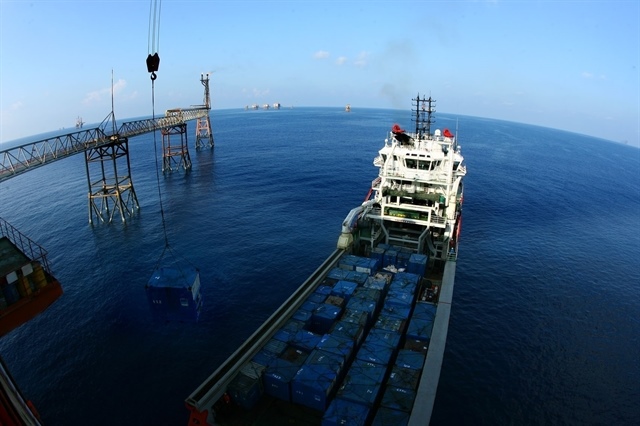
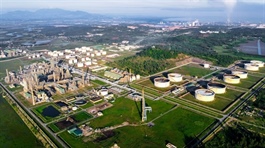
An oil field of Vietnam National Industry - Energy Group. Resolution 79-NQ/TW, dated January 6, reaffirms the State sector’s leading role in Việt Nam’s economy. — VNA/VNS Photo Huy Hùng |
Party General Secretary Tô Lâm has signed a Politburo resolution seeking to reposition the State sector as a driving force in Việt Nam’s next chapter of growth.
Its aim is to place up to three State-owned enterprises (SOEs) among the world’s 500 largest companies by 2030.
Resolution 79-NQ/TW, dated January 6, reaffirms the State sector’s leading role in Việt Nam’s economy in maintaining macroeconomic stability, safeguarding major economic balances, and ensuring national defence and security.
However, the resolution stresses that the sector is equal before the law with other economic sectors and is expected to compete and cooperate on a fair and transparent basis, with equitable access to resources, markets, and development opportunities.
It urges the sector to take the lead in industrialisation and modernisation, economic restructuring, and shaping a new growth model driven by science and technology, innovation, and digital transformation to enhance national competitiveness.
A key focus is the restructuring of SOEs to improve efficiency and governance in line with international standards.
By 2030, Việt Nam aims to have 50 SOEs among Southeast Asia’s 500 largest firms and one to three in the global top 500.
All SOEs are expected to adopt modern, digital-based governance systems, while all State economic groups and corporations must apply OECD corporate governance principles.
The resolution also targets the development of large State-owned economic groups and commercial banks capable of competing regionally and globally, with at least three State-owned commercial banks ranking among Asia’s 100 largest by total assets.
By 2045, Việt Nam aims to place around 60 SOEs among Southeast Asia’s 500 largest companies and five within the world’s top 500.
The resolution envisions the State economy becoming a solid foundation for strategic autonomy, resilience and the overall competitiveness of the economy, underpinned by modern, transparent and efficient governance, strong competitiveness, and deep integration into the global economy.
Solutions

An oil field of Vietnam National Industry - Energy Group. Resolution 79-NQ/TW, dated January 6, reaffirms the State sector’s leading role in Việt Nam’s economy. — VNA/VNS Photo Huy Hùng |
After four decades of Đổi Mới (Renewal), the State sector has been seen slow to evolve with below-expectation efficiency in the management and use of resources, leading to significant waste and losses.
The shortcomings stem mainly from the lack of understanding of the role of the State economy, an inconsistent legal framework, weak enforcement discipline, limited corporate governance capacity and insufficient accountability.
As Việt Nam targets becoming a developing country with modern industry and upper-middle income status by 2030, and a high-income developed nation by 2045, the State economy is expected to further take its pioneering and leading role, the resolution stressed.
To achieve the goal, the Politburo called for renewed leadership thinking, a more transparent and coherent legal framework, and the removal of institutional bottlenecks.
The resolution stresses that the Government will ensure a level playing field for all economic sectors in accessing and using national resources, while promoting public-private partnerships.
The Politburo also asked for efforts to be enhanced to complete national databases, strengthen oversight of State capital and assets, eliminate overlapping inspections, strictly handle violations, recover lost assets and accelerate the resolution of inefficient projects to unlock resources.
The State Capital Investment Corporation (SCIC) will be restructured towards professional capital investment, with a long-term goal of forming a national investment fund.
Meanwhile, the Việt Nam Asset Management Company (VAMC) and the Việt Nam Debt and Asset Trading Corporation (DATC) will have their capacities strengthened to support the market-based restructuring of SOEs and State-owned commercial banks.
New position for new development phase
Resolution 79 is issued timely to respond to the urgent need to reposition the role of the State economy in the country’s new development phase in the changing global landscape marked by intensifying strategic competition, supply chain disruptions, energy transition, digital transformation and growing demands for green and sustainable development, Phạm Anh Tuấn, Deputy Director of Vietnam Institute of Economics, said.
“Resolution 79-NQ/TW represents a new step forward, repositioning the State economy as a critical anchor of the national economy amid heightened volatility,” Tuấn said, adding that the resolution provides a comprehensive long-term framework for the development of the State economy.
Beyond reaffirming the sector’s leading role, the resolution sets out concrete goals and benchmarks, which reflects a significant shift in thinking, he stressed.
To translating resolution into practice, Tuấn stressed three factors, including rapid and clear institutionalisation with a defined roadmap, a shift in governance mechanisms towards market principles and stronger accountability, and the concentration of resources on truly strategic sectors while creating space for private sector development.
According to a 2026 outlook by MB Securities (MBS), SOEs currently account for roughly 29 per cent of GDP and maintain leading positions in terms of total assets, revenue and market share.
The MBS analysis expects Resolution 79 to provide a boost comparable to that of Resolution 68 on private-sector development. “If bottlenecks are removed and resources are unlocked, SOEs will accelerate in the period ahead,” the report said.
The Ministry of Finance showed that as of the end of 2024, total assets held by 671 SOEs, including 473 fully State-owned and 198 in which the State holds more than 50 per cent, exceeded VNĐ5.6 quadrillion (US$213 billion) up 45 per cent year-on-year.
SOEs recorded total revenue of nearly VNĐ3.3 quadrillion in 2024, an increase of 24 per cent, while pre-tax profit reached about VNĐ227.5 trillion, up 8 per cent. Contributions to the State budget amounted to nearly VNĐ400 trillion, up 9 per cent.
- 03:14 12/01/2026