Green policy to push major changes in construction materials
Green policy to push major changes in construction materials
Despite clear momentum, the green transition in construction materials still faces obstacles. High investment costs for technology, research and international certification remain a major barrier, while domestic standards are not yet unified.
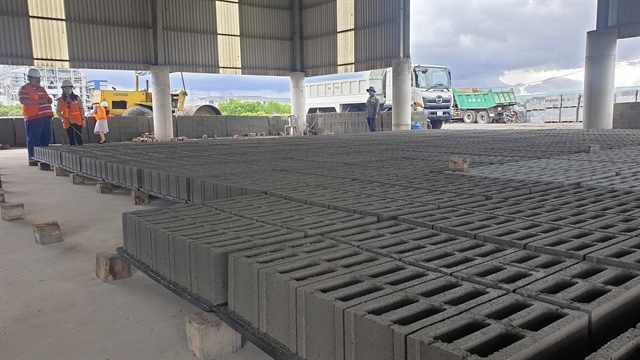
Unbaked tiles made from fly ash, a product created by Duyên Hải DGM Green Materials Company Limited. — VNA/VNS Photo Thanh Hòa |
Since January 1, Việt Nam now requires energy labelling for certain groups of construction materials, a policy that is expected to drive major changes in the construction materials industry.
Under the amended Law on Economical and Efficient Use of Energy, businesses are encouraged to restructure production, reduce emissions and shift towards greener, more sustainable models, according to industry insiders.
Experts say energy labelling will focus on materials that directly affect a building’s energy consumption. These include building envelope materials like construction glass and thermal and sound insulation, as well as products that require large amounts of energy during manufacturing, including cement, bricks and finishing materials.
Energy labels clearly show how efficiently a material uses energy, making it easier for investors, design consultants and consumers to compare products from the early design stage. Over time, factors such as energy efficiency, CO2 emissions and long-term operating costs are expected to play a larger role in purchasing decisions, rather than price alone.
At the macro level, the policy is seen as an important step in the green transition of the construction sector, which currently accounts for a significant share of national emissions. Energy labelling is expected to put pressure on businesses to upgrade technology, improve production processes and reduce fuel use.
Nguyễn Thị Tâm, director of the Centre for Equipment, Environment and Occupational Safety at the Institute for Building Materials under the Ministry of Construction, said energy labelling would improve transparency while supporting national energy-saving goals. Standardised data on the thermal performance of materials will help designers and users select products suited to specific purposes, thus reducing electricity demand for cooling and ventilation, she noted.
Preparation
Even before the regulation took effect, several major companies had already adjusted their strategies and invested in green, low-emissions materials.
Saint-Gobain Việt Nam General Director Nguyễn Trường Hải said the company aims to develop the first carbon-neutral construction materials factory in Việt Nam and Southeast Asia. Saint-Gobain has committed to cutting CO2 emissions by 33 per cent by 2030 and achieving carbon neutrality across its operations by 2050.
INSEE Việt Nam has also expanded its range of green cement products certified by the Singapore Green Building Council, which also hold international Environmental Product Declarations. According to Nguyễn Thanh Dũng, head of Sustainable Construction at INSEE Việt Nam, these products emit 17–51 per cent less CO2 than traditional cement. However, high costs, certification requirements and limited market awareness remain key challenges.
In the finishing materials segment, Thắng Cường JSC General Director Lê Văn Phương said the company invested in advanced production lines featuring energy-saving kilns, heat recovery systems and automated controls. These upgrades have helped cut CO2 emissions by 15–20 per cent. The company views green standards as a long-term competitive advantage and aims to reach internal net zero emissions by 2035.
Thái Duy Sâm, vice chairman and secretary general of the Việt Nam Building Materials Association, said domestic consumption is the biggest bottleneck. Higher prices and limited consumer awareness mean green materials are mainly used in large projects and have yet to spread widely in the mass market.
Experts agree that stronger leadership is essential to achieve the net-zero target by 2050. Proposals include moving from voluntary to mandatory carbon disclosure for construction materials, especially for high-rise buildings and publicly funded projects, along with tax and credit incentives for businesses investing in emissions-reduction technologies.
- 07:00 20/01/2026