Double-digit GDP growth within reach with shift to higher-value expansion
Double-digit GDP growth within reach with shift to higher-value expansion
Vietnam has a credible basis to pursue double-digit GDP growth, but sustaining that pace will hinge on rethinking the drivers of expansion. Hoang Van Cuong, a member of the PM Policy Advisory Council, assesses the export model, reliance on foreign investment, and the shift needed towards higher value-added growth.
|

Exports have outperformed expectations and reached GDP growth targets early. How do you assess this achievement in terms of sustainability and risk?
In 2024, Vietnam’s total import-export value exceeded $786 billion, up 15.4 per cent on-year, with exports reaching $406 billion, up 14.3 per cent – an unprecedented achievement. However, this record was quickly broken.
According to data from Vietnam Customs, as of December 15, the country’s total import-export value had reached $883.7 billion, including $451.2 billion in exports – surpassing the entire 2024 figure and rising nearly 17 per cent on-year. This exceeded the target set to secure 8 per cent GDP growth, which required export growth of more than 12 per cent.
Export turnover has risen year after year over a prolonged period, with the sole exception of 2023. This sustained growth highlights Vietnam’s strengthening position and credibility in global export markets.
Vietnam has become a critically important link in the global production and trade chain. However, an economy that relies too heavily on exports faces potential risks in the future when export growth inevitably slows.
Foreign-invested enterprises (FIEs) generate nearly three-quarters of export turnover. Is this dependence a structural weakness or a transitional phase?
This is a real challenge that requires addressing multiple issues.
First, like other developing economies, Vietnam has a strong demand for foreign capital and has worked to create the most attractive possible investment and business environment to draw in investment, including facilitating exports by the foreign direct investment (FDI) sector through the signing of and participation in 20 free trade agreements.
Second, the share of exports by domestic enterprises must be increased to reduce the proportion of FDI exports in total export turnover.
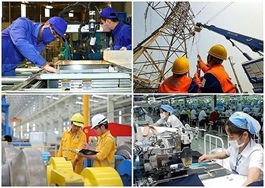
Third, rising exports from the FDI sector are very welcome, as they make an important contribution to Vietnam’s economy. However, the problem is that the value-added content of goods produced in Vietnam by FIEs remains low.
More precisely, Vietnam has largely served as a base for processing, assembly, packaging, and testing. Most of the raw materials, equipment, and machinery used to produce export commodities by FIEs are imported.
The only way to address this challenge is to develop supporting industries and proactively secure sources of materials and components to supply FIEs.
When supporting industries develop, the value added of goods produced in Vietnam by the FDI sector increases. In that case, rising exports also mean rising exports of domestically produced content.
Moreover, when Vietnamese firms participate deeply in global production chains, foreign businesses are more likely to commit to long-term investment in Vietnam, as their dependence on imported inputs is reduced and the risk of supply-chain disruptions is minimised.
By contrast, if activities are limited to processing and assembly, FIEs can leave at any time if other locations in the world offer more attractive investment conditions – especially lower labour costs.
If export growth slows, can the country still aim for double-digit GDP growth by focusing on higher value-added exports and expanding the trade surplus?
Export strategy needs to shift from chasing high growth rates to maximising the value added by exports produced in Vietnam.
GDP can be measured in several ways, but a widely used approach defines it as the sum of final consumption by households and government, gross capital formation, and the trade balance.
Under this framework, when exports and imports rise in tandem and the trade surplus remains modest, exports make only a limited contribution to overall GDP growth.
For example, as of December 15, Vietnam’s trade balance recorded a surplus of $18.64 billion, while imports reached $432.54 billion, up 19.4 per cent on-year. If import turnover – particularly raw materials and fuels, which account for 41 per cent – could be reduced, the trade surplus could increase by several tens of billions of dollars, significantly boosting GDP growth.
Therefore, shifting the focus from quantity to quality in exports is essential. Even if export turnover grows more slowly, or does not grow at all, an increase in the value-added content produced in Vietnam combined with a large trade surplus would allow exports to make a substantial contribution to GDP growth.
How can Vietnam enhance the value and competitiveness of its exports in the years ahead?
Textiles and footwear, for example, make a major contribution to the country’s export turnover. However, if Vietnam limits itself to producing basic apparel, hats, and standard footwear, its export competitiveness will continue to erode, as domestic labour costs have been on the rise.
Therefore, instead of mass-market products, firms should focus on goods made from silk, lotus fibre, and other natural fabrics that are environmentally friendly, higher in value, and better aligned with consumption trends in developed markets.
Encouragingly, Resolution No.68-NQ/TW requires the government to promptly develop and refine the legal framework as well as introduce innovative policies that encourage investment in R&D.
It allows enterprises to allocate up to 20 per cent of taxable corporate income to establish funds for science and technology development, innovation, digital transformation, and R&D.
Meanwhile, Resolution No.57-NQ/TW on breakthroughs in the development of sci-tech, innovation, and national digital transformation sets out a series of incentive and preferential mechanisms for R&D activities.
It firmly mandates R&D expenditure at 2 per cent of GDP, allocates at least 3 per cent of total annual state budget spending to sci-tech development, innovation, and national digital transformation, and calls for a gradual increase in line with development needs.
As Vietnam enters a new era with aspirations to rise, prosper, and achieve greater national strength – expressed through setting a double-digit GDP growth target in 2026 and beyond – the country has sufficient grounds to prioritise economic expansion, provided that macroeconomic stability is maintained, inflation is kept under control, and the major balances of the economy are safeguarded.
- 08:33 06/01/2026