Việt Nam's forest credits gain investor interest
Việt Nam's forest credits gain investor interest
Several organisations, including the LEAF Coalition, Amazon and Eni, have expressed interest in Việt Nam's forest credits.
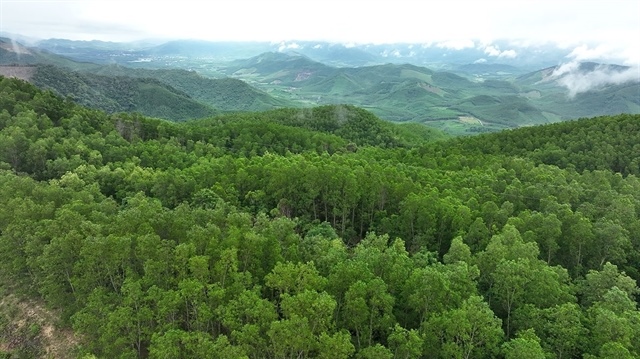
The area of large timber plantations in Vân Canh Commune, Gia Lai Province. — VNA/VNS Photo |
Việt Nam is accelerating efforts to develop a structured market for forest carbon credits as new technical studies, international experience and buyer-side assessments point to significant commercial potential for high-quality forestry-based emission reductions.
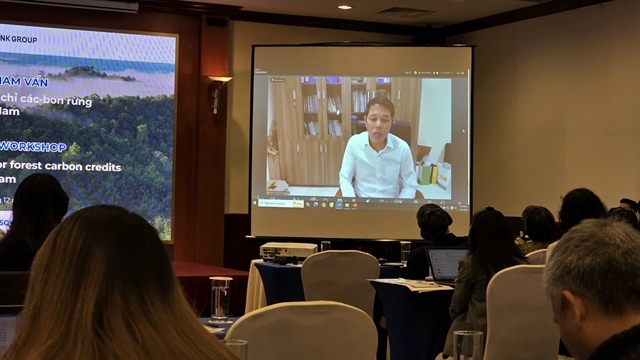
At the consultation workshop held in Hà Nội earlier this month, stakeholders from ministries, provincial authorities, development partners and international experts reviewed findings from a World Bank-funded technical assistance programme assessing the legal and commercial outlook for Việt Nam's forest carbon credits.
The programme is implemented by a consortium led by the Vietnam Energy and Environment Consultancy (VNEEC) in collaboration with South Pole.
Under the North Central Region Emission Reductions Payment Agreement (ERPA), Việt Nam generated 16.2 million tonnes of carbon dioxide (CO₂) equivalent from 2018-19, independently verified by Aster Global. Of this volume, 10.3 million tonnes have already been transacted and the Government has authorised a further 1 million tonnes for transfer under Resolution 261/NQ-CP, leaving approximately 4.9 million tonnes available for potential use.
Meanwhile, the Central Highlands and South Central Coast emission reduction programmes are expected to deliver about 20 million tonnes of CO₂ equivalent between 2021 and 2025, including 5.15 million tonnes designated for transfer to Emergent.
Speaking at the workshop, Roxanne Tan, international carbon market expert at South Pole, said that buyers across compliance and voluntary markets had shown interest in Việt Nam's forestry credits, though marketability would be strongly influenced by credit vintage and alignment with international mechanisms.
A survey conducted over two weeks in October among potential buyers found that 25 per cent of contacted organisations responded.
"Buyers are positive about the Việt Nam carbon market. They are moderately to highly interested," Tan said, adding that forestry credits from Việt Nam could attract demand provided they satisfy standard-specific requirements and regulatory assurances.
The survey also showed that buyers prefer transactions in the range of 100,000-500,000 tonnes and often refrain from disclosing price expectations due to commercial confidentiality. The most frequently cited transaction range was between US$5-15 per tonne.
Internationally recognised standards such as Verra's VCS, ART TREES and the Gold Standard were identified as the most preferred for forestry credits, while afforestation and reforestation activities were viewed favourably by many respondents.
Tan also highlighted the importance of regulatory clarity when Việt Nam considers the international transfer of mitigation outcomes.
She emphasised that transaction pathways under Article 6 would depend heavily on predictable authorisation procedures and alignment with host-country requirements.
"Buyers generally prefer projects that complete carbon certification and secure the Article 6 Letter of Authorisation before finalising a purchase agreement," she said, pointing to the role of Letters of Authorisation as a condition precedent in many contracts.
Market assessments presented at the workshop compared the compatibility of Việt Nam's current and future forestry credits with key market segments, including ITMO trading for NDC purposes, the Carbon Offsetting and Reduction Scheme for International Aviation (CORSIA), the domestic emissions trading system (ETS) and the voluntary market.
Credits from the ERPA's 2018-19 vintage do not meet the validity requirements for domestic compliance and Article 6 mechanisms but remain eligible for the voluntary market where regulations are more flexible despite increasingly stringent expectations.
Several organisations including the LEAF Coalition, Amazon and Eni have expressed interest in Việt Nam's forest credits. The study also found that seven out of 15 survey respondents indicated interest in further discussions with the Government.
The area of large timber plantations in Vân Canh Commune, Gia Lai Province. — VNA/VNS Photo |
Việt Nam is also developing a national technical standard for forest carbon credits, which sets detailed requirements for project eligibility, carbon accounting, validation and verification, according to Vũ Tấn Phương, director of the Vietnam Forest Certification Office (VFCO).
The draft standard, prepared by the VFCO, draws on international methodologies such as VCS, ART, ACR and ISO guidelines and specifies criteria for REDD+, afforestation and reforestation, improved forest management and agroforestry.
The standard addresses carbon pools, emission factors, leakage, reversals, uncertainty analysis and environmental and social safeguards.
The technical assistance identified several challenges hindering market readiness, including legal and institutional gaps, infrastructure needs and implementation capacity.
Recommendations include finalising key decrees on international carbon credit transfers, domestic carbon exchanges and forest carbon sequestration services; operationalising the national registry and Measurement Reporting and Verification (MRV) systems; and expanding training for provincial authorities and forest owners to strengthen project development and safeguard compliance.
Despite these challenges, experts emphasised that Việt Nam's upcoming credit supply, particularly from programmes generating post-2021 vintages, is better positioned for mechanisms under Article 6.2 and CORSIA when supported by proper authorisation and standard alignment.
Nguyễn Hồng Loan, director of Green Climate Innovation Company Limited (GreenCIC), also noted substantial price differentials across market types: domestic transactions are projected at $2-3.7 per tonne, Article 6 transfers between $20-47, CORSIA transactions around $21-22 and voluntary REDD+ at approximately $6 for older vintages.
Forest carbon credits are increasingly recognised as a financial resource supporting forest protection, restoration and livelihood improvement for local communities.
As Việt Nam continues to shape its carbon market architecture, the convergence of legal reforms, technical standardisation and growing interest from international buyers is setting the stage for broader participation in both domestic and global markets.
- 17:07 16/12/2025