Việt Nam aims to build its own railway industry with $100 billion push
Việt Nam aims to build its own railway industry with $100 billion push
New rules let local companies compete for massive train and track contracts
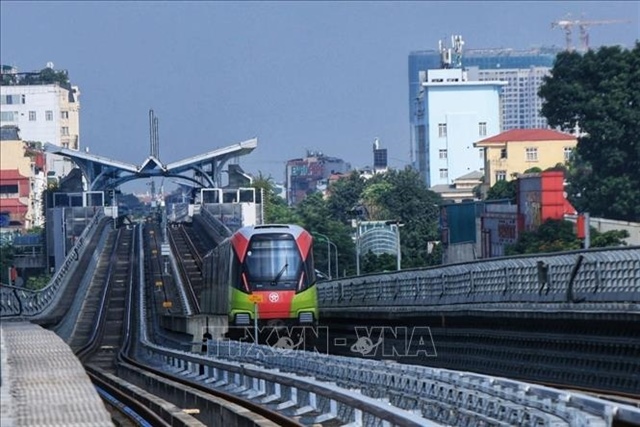
A train runs on the elevated section of the Nhổn–Hà Nội urban railway line in Hà Nội. — VNA/VNS Photo |
Việt Nam is betting that a new Government decree will help it build its own trains and railway equipment instead of relying on foreign suppliers, opening the door for local companies to compete for major contracts in a US$100 billion infrastructure boom.
Decree 319/2025/NĐ-CP, issued on December 12, sets clear rules for which Vietnamese firms can receive technology and manufacturing contracts for the nation's biggest rail projects. It's a major shift from the old approach of relying almost entirely on foreign contractors.
The opportunity is enormous.
Việt Nam plans to spend up to $64 billion over the next 20 years building a high-speed rail line from north to south. Technology and equipment – trains, carriages, signals and tracks – will account for up to 40 per cent of that cost. Including urban rail projects in Hà Nội, HCM City and other cities, the total value tops an estimated $100 billion through 2050.
Nguyễn Minh Thảo, deputy head of the Department for Business Development and Business Environment at the Ministry of Finance's Strategy and Policy Institute, said the new approach enables domestic firms to directly join major projects and gradually master technology rather than only performing low-value work.
"More importantly, Decree 319 has opened opportunities for domestic private enterprises to compete equally with State-owned enterprises and FDI companies, creating a ripple effect for the railway industry in the long term," Thảo said.
What companies need to qualify
Companies must have real factories and facilities ready to receive and install production equipment. They need money – either their own or the ability to borrow it – to pay for technology transfers. Most importantly, they must have skilled engineers and workers who can actually run advanced equipment without foreign help.
Firms also need proven experience working with international partners on technology projects. This requirement is meant to reduce risks when bringing in sophisticated systems. Enterprises going bankrupt or losing their business licences are automatically phased out.
By 2050, Việt Nam aims to build 25 railway lines covering 6,354 kilometres. That means the country will need 28.7 million metres of rail, 46 million concrete sleepers and thousands of locomotives and train cars in the next few decades.
Prime Minister Phạm Minh Chính said in April that Việt Nam must be able to make its own trains and railway equipment by 2045 at the latest.
"You can't build a modern railway system just by buying everything from abroad," Vietnam Association of Mechanical Industries Chairman Nguyễn Chí Sang told chinhphu.vn.
"Developing our own industry could cut project costs by 10-20 per cent and create hundreds of thousands of skilled jobs."
A train runs on the elevated section of the Nhổn–Hà Nội urban railway line in Hà Nội. — VNA/VNS Photo |
Several major Vietnamese companies already meet these strict requirements. Hoa Phat Group, Southeast Asia's biggest steelmaker, will start building a railway steel factory on December 19 at the Dung Quất Economic Zone in Quảng Ngãi Province.
The $395 million plant will produce 700,000 tonnes of specialised steel rails per year using advanced European equipment.
Making steel rails in Việt Nam instead of importing them could reduce costs by 15-20 per cent, representing significant savings when the country needs thousands of kilometres of track.
Other companies that could participate include Thaco for manufacturing train cars, Viettel and EVN for electrical and signal systems, and Lilama for heavy engineering work.
“Without these new rules, Vietnamese companies would stay stuck doing minor work while foreign firms handle the important stuff,” Thảo said.
- 10:06 19/12/2025