Sharp market swings put investor protection mechanisms in focus
Sharp market swings put investor protection mechanisms in focus
Since mid-October, the market has exhibited increasingly negative behaviour, with the index repeatedly losing ground and logging its strongest downward move since October 20.

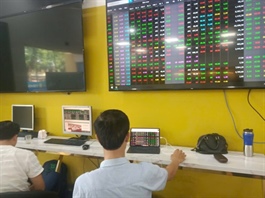
Investors watching stock movements on a computer screen. VNA/VNS Photo |
As Việt Nam's stock market transitioned from a long recovery phase into a period marked by sharp gains followed by abrupt declines, market participants and regulators are highlighting the urgent need for mechanisms that can protect investors and strengthen the resilience of the financial system.
The market's benchmark VN-Index made significant progress through much of 2025, breaking new highs and repeatedly setting records for trading value and liquidity.
Yet since mid-October, the market has exhibited increasingly negative behaviour, with the index repeatedly losing ground and logging its strongest downward move since October 20.
This shift was reflected not only in price action but also in declining liquidity, with average daily matched trading value around VNĐ20.3 trillion (US$771.4 million) during the week of December 8-12, down 15 per cent from the previous week and near six-month lows on the HoSE.
Investors and analysts cite multiple factors driving the recent volatility.
According to Nguyễn Thế Minh, head of the Research and Development Division at Yuanta Vietnam Securities, higher short-term deposit rates offered by commercial banks have attracted capital away from equities, sapping risk appetite.
Banks, including Vietnam International Commercial Joint Stock Bank (VIB), Sacombank, Nam A Bank and Orient Commercial Joint Stock Bank (OCB), are offering rates close to the regulatory cap of 4.75 per cent per annum for deposits under six months, following a series of rate hikes by 14 banks in late November.
This dynamic has fuelled concerns about tighter monetary conditions, which can weigh on equity valuations.
Hồ Sỹ Hoà, head of Research and Investment Advisory at DNSE Securities, added that credit growth, running at roughly 15 per cent compared with an 11 per cent increase in deposits, has placed additional pressure on interest rates.
He also noted that large IPOs in recent months have temporarily locked up substantial retail capital.
For example, a major IPO in VPS attracted over 19,000 investor accounts, with retail participation exceeding 98 per cent, syphoning liquidity from secondary market trading.
Regulators acknowledge that this environment of high liquidity with high volatility is influenced by market structure.
Bùi Hoàng Hải, vice chairman of the State Securities Commission of Vietnam (SSC), observed that individual investors dominate the market, accounting for approximately 85–95 per cent of trading value.
"Strong volatility leads the market to be perceived as high risk," he said, noting that markets with higher risk profiles often face higher capital costs relative to markets with lower volatility.
He emphasised the need to rebalance the investor base toward more professional institutions.
One of the key solutions is the Central Counterparty (CCP) mechanism, slated for implementation in the first quarter of 2027. A CCP interposes itself between buyers and sellers in matched trades, becoming the counterparty to both sides.
This structure ensures that even if one party defaults, the CCP guarantees settlement via guarantee funds and other safety measures.
According to Hải, only when the CCP mechanism is fully operational can we control systemic risk and limit the spread of risk across the stock market.
The introduction of CCP is already enshrined in Việt Nam's legal framework through the 2019 Securities Law and its amendments, and the Vietnam Securities Depository and Clearing Corporation (VSDC) is preparing the necessary legal entity and risk-management systems.
Nguyễn Sơn, Chairman of VSDC, highlighted that risk-mitigation tools must be designed to reflect Việt Nam's specific conditions, including exchange rate volatility.
Beyond the CCP, the report also pointed out broader gaps in risk-management infrastructure. Hedging instruments remain underdeveloped in Việt Nam's derivatives market, which currently offers only two basic products: VN30 index futures and government bond futures.
Additional products that allow investors to manage downside risk through short positions or alternative hedging strategies are not yet available, limiting investors' ability to protect portfolios in volatile conditions.
The market's recent pattern, rapid rises followed by sharp corrections, underscores the need for more robust institutional and product infrastructure.
While the market has shown resilience in 2025, the absence of widely accessible hedging tools, limited professional investor participation and structural liquidity traps have contributed to pronounced volatility.
- 09:57 22/12/2025