Green transition emerges as new engine of growth
Green transition emerges as new engine of growth
Green transition is no longer an option; rather, it has become a top strategic priority for businesses, especially as Việt Nam has committed to achieving net-zero emissions by 2050.
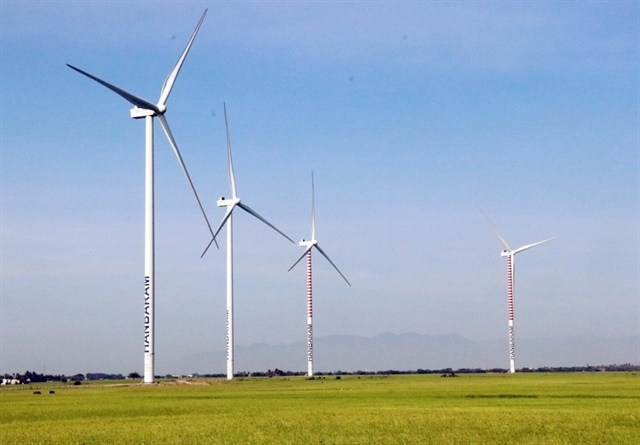
Wind turbines of the Hanbaram wind power project in Khánh Hoà province. — VNA/VNS Photo |
At present, domestic enterprises are facing great pressure from international regulations such as the European Union (EU)’s Carbon Border Adjustment Mechanism (CBAM) and environmental, social and governance (ESG) standards. Given this, strong State support through appropriate policies are required to accompany businesses in accelerating an efficient green transition, thereby turning challenges into opportunities, promoting a green economy, and creating momentum for sustainable growth.
Dual benefits of green transition
Green transition refers to the process of shifting the economy towards environmental sustainability, less greenhouse gas emissions, and efficient use of resources. This transition delivers multi-dimensional benefits and long-term strategic value for enterprises, particularly in enhancing their competitiveness in international markets.
The Việt Nam Chamber of Commerce and Industry (VCCI) said adopting green transition generates dual impacts. First, it helps businesses cut carbon emissions by 15–25 per cent through investments in renewable energy while saving 20–30 per cent in annual energy costs. At the same time, it boosts access to broader international markets and enhances brand reputation and export value as “green” products are always prioritised under free trade agreements such as the Comprehensive and Progressive Agreement for Trans-Pacific Partnership (CPTPP) and the EU-Việt Nam Free Trade Agreement (EVFTA).
The benefits of green transition are evident, yet the process in Việt Nam still faces numerous problems, causing many businesses to hesitate. High investment costs are identified as the biggest barrier, particularly for small- and medium-sized enterprises (SMEs). Installing renewable energy systems or waste treatment technologies may require millions of US dollars while short-term returns remain uncertain.
A shortage of high-quality human resources and advanced, modern technologies is also a major bottleneck hindering businesses on their path toward “greening”.
According to a recent survey by VCCI, only about 30 per cent of asked enterprises have staff with professional knowledge of ESG, leading to “greenwashing” or delays in “green compliance”. Moreover, the legal framework has yet to fully align with international standards, resulting in overlapping procedures and legal risks that make businesses cautious about investing.
To reaffirm the commitment to green development and support businesses in the green transition, the Party and the State have issued a number of important policy guidelines. These include the National Green Growth Strategy for the 2021–30 period with a vision to 2050, the National Action Plan on Green Growth for 2021–30, and the scheme for developing a circular economy, among others.
However, VCCI Deputy Secretary General Đậu Anh Tuấn noted that administrative burdens, informal costs, and inconsistency in law enforcement still create great pressures on businesses during the green transition process. SMEs, in particular, are facing difficulties in accessing green finance and technical advice.
Therefore, he added, the Government needs to take more concrete and decisive actions to remove institutional bottlenecks related to policy implementation, green competitiveness, and the ability to attract high-value investment. Besides, it should continue to accelerate administrative procedure reforms in key areas such as investment, land, environment, and construction.
Promoting investment in and the development of green enterprises, as well as building an efficient green finance ecosystem, is also a prerequisite for advancing green transition in Việt Nam, Tuấn suggested.
Close coordination between the State and the business community needed
To speed up green transition among businesses, VCCI President Hồ Sỹ Hùng recommended close coordination between the State and the business community, with concrete and feasible solutions to remove bottlenecks in the digital era.
Businesses need a stable, transparent, predictable, and consistently enforced legal framework across different stages and localities, in line with the Politburo’s Resolution No. 66-NQ/TW, dated April 30, 2025, on law making and enforcement.
At the same time, breakthroughs are required in mechanisms for the energy sector by devising solutions to remove barriers linked with the “financial viability” of large-scale power projects such as LNG and offshore wind ones. It is also essential to address the “shortage” of high-quality human resources with digital skills, in accordance with the Politburo's Resolution No. 71-NQ/TW, dated August 22, 2025, on breakthroughs in education and training development, Hùung stated.
In addition, businesses also need to take proactive steps such as building green strategies, integrating ESG standards into their entire value chains, allocating resources for efficient energy use and circular water treatment, improving manpower quality, and taking part in the carbon market and green supply chains. These will help them turn challenges into advantages, demonstrating their pioneering role in a low-carbon economy.
Green growth and sustainable development are not an easy path, but they promise many “sweet fruits” commensurate with businesses’ efforts. With its important geopolitical and economic position, Việt Nam is believed to hold great opportunities to transform, leapfrog development, and create strong momentum for economic, social, and environmental progress.
- 07:00 23/12/2025