Fisheries take the lead in the Mekong Delta’s green transition
Fisheries take the lead in the Mekong Delta’s green transition
Across the Mekong Delta, leading aquaculture producers, processors and exporters, along with suppliers of inputs, are transitioning to circular, high-tech and clean production models that cut greenhouse gas emissions and comply with international certification standards.
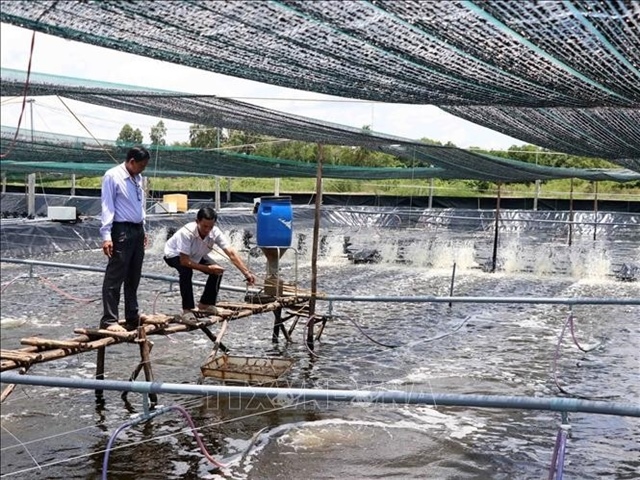
An ultra-intensive shrimp farming model linked with environmental protection in Cà Mau province. — VNA/VNS Photo |
As Việt Nam accelerates its shift towards a more sustainable agricultural model, the fisheries sector has been designated a frontrunner in advancing the green transition and circular economy, particularly in the Mekong Delta, the nation’s largest aquaculture heartland, accounting for 70-74 per cent of total aquaculture area and output.
Businesses, farmers shift towards green, circular production
Against the backdrop of rapid aquaculture growth, the need for production models that balance high productivity with environmental protection has become increasingly pressing. Experts underline that sustainable development requires the sector to move away from resource-intensive methods towards a circular economy supported by high technology and greener value chains, encompassing circular farming systems, clean energy adoption, emissions reduction, and more efficient use of water and natural resources.
The Việt Nam Association of Seafood Exporters and Producers (VASEP) noted that green and circular transformation has become a dominant trend across the industry. Many enterprises are investing in circular production and sustainable aquaculture models to meet increasingly stringent environmental standards imposed by trading partners and import markets, in line with international requirements on environmental protection, trade and disease prevention.
Across the Mekong Delta, leading aquaculture producers, processors and exporters, along with suppliers of inputs, are transitioning to circular, high-tech and clean production models that cut greenhouse gas emissions and comply with international certification standards. Notable practices include shrimp–mangrove integrated farming, ecological aquaculture without chemicals or antibiotics, and zero-discharge circular systems, which have helped boost productivity and product quality while gaining strong acceptance in both domestic and overseas markets.
Dutch feed producer De Heus is working with local partners to roll out a recirculating aquaculture system combined with integrated multi-trophic aquaculture (RAS-IMTA) in Cà Mau province, initially covering 100 hectares with plans to expand to 1,500 ha. The company has pledged to support the shift towards green, circular and environmentally responsible aquaculture in line with Việt Nam’s Net Zero 2050 target, while helping shrimp farmers improve efficiency, meet export standards, reduce emissions and protect the environment.
Alongside resource-strong enterprises, many farmers have also proactively joined pilot circular farming projects, supported by local agricultural authorities, donors and business partnerships.
Đặng Thị Loan’s family in Vĩnh Hậu commune, Cà Mau province, is among the first households to participate in a circular aquaculture model combined with mangrove restoration, jointly implemented by the International Union for Conservation of Nature (IUCN) and the Coca-Cola Foundation. Farming shrimp and crabs on more than 1.5 hectares under a recirculating pond system, Loan said that after a year of piloting, technical guidance and ecosystem restoration have helped improve growth and quality, while mangrove forests provide natural shelter, reducing losses.
Advancing green aquaculture in the Mekong Delta
Digital transformation, coupled with green transition and circular production, has become a mandatory pathway across economic sectors. For fisheries, this translates into promoting green aquaculture and processing practices that safeguard the environment, enhance livelihoods, and improve the quality, value and branding of Vietnamese seafood products to ensure long-term sustainability.
National strategic directions for sustainable agricultural and fisheries development are outlined in resolutions of the Party Central Committee (11th and 12th tenures) on proactive climate change adaptation, strengthened resource management and environmental protection, as well as the National Climate Change Adaptation Plan for 2021–2030 with a vision to 2050.
Sustainable aquaculture development is also emphasised in the Government’s Resolution 46/NQ-CP on accelerating agricultural industrialisation and promoting green, climate-resilient agriculture, environmental protection and national food security. These orientations are further detailed in the master plan on sustainable aquaculture development in the Mekong Delta to 2030, issued by the Ministry of Agriculture and Environment.
Dr. Phạm Trọng Thịnh, a climate change expert at IUCN, said that building on national strategic frameworks, Việt Nam needs to further strengthen resilience and adaptive capacity, reduce disaster risks and climate impacts, while improving institutions and policies, developing human resources, advancing science and technology, mobilising financial resources and expanding international cooperation.
Alongside the application of advanced technologies such as recirculating aquaculture systems, biofloc farming, automation, AI, microbial products and renewable energy, Mekong Delta localities should also scale up sustainable models including shrimp–mangrove farming, ecologically balanced shrimp cultivation, pond rehabilitation, and stronger production–consumption linkages, Thịnh suggested.
- 13:42 20/12/2025