Domestic market grows to $269 billion in 2025 on improving demand and digital push
Domestic market grows to $269 billion in 2025 on improving demand and digital push
The Overview Report on Việt Nam’s Domestic Market 2025 shows that total retail sales of goods and services increased by around 9–10 per cent this year, bringing the size of the retail market to US$269 billion, including $205 billion from goods retail.
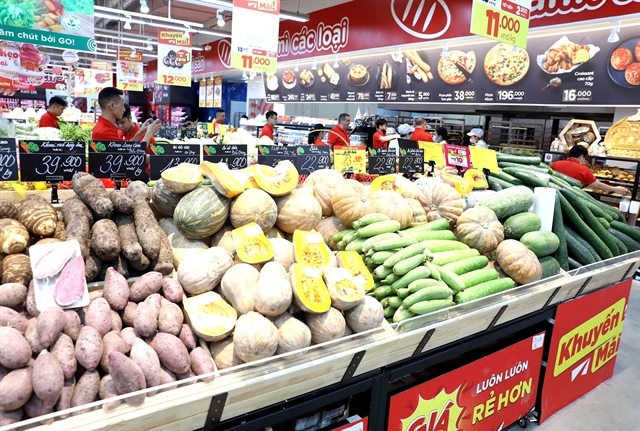
Staff stock shelves at Go! Hưng Yên. The total retail sales of goods and services increased by around 9 – 10 per cent, bringing the retail market size to US$269 billion. — VNA/VNS Photo Thế Duyệt |
Việt Nam’s domestic market posted solid growth in 2025, reaching US$269 billion despite challenges from global economic, political and trade fluctuations and domestic issues related to product quality, consumer sentiment and income levels.
That's according to a report published on Tuesday by the Ministry of Industry and Trade’s Agency for Domestic Market Surveillance and Development.
The Overview Report on Việt Nam’s Domestic Market 2025 shows that total retail sales of goods and services increased by around 9 -10 per cent this year, bringing the size of the retail market to US$269 billion, including $205 billion from goods retail.
Growth exceeded levels seen in recent years after the COVID-19 pandemic, underpinned by resilient consumer demand, rapid digitalisation and expanding commercial infrastructure, the report said.
Commercial infrastructure continued to be upgraded and developed, becoming more convenient and modern, with approximately 8,300 traditional markets, 1,300 supermarkets and 280 shopping centres attracting major domestic and international brands in 2025.
Meanwhile, the supply of goods remained diverse and abundant, while stricter quality inspections and tougher enforcement helped bolster consumer confidence.
The digital transformation accelerated across the retail sector as businesses invested in enterprise resource planning systems, cashless payments, online platforms and livestream commerce.
E-commerce sales surged more than 20 per cent from a year earlier to about $32 billion, accounting for roughly 12 per cent of total market revenue.
Omnichannel retail models expanded rapidly, allowing firms to leverage growing volumes of customer data to improve services and optimise operations.
The report highlighted that the economic rebound is supported by stable growth, rising incomes and well-controlled inflation, which is significantly lower than the National Assembly’s ceiling of 4.5 per cent.
However, the report pointed out several limitations.
Việt Nam’s highly open economy remains vulnerable to external risks, such as geopolitical instability and trade tensions, which may disrupt supply chains, foreign exchange markets and input prices.
Domestic enterprises, though improving, still lag behind FDI firms in scale, financial capacity, advanced technology adoption and corporate governance capability.
Rapid growth in online retail also poses challenges in product quality control, cybersecurity and consumer protection, while traditional retail models have not adapted sufficiently to changes in consumption behaviour and risk losing market share.
Still, the ministry said that with a population exceeding 100 million, a young demographic structure and steadily increasing incomes, Việt Nam’s domestic market is poised to become one of the region’s largest in the next few years.
As exports face rising barriers from protectionist policies in major markets, the Government considers the domestic market a key pillar and driving force for future economic growth.
E-commerce is expected to continue expanding rapidly, with projected revenue reaching $50 billion by 2030.
Regionally, Việt Nam stands out as an attractive destination for global manufacturers and retailers, supported by domestic trade growth of 9-11 per cent annually and import-export growth of 15-17 per cent.
With total trade revenue of more than $900 billion and persistent trade surpluses, the country has become a key link in regional and global supply chains.
“Given these strengths and its growing role in trade and services, Việt Nam is expected to remain one of the region’s most dynamic economies, with the domestic trade sector emerging as a critical engine of national economic growth,” the report noted.
To promote the development of the domestic market, the report suggested that the Government should continue monitoring, evaluating and forecasting inflation developments and adjust fiscal and monetary policies appropriately to prevent inflationary pressure in 2026 and beyond.
This will especially be needed amid faster disbursement of public investment, which will begin to impact the economy more visibly from early 2026.
As e-commerce becomes an increasingly important distribution channel, the Government and relevant ministries should issue appropriate policies to encourage enterprises to invest in digital technology for management and distribution.
At the same time, regulatory agencies must strengthen mechanisms to safeguard personal and financial data used in online transactions, thereby ensuring consumer trust and supporting sustainable e-commerce development, as well as encouraging greater investment in logistics and commercial infrastructure.
Retailers are urged to step up digital and omnichannel strategies, personalise services using data and artificial intelligence and develop tailored offerings for an ageing population. Expansion into rural areas, which account for more than 65 per cent of the population, is also seen as a major opportunity.
Supporting service providers, particularly in cold-chain logistics, warehousing, express delivery and digital infrastructure, are expected to play an increasingly important role as Việt Nam’s domestic trade sector emerges as a key engine of economic growth.
- 07:35 31/12/2025