Integration of OCOP branding with craft villages helps boost value
Integration of OCOP branding with craft villages helps boost value
Developing craft villages along with OCOP branding is not only an economic task, but also a cultural and social mission.
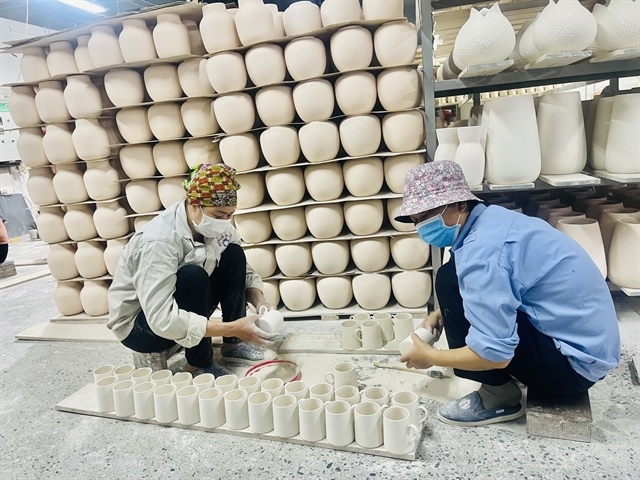
Artisans at Bát Tràng Pottery Village, one of the most famous craft villages in Hà Nội. The capital city aims to develop craft villages along with OCOP branding and rural tourism to enhance the value of Vietnamese goods. — VNA/VNS Photo Tuyết Mai |
Developing Hà Nội’s traditional craft villages along with building strong brands under the 'One Commune, One Product' (OCOP) programme has become a key strategy to enhance the value of Vietnamese goods and strengthen the capital city’s position in both domestic and international markets.
With more than 1,350 craft villages, including over 300 traditional ones, Hà Nội’s handicraft sector plays an important role in rural economic development, job creation and cultural preservation while contributing to the 'Vietnamese people prioritise Vietnamese goods' campaign.
However, the city’s craft villages face growing challenges amid rapid global integration and increasing competition, including small-scale operations, outdated technology, limited innovation, weak branding and restricted market access.
As the OCOP programme has proved effective in helping local producers standardise production, improve quality, enhance packaging and traceability, and expand their market reach, municipal authorities have introduced a range of policies to promote craft village development and encourage the production of OCOP-certified products.
President of the Hà Nội Handicraft and Craft Village Association Hà Thị Vinh said it is vital for craft villages to change their mindset towards brand building to achieve sustainable growth, stressing that a brand must first be built on quality.
“Product quality must be considered the core in branding,” said Vinh, adding that artisans should combine handmade techniques with modern design trends to create products that are both traditional and contemporary.
“Consumers today are different. They don’t just buy a product but a story of culture, people and heritage.”
Linking craft villages with tourism and cultural experiences, she added, is one of the fastest ways to spread brand value.
Phạm Anh Tuấn, vice president of the Việt Nam Fatherland Front in Hà Nội, said developing craft villages in line with OCOP branding is not only an economic goal, but also a cultural and social mission.
He stressed the importance of helping each craft village preserve its traditional identity while achieving sustainable growth and deeper integration into the value chain of high-quality Vietnamese goods.
Tuấn urged stronger communication efforts to raise public awareness of the OCOP programme, moving towards the goal of 'one village – one brand, one product – one story.'
He also called for greater support in planning, infrastructure and environmental management to develop modern craft villages that connect production with cultural preservation, green tourism and sustainable growth.
“It is necessary to increase the adoption of science, technology and digital transformation in production, quality management, traceability and e-commerce, along with trade promotion and skill training,” Tuấn added.
“We must foster links between the Government, scientists, enterprises and farmers to develop brands, protect intellectual property and improve the competitiveness of OCOP products.”
President of the Việt Nam Consumer Cooperative Union (VCCU) Nguyễn Thị Lan Hương said integrating OCOP branding into the development of Hà Nội’s craft villages is essential to improving the value, competitiveness and recognition of Vietnamese products at home and abroad.
She said the VCCU is working to establish retail chains and distribution channels for local producers and craft villages, especially those producing OCOP goods, to ensure quality, transparency and convenience for consumers.
“Branding is not just about logos or packaging but a process integrating product quality, production standards, cultural stories and supply chain links,” said Hương.
She also called for the introduction of incentive policies to help local producers and retailers build supply chains for OCOP products from craft villages, which would significantly boost their value and better protect consumers.
OCOP and rural tourism
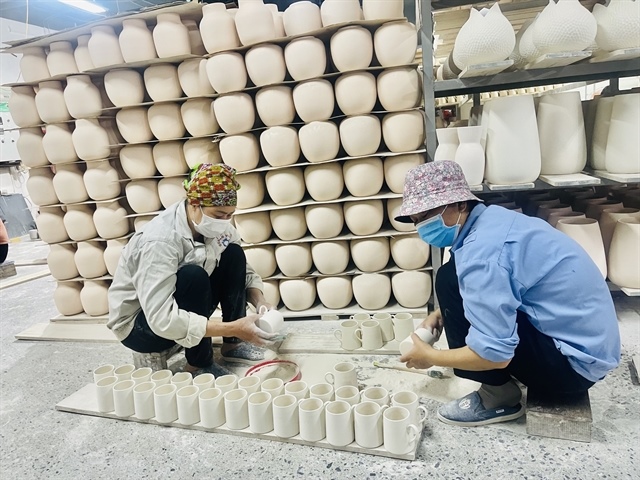
Artisans at Bát Tràng Pottery Village, one of the most famous craft villages in Hà Nội. The capital city aims to develop craft villages along with OCOP branding and rural tourism to enhance the value of Vietnamese goods. — VNA/VNS Photo Tuyết Mai |
Hà Nội’s OCOP products have been increasingly recognised in both domestic and international markets.
Since the launch of the OCOP programme in 2019, the capital city has achieved remarkable results with 3,463 OCOP products so far, accounting for 21 per cent of the country’s total and leading the nation in both scale and quality.
Nine of the products have achieved a five-star rating, with 19 more considered for a potential five star label. Meanwhile, 1,576 goods have a four-star rating and 1,859 have earned three stars.
Alongside the OCOP programme, Hà Nội is also promoting rural tourism as a strategic direction to leverage its cultural, ecological and economic potential. There are currently 52 recognised tourism destinations, including 26 community-based tourism sites associated with craft villages and rural agricultural areas.
As Hà Nội enters a new phase of OCOP and rural tourism development with the goal of improving quality, accelerating digital transformation and promoting sustainable growth, the capital city has outlined four key tasks, including strengthening communication and worker training, developing production links and material zones, promoting organic and processed products and applying digital technology in marketing and distribution.
Hà Nội will give priority to developing OCOP in connection with tourism and craft villages to create integrated value chains among agriculture, culture and tourism that will drive rural economic restructuring towards modernity and inclusiveness.
The capital city has proposed that the Government rapidly issue the national target programme on new rural development, the OCOP programme and the rural tourism development programme for 2026–2030.
Hà Nội has also urged the introduction of criteria for agricultural and rural tourism, as well as mechanisms and incentives to attract investment in rural tourism.
The Hanoi Support Centre for Enterprise and Investment Promotion will focus on providing support to companies, including those in craft villages, to expand their export markets.
Under the master plan to develop craft villages in Hà Nội for the 2025-2030 period, the capital city aims to certify products from more than 50 per cent of craft villages under the OCOP programme. Another goal is to develop three craft villages for tourism, with 10 craft village tour routes set to be established.
- 10:35 07/11/2025