

Việt Nam seen as one of Southeast Asia’s most dynamic F&B markets
Việt Nam seen as one of Southeast Asia’s most dynamic F&B markets
Strong agricultural output and rising demand are creating opportunities for Việt Nam’s food and beverage industry, but businesses need to invest in processing, innovation and branding to compete for a greater share of global markets.
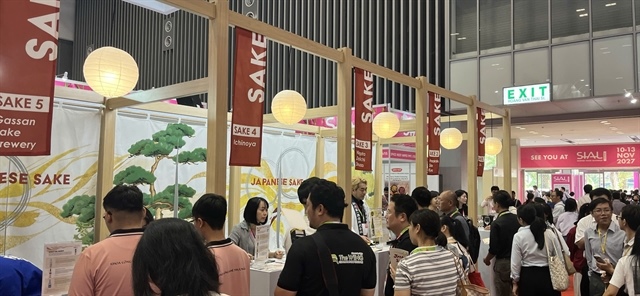
Visitors browse Japanese sake products at SIAL Vietnam 2026, held alongside Vietnam Foodexpo 2026 in HCM City last week. — VNS Photo Bồ Xuân Hiệp |
Việt Nam’s agricultural base, expanding food processing industry and growing domestic consumption are drawing interest from international food and beverage (F&B) businesses.
However, the country faces the challenge of turning these advantages into higher-value products and stronger brands for global markets, experts say.
Speaking on the sidelines of the inaugural SIAL Vietnam 2026 in HCM City last week, Henri Tan, managing director of SIAL Network – ASEAN & India, described Việt Nam as “one of Southeast Asia’s most dynamic F&B markets”.
“The country is a major supplier of coffee, seafood, rice, cashew nuts, tropical fruits and spices,” he said.
“Its strong agricultural production, expanding food processing capabilities and growing domestic market make Việt Nam attractive to international buyers seeking quality products and reliable suppliers,” he told Việt Nam News and Law.
However, attracting buyers is only part of the challenge. Vietnamese producers also need to invest in processing, product development and branding to capture more value and compete in higher-value market segments.
Moving beyond raw exports
Việt Nam has considerable room to increase the value of its food exports. Many businesses still focus on raw materials, while processing, branding and distribution could help them capture a greater share of supply-chain value.
Dr. Đinh Thế Hiển, director of the Research Institute of Informatics and Applied Economics, said raw materials accounted for around 5-10 per cent of total value along the food supply chain, compared with 50-70 per cent for distribution and retail.
The estimates show why export growth alone may not be enough: businesses also need stronger processing capabilities and better access to overseas markets.
International buyers are increasingly looking for traceability, consistent quality, clear product origins and convenience.
Tan said processed foods, packaged snacks, ready-to-eat products and specialty beverages could offer opportunities beyond Việt Nam’s established exports.
For small and medium-sized enterprises (SMEs), having a good product was only the starting point. Understanding overseas market requirements, finding suitable distributors and building relationships with reliable buyers were equally important, he said.
Coffee seeks higher value
The coffee industry illustrates the move beyond raw exports. Việt Nam is a major producer, but the next step is to develop processed products and brands that can compete globally.
Nguyễn Nam Hải, chairman of the Việt Nam Coffee – Cocoa Association (VICOFA), said the industry’s priority over the next five years was to move higher up the global coffee value chain.
This would require investment in advanced processing, new products and Vietnamese brands with international appeal.
The aim was to build on the country’s production strength by improving quality, sustainability and value creation, allowing growers and businesses to retain more value from their products, he said.
Hải said international buyers were attracted by Việt Nam’s ability to supply coffee in large volumes while offering distinctive products from different growing regions.
He also saw the exhibition as an opportunity for domestic coffee businesses to introduce new products and meet overseas buyers.
Building Vietnamese brands
Developing recognisable brands and meeting international quality requirements remain major challenges for local food producers.
Recognition of Vietnamese cuisine does not automatically translate into demand for Vietnamese food brands.
Producers still need consistent quality, meet food safety and sustainability requirements, and stand out from established competitors.
Smaller businesses may struggle to afford new technology, obtain international certifications and establish overseas distribution networks.
Bùi Hồng Hạnh, founder and CEO of Vietnamese chocolate maker Legendary Chocolatier, said the company combined Vietnamese cacao with local ingredients to produce distinctive chocolates.
The company exports to Japan, South Korea, Singapore, Canada, Taiwan and Hong Kong (China), and is seeking to expand into North America and Europe.
Building brand recognition overseas, meeting different market requirements and competing with established global brands while keeping prices competitive remained difficult, she said.
The company continued to invest in research and development, manufacturing technology and quality control, as well as products and packaging that reflect Vietnamese culture.
Barbara Jankiewicz, business development manager at Poland-based consulting firm MDelta, said the country’s growing consumer demand and role in regional food supply chains offered opportunities for international businesses.
Established in Paris in 1964, the SIAL Network organises food industry exhibitions in several international markets. Its first Vietnamese edition took place from November 11-14 alongside the Vietnam Foodexpo 2026 in HCM City.
Tan said the network could help Vietnamese SMEs better understand overseas markets and connect with potential buyers.
But turning contacts into lasting business relationships will depend on whether they can meet international standards, maintain consistent quality and offer competitive products.
For Việt Nam, the longer-term challenge is to move beyond supplying agricultural commodities and develop products and brands that can command greater value in international markets.
- 12:36 17/11/2026