UK trade preferences come with strict requirements
UK trade preferences come with strict requirements
The UK offers Vietnamese exporters a promising market, but turning trade preferences into firm orders depends on the initiative and capability of individual businesses, a trade promotion official has said.
Speaking at a seminar on strategies for accessing the UK market through the Comprehensive and Progressive Agreement for Trans-Pacific Partnership (CPTPP) and the UK-Vietnam Free Trade Agreement (UKVFTA) in Ho Chi Minh City on November 10, Ho Thi Quyen, deputy director of the Ho Chi Minh City Investment and Trade Promotion Centre (ITPC), said, "The UK is one of the world's major economies, with strong purchasing power and a well-developed distribution network, making it a promising export market for Vietnamese goods. However, the market also imposes stringent requirements on product quality, technical standards, food safety, traceability, and environmental and social responsibility."
According to Quyen, the concurrent implementation of the UKVFTA and the UK's accession to CPTPP, which took effect in late 2024, has given businesses additional options when developing export strategies, allowing them to select the most appropriate preferences based on individual products and rules of origin, and to explore overseas investment strategies.
"While the market opportunities and preferences offered by free trade agreements are clear advantages, the ability to turn these benefits into orders, contracts, and a long-term presence in the UK market depends first and foremost on the initiative and capabilities of individual businesses," Quyen said.

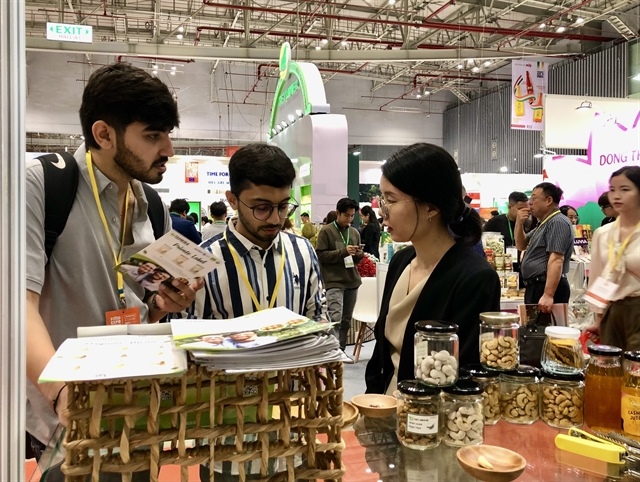
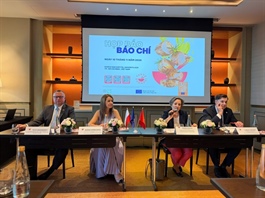
Seminar on accessing the UK market via the CPTPP and UKVFTA, Ho Chi Minh City on November 10. Photo: ITPC |
The seminar aimed to help businesses stay updated on market opportunities and preferential terms under the UKVFTA and the CPTPP. It also sought to help them make more effective use of the agreements, meet export requirements, develop market-entry strategies and expand distribution channels in the UK.
Providing an in-depth analysis of how the two agreements operate, Canh Trinh, lecturer at the Faculty of International Business and Marketing at the Ho Chi Minh City University of Economics, said Vietnam is currently the UK's 17th-largest goods supplier, accounting for 1.2 per cent of the country's total imports, and ranks 65th in services supply.
“Statistics for 2025 show that approximately 3,000 UK businesses exported goods to Vietnam, while around 5,600 Vietnamese businesses exported to the UK,” Trinh said.
In terms of value chains, exports to the UK support approximately 460,400 jobs in Vietnam, while UK exports to Vietnam support around 12,900 jobs in the UK.
However, only 0.3 per cent of the value added in Vietnam's exports originates from the UK, while 48.5 per cent comes from foreign sources, mainly China, South Korea and the United States.
"As a result, electronic products exported to the UK rely heavily on imported components from outside the bloc, posing challenges in meeting rules of origin requirements and benefiting from cumulation provisions," Trinh added.
The UKVFTA took effect in 2021, building on the foundations of the EVFTA, according to Canh.
"The agreement is set to eliminate 99 per cent of import tariffs between the two sides over six to seven years, helping Vietnam save an estimated $148 million in duties on goods exported to the UK, while UK businesses are expected to save approximately $46.8 million," Canh said.
Meanwhile, the UK's accession to the CPTPP and its recognition of Vietnam as a market economy in 2023, have opened up a multilateral cumulation mechanism.
This allows Vietnamese businesses to cumulate input materials sourced from the bloc's 11 other member countries and qualify for zero per cent tariffs using CPTPP certificates of origin. The mechanism is expected to move towards self-certification of origin after a transition period ending in 2029.
"With Vietnam serving as chair of the CPTPP Council in 2026, while other exporting countries such as India are stepping up trade cooperation with the UK, Vietnamese businesses need to select the appropriate agreement based on the sourcing of materials for each product and ensure compliance with rules of origin before considering price factors," he said.
Approaching the issue from the perspective of quality standards and export procedures, Nguyen Ly Truong An, deputy director of Blue Sea Trading and Transport Co., Ltd., said bilateral trade turnover reached $9.38 billion in 2025, up 11.3 per cent from 2024, with Vietnam recording a trade surplus of $7.4 billion.
Notably, the export structure is shifting significantly towards processed industrial and high-tech products.
Computers, electronic products and components, for example, recorded a sharp 49 per cent growth in the first quarter.
Despite the growth potential, An noted that Vietnamese goods still account for a modest share of the UK's total import market, which was valued at $1.2 trillion in 2025.
Meanwhile, Vietnam's export capacity remains heavily reliant on the foreign-invested sector, which accounted for 80.7 per cent of the country's total exports in the first nine months. As the trade surplus expands, scrutiny from the UK market is also likely to intensify.
Sharing practical insights from the local market, Nguyen Minh Khoi, chair of the Trade Working Group at the British Business Group Vietnam and programme director at the Tony Blair Institute for Global Change, cited a report published by the UK Department for Business and Trade in September.
The report shows that, by UK region, imports from Vietnam are most concentrated in the South East, valued at $2.47 billion, or 23.7 per cent of the total, followed by London at $1.3 billion, or 13.4 per cent.
“UK consumers assess product quality based on tangible evidence rather than relying solely on promotional messages. Some 50 per cent focus on product durability and lifespan, 32 per cent require transparency about material composition, 30 per cent look for certifications, another 30 per cent consider product origin, and 26 per cent take recyclable packaging into account,” he said.
In the first half, bilateral trade between Vietnam and the UK reached approximately $5.02 billion.
Vietnam's exports to the UK totalled $4.51 billion, up 16.34 per cent year-on-year, while imports stood at around $508.64 million, an increase of 10.24 per cent.
Vietnam continued to record a trade surplus of nearly $4 billion with the UK, with key exports including electronic products, telephones, machinery and equipment, footwear, textiles and garments, agricultural products, and seafood.
Beyond trade, investment cooperation between the two countries also offers positive prospects.
- 14:42 11/11/2026