

Climate pressures mount on Vietnam's coffee sector
Climate pressures mount on Vietnam's coffee sector
Despite being the world's second-largest coffee producer and leading robusta supplier, Vietnam is facing mounting pressure from climate change, declining soil health, and water stress, which directly affects productivity and the livelihoods of millions of farming households.

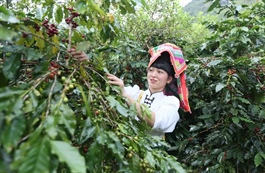
Photo: Nestlé Vietnam |
The information was shared by Binu Jacob, CEO of Nestlé Vietnam at the 'Shaping the Future' discussion session during the Fortune Southeast Asia 500 Summit on November 3.
Jacob said, “There is no single solution or technology to address these challenges and enhance the competitiveness of Vietnamese coffee beans. It is vital to combine suitable coffee varieties, soil conditions, water management, and experience sharing among farming households to develop production efficiency.”
Nestlé has prioritised the development of coffee varieties suited to local soil conditions in the Central Highlands. According to Jacob, Nestlé has partnered with the Western Highlands Agriculture and Forestry Science Institute (WASI) to research the varieties.
One of Nestlé's priorities in the Central Highlands is developing coffee varieties suited to local soil conditions. According to Jacob, the company has partnered with WASI to research disease-resistant coffee varieties that require less water and pesticides.
At the same time, the development of suitable coffee varieties must be accompanied by the capacity for propagation, enabling large-scale implementation. Through tissue culture techniques, a single coffee leaf can be used to propagate approximately 2,000 seedlings. Over the past 15 years, the programme has produced 100 million disease-resistant coffee varieties and distributed them to farmers in the Central Highlands at subsidised prices.
Jacob said, “The solution is vital to address several ageing coffee plantations. Coffee yields typically begin to decline after around seven to 10 years, creating a need for replanting to maintain production efficiency.”
“To ensure the coffee supply in long term, attention should be paid to restore health and manage water resources through regenerative farming practices,” he said. “Once properly implemented, reducing water and pesticide can improve economic returns without lowering yields.”
A key factor of Nestlé's regenerative agriculture model in Vietnam is crop diversification on the same plots of land. Besides sourcing coffee, Nestlé also encourages farmers to intercrop pepper, avocados, and other fruit trees. Thanks to this approach, farming households can make better use of land, generate additional income, and reduce farmers' dependence on a single agricultural commodity.

Photo: Nestlé Vietnam |
“Nestlé's experience shows that intercropping does not reduce coffee yields per hectare. On the contrary, farmers' incomes can increase by 30-150 per cent, depending on the crops selected and implementation conditions. Crop diversification also benefits soil health, contributing to improving the sustainability of farming systems,” Jacob noted.
Changes at the farm level have a direct impact on farmers' livelihoods, while also affecting the quality and stability of raw material supplies for processing companies. This requirement is becoming increasingly important given that Vietnam’s coffee industry can’t rely on large volumes and low prices to maintain competitive edges and secure its position in international markets.
He further noted, “Vietnam was traditionally known as a supplier of low-cost coffee. However, in light of higher quality and sustainability standards in export markets, it is increasingly difficult to sustain a business model based on price competition. Vietnam needs to upgrade its value chain, from farming practices to processing, to develop products that meet evolving market requirements.”
He believes that smallholder farmers can also transition from traditional farming practices to regenerative agriculture. This presents an opportunity for farmers to improve their ability to meet international buyers' standards while creating additional competitive advantages for Vietnamese coffee.
Nestlé is working alongside farmers to ensure a stable supply of raw materials that meets the increasingly stringent requirements of processing and export operations. As one of Vietnam's major coffee buyers, Nestlé currently purchases approximately 20-25 per cent of Vietnam's annual coffee output.
"Strengthening the resilience of farming households is important for both company and the future of Vietnam's coffee industry. However, transitioning to sustainable farming practices requires time and patience. This process calls for long-term cooperation between businesses, government agencies, and farmers," he emphasised.
The experience of coffee cultivation in the Central Highlands illustrates how regenerative agriculture can serve as an approach to making more efficient use of land, water, and available resources while sustaining farmers' livelihoods. It is also one of the conditions for Vietnam's coffee industry to maintain its competitiveness as international market standards continue to rise.
- 11:55 06/11/2026