

Moves made to standardise digital economy measurement
Moves made to standardise digital economy measurement
To assess progress towards the target accurately, authorities need to agree on the indicators, measurement methods and official data sources used to calculate the digital economy's contribution to the national economy.

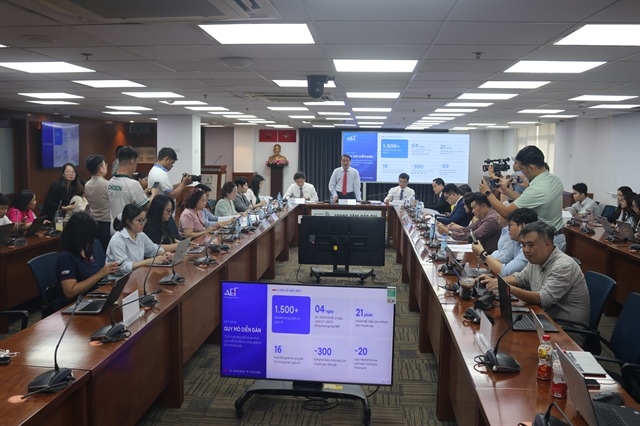
Deputy Prime Minister Hồ Quốc Dũng speaks at the event on Wednesday morning. — VNA/VNS Photo |
The Government is seeking to standardise the indicators and methodology used to measure the digital economy's contribution to gross domestic product (GDP), as the Government works towards a target of having the sector account for at least 30 per cent of GDP by 2030.
Deputy Prime Minister Hồ Quốc Dũng chaired a meeting with the Ministry of Science and Technology and the Ministry of Finance at the Government headquarters on October 21 to reach agreement on the measurement indicators.
Attendees included Deputy Minister of Science and Technology Trần Trung Tính, Deputy Minister of Finance Nguyễn Thị Bích Ngọc and Deputy Chairman of the Government Office Phạm Mạnh Cường.
According to the Ministry of Science and Technology, digital economy development is a strategic direction of the Party and State. The target of a digital economy accounting for at least 30 per cent of GDP by 2030 is set out in Resolution No. 57-NQ/TW, dated December 22, 2024, on breakthroughs in science and technology, innovation and national digital transformation.
To assess progress towards the target accurately, authorities need to agree on the indicators, measurement methods and official data sources used to calculate the digital economy's contribution to the national economy.
At the meeting, participants discussed how to implement digital economy indicators under resolutions issued by the Party’s Central Committee and the Government. They also examined the definitions, calculation methods and responsibilities of the agencies in charge, taking into account the Government's latest documents.
These include Resolution No. 11/NQ-CP, which amends, supplements and updates Resolution No. 71/NQ-CP dated April 1, 2025, on the Government's action programme implementing Resolution No. 57-NQ/TW.
Discussions focused on establishing indicators to assess implementation results in 2027 and guide progress towards the 2030 target, ensuring that the measurement framework is consistent with the country’s digital economy development objectives.
After hearing reports from the ministries and relevant agencies, Deputy Prime Minister Dũng assigned the Ministry of Science and Technology to lead coordination with the Ministry of Finance to agree on the name of the indicators used to measure, monitor and assess the digital economy's contribution to GDP.
He also directed the two ministries to reach agreement on the indicators' definition, scope and measurement approach, clarify the methodology for identifying and calculating the digital economy, and report their findings to the Prime Minister.
Dũng stressed the need for consistent terminology, statistical methods and indicators to provide a common basis for monitoring and evaluating progress towards the national digital economy development target.
According to the National Statistics Office under the Ministry of Finance, the digital economy's contribution to GDP, measured by its share of value added, rose from 12.87 per cent in 2021 to 14.02 per cent in 2025.
Under the 2026 work plan of the Government's Steering Committee for the Development of Science and Technology, Innovation and Digital Transformation and Project 06, the target is to raise the digital economy's contribution to GDP to 14.5 per cent in 2026.
- 16:21 21/10/2026