




Carbon market seen as new driver for green transition
Carbon market seen as new driver for green transition
The registry is expected to provide a key foundation for managing carbon allowances and credits as Việt Nam moves towards establishing a domestic carbon market.
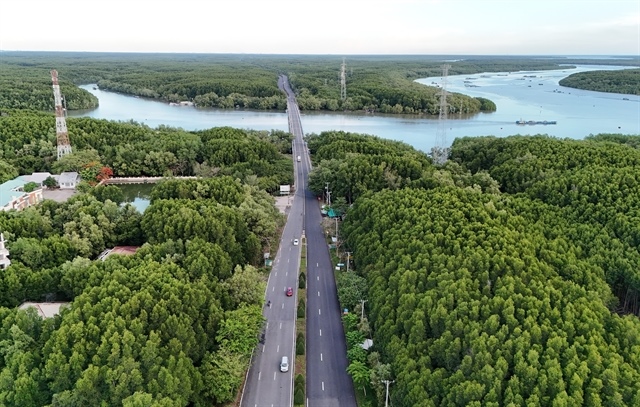
The Cần Giờ protective forest spans four communes of Cần Giờ, Bình Khánh, An Thới Đông and Thạnh An, offering significant potential for carbon credit development. — VNA/VNS Photos |
Moves are being made to get the long-planned carbon market off the ground, with authorities racing to build the legal, data and trading infrastructure needed to make carbon credits a viable commodity.
The Ministry of Agriculture and Environment recently issued a decision requiring the national registry for greenhouse gas emission allowances and carbon credits to be completed and operational by October 10, 2026.
The registry is expected to provide a key foundation for managing carbon allowances and credits as Việt Nam moves towards establishing a domestic carbon market.
The push comes as it faces growing climate risks. Average annual temperatures across the country increased by about 0.2 degrees Celsius per decade between 1961 and 2023, while Việt Nam ranked 10th globally for climate change risk in 2024, according to government officials.
According to Nguyễn Hùng Minh, deputy head of the Carbon Market Division at the Department of Climate Change, greenhouse gases and the greenhouse effect are the main drivers of global warming.
The effects include rising sea levels and increasingly extreme weather.
Việt Nam has spent more than a decade developing policies to address climate change, with measures ranging from Party resolutions and environmental legislation to government decrees and international agreements.
The 2020 Law on Environmental Protection provides the main legal basis for climate action, including Article 139, which establishes the framework for developing a domestic carbon market.
Authorities are now considering further changes to the legal framework, including the possible development of a dedicated climate change law.
Director general of the Department of Climate Change, Nguyễn Tuấn Quang, said the agency had also helped develop a government scheme on the management and use of carbon credits.
The scheme provided the basis for a recent Party Secretariat conclusion calling for carbon credits to be managed and used to support sustainable economic and social development while contributing to national security.
Việt Nam is also seeking to expand international cooperation on carbon trading.
The government has approved bilateral carbon credit trading agreements with Singapore and Japan, while technical negotiations with South Korea and Switzerland are under way. Officials expect the latter agreements to be completed by the end of 2026.
The country is also working to improve its climate data infrastructure and link its national climate database with the Ministry of Public Security’s National Data Centre.
Deputy Agriculture and Environment Minister Lê Trọng Yên has called for the development of a reliable supply of carbon commodities and transparent trading mechanisms, saying these are necessary for a carbon exchange to operate effectively and deliver tangible benefits to businesses and communities.
Blue carbon attracts investors
Alongside the broader carbon market, Việt Nam is looking to its coastal ecosystems for investment opportunities.
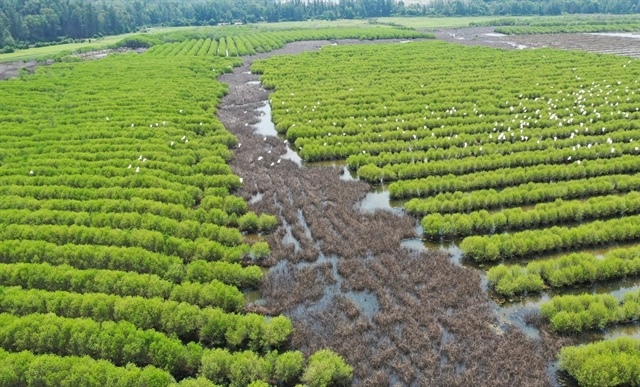
The Cần Giờ protective forest spans four communes of Cần Giờ, Bình Khánh, An Thới Đông and Thạnh An, offering significant potential for carbon credit development. — VNA/VNS Photos |
Blue carbon, carbon captured and stored by coastal and marine ecosystems such as mangroves, seagrass beds and tidal wetlands, was a key focus at a meeting held by the Ministry of Agriculture and Environment and the United Nations Development Programme in Việt Nam on September 23.
Government agencies, development partners, financial institutions and private companies discussed a national action roadmap for 2026-2030 and ways to turn blue-carbon initiatives into investment-ready projects.
Participants identified several requirements, including clearer policies, reliable data, technical standards, stronger project preparation capacity and suitable financing mechanisms.
The ministry said Việt Nam would in 2026 and 2027 focus on developing the institutional, data and technical foundations for blue carbon.
By 2030, it aims to establish unified management of blue-carbon ecosystems and gradually incorporate them into the country’s nationally determined contribution and other climate targets.
The government also hopes the approach will help create sustainable livelihoods for coastal communities.
Francesca Nardini, UNDP’s deputy resident representative in Việt Nam, said the agency would continue working with the government and other partners to turn the potential of blue carbon into coordinated, evidence-based projects capable of attracting investment.
A representative of the British Embassy in Việt Nam, Fergus McBean, said stronger institutions and transparent policies would help build investor confidence and attract private-sector capital.
For Việt Nam, the next challenge is to translate its growing body of climate policies into a market that can function in practice.
That will require not only a clear legal framework, but also reliable data, standardised measurement and verification, transparent trading rules and projects capable of generating credits that investors are willing to buy.
Environmental protection should be viewed as a foundation for development rather than simply a way of dealing with its consequences, said Tăng Thế Cường, director general of the Department of Environment.
Climate and environmental considerations should be incorporated into development strategies and projects from the planning stage, he said.
- 09:11 12/10/2026