Capital market development critical to unlock investment resources
Capital market development critical to unlock investment resources
The figures highlighted the need to broaden sources of finance beyond bank lending and improve the efficiency of resource use.

Contruction of Long Phú 1 Thermal Power Plant in Cần Thơ City. Meeting the country's growth ambitions required not only sufficient funding but also more effective allocation and use of capital. — VNA/VNS Photo Trung Kiên |
Developing capital markets and removing bottlenecks to mobilising the private resources are key priorities for Việt Nam to diversify funding channels and improve capital efficiency to support ambitious economic growth targets in 2026-30.
The country is estimated to need around VNĐ38-39 quadrillion (US$1.45-$1.47 trillion) in investment over the five-year period, more than double the VNĐ17.4 quadrillion recorded in 2021-25.
The figures highlighted the need to broaden sources of finance beyond bank lending and improve the efficiency of resource use.
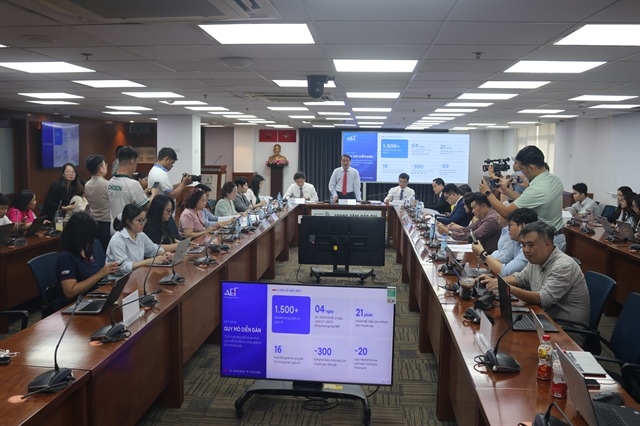
Nguyễn Đức Hiển, deputy head of the Communist Party of Việt Nam Central Committee's Commission for Policies and Strategies, said meeting the country's growth ambitions required not only sufficient funding but also more effective allocation and use of capital.
Projected investment needs include VNĐ12.5 quadrillion from the state sector, of which VNĐ8.3-8.5 quadrillion would be public investment, and about 20.4 quadrillion from the private sector.
The capital demand places pressure on both the state budget and the banking system, underscoring the importance of developing equity and bond markets, investment funds and other long-term financing channels, he said.
Hiển cited statistics that credit outstanding rose 9.23 per cent in the first nine months of 2026 from the end of 2025, while deposits increased 10.5 per cent.
About 80 per cent of funds mobilised by credit institutions had maturities of less than 12 months, while nearly half of outstanding loans were medium- or long-term, which is creating a maturity mismatch that constrains banks' capacity to provide long-term capital.
To ease these pressures, Hiển called for stronger capital bases at State-owned commercial banks, improved access to international funding and the development of institutional investors and the fund management industry.
He also highlighted the need to improve stock market infrastructure and foreign investor access, while strengthening transparency, credit ratings and investor protection in the corporate bond market.
The corporate bond market needs greater transparency, stronger credit-rating mechanisms and better investor protection to help businesses secure medium- and long-term funding, he added.
Other potential funding sources include green and sustainable finance, remittances, carbon markets, off-budget financial funds and international bond issuance.
He urged for greater efforts to unlock stalled projects, make better use of surplus public assets and improve access to finance for small- and medium-sized enterprises (SMEs) and innovative businesses.
Cấn Văn Lực, a member of the National Financial and Monetary Policy Advisory Council, said investment would need to reach 36-39 per cent of GDP annually for Việt Nam to achieve growth of 10 per cent a year during 2026-30.
Lực said the private sector would be central to meeting the funding requirement, as the state budget could not cover all investment needs and bank lending faced constraints.
He added that raising more capital must go hand in hand with improving investment efficiency.
Việt Nam's incremental capital-output ratio, which measures the investment required to generate additional economic output, stood at about 6 during 2021-25. The country aims to reduce the ratio to 4.5-4.8 in 2026-30.
Total factor productivity is projected to contribute 51-55 per cent of economic growth during the period, underscoring the importance of productivity gains alongside capital accumulation.
Investment should therefore prioritise productivity, technological adoption, innovation and projects that generate higher value added to ensure that mobilised resources translate into sustainable economic growth, Lực said.
- 17:08 23/10/2026