Industrial investors prioritise execution and infrastructure over cost
Industrial investors prioritise execution and infrastructure over cost
Vietnam’s industrial property market is entering a new phase of competition, as land availability and cost advantages are no longer sufficient to determine investors’ choices.
At the second discussion session of Vietnam Industrial Property Forum 2026, held on September 29 in Ho Chi Minh City, experts and industry insiders said execution capability, the level of infrastructure integration, energy security, and the quality of support provided throughout a project’s lifecycle are increasingly becoming decisive factors in the attractiveness of industrial parks.
Hoang Thuy Duong, partner, KPMG Vietnam, said Vietnam is facing a major opportunity amid positive economic growth and the continued restructuring of global value chains, which is further strengthening the country’s role in global manufacturing networks.
“Vietnam’s competitiveness can no longer be viewed simply through the lens of scale, cost advantages, or low-cost labour. New requirements around sustainability, AI, automation, and genuine economic efficiency are prompting a rethink of how industrial park products are developed and delivered,” he said.
The discussion therefore focused on three key issues: what investors are really looking for when selecting manufacturing locations, how industrial infrastructure products need to evolve, and what determines economic efficiency for businesses.
Duong also said that, alongside its existing advantages, Vietnam still needs to address delays related to the speed of licensing, administrative procedures, and energy infrastructure. Close coordination among government authorities, infrastructure developers, and investors will be important to strengthening Vietnam’s competitiveness.
From an industrial real estate advisory perspective, John Campbell, director and head of Industrial Services, Savills Vietnam, said that as Vietnam moves into higher-value segments, manufacturers’ criteria for selecting locations are also changing.
“It’s not about the land itself; it’s more about the certainty of execution. Within certainty of execution, there are three key factors I would like to highlight. First is speed and execution, including power capacities and the time it takes from licensing to production. Those are significant factors, and that is why we have seen the rising popularity in the last eight years of ready-built factories that can provide that immediate readiness,” stated Campbell.
Second is operational certainty, including a mix of skilled labour supply, access to ports and infrastructure, and working with a developer or landlord who continues providing responsive support after the deal is closed because these can be 50-year partnerships.
Third is future-readiness certainty. According to Campbell, manufacturers look at whether there is room to expand in a particular location, as well as what the clear energy and power pathway is for the next 20 to 30 years as manufacturing becomes increasingly energy-intensive.
“Sustainability makes sense commercially when it solves a real business problem,” added Campbell. “In the next 5 years, integrated eco-industrial parks with sophisticated master plans that connect manufacturing, logistics, and services will be the clear winners in attracting high-value foreign investment to Vietnam.”
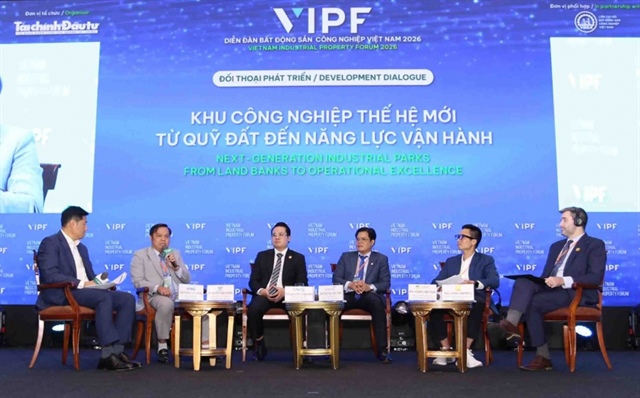
Overview of the panel discussion. Photo: Le Toan |
Drawing on his experience in developing and operating industrial parks in Long An since 2018, Nguyen Huu Thuc, CEO of IMG Phuoc Dong, said the traditional industrial park model is gradually losing its competitive advantage.
According to Thuc, the market is shifting from competition based on the ability to provide industrial land to competition based on the ability to meet investors’ actual needs.
“IMG Phuoc Dong currently focuses on two main groups of solutions,” he said. “The first is ensuring ready-to-use technical infrastructure, including a power system with 22kV and 110kV substations, an on-site clean water treatment plant, and a complete wastewater treatment system, enabling secondary investors to connect to the infrastructure and implement their projects.”
“The second is enhancing operational capabilities and investor support. Our internal personnel are organised to directly assist businesses with legal procedures, thereby shortening the time from obtaining licences to the official commencement of factory operations,” he added.
According to Thuc, as infrastructure across industrial parks becomes increasingly similar, the ability to provide direct support to investors throughout project implementation and operations will become an important competitive advantage.
Nguyen Thanh Chuong, CEO, Thanh Thanh Cong Industrial Real Estate Corporation, viewed the transformation of the industrial park model through the lens of practical development experience.
According to him, industrial parks in the past were typically developed in areas with an existing labour pool or local sources of raw materials to serve particular groups of investors.
“However, the new wave of investment is placing higher demands on the quality and level of infrastructure integration,” he added. “Accordingly, next-generation industrial parks need to combine green technical infrastructure, renewable energy, and integrated logistics, while also creating an appropriate living environment and amenities for workers to ensure stable long-term operations.”
From the perspective of developing an industrial ecosystem, Nguyen Tuan Anh, deputy general director, KN Holdings, said the transition towards the next-generation industrial park model is inevitable, but the key issue is to clearly define the role of each industrial park to use resources efficiently.
According to him, Vietnam currently has around 478 industrial parks, with a total planned area of approximately 150,000 hectares. By 2030, the number is expected to reach around 600 parks, with a total area of approximately 180,000 ha, equivalent to an additional 30,000 ha.
“During the development process, if every industrial park attempts to integrate every possible function, resources may become fragmented and development models may become overly spread out. Instead, we need to build an ecosystem with clearly differentiated roles,” said Tuan Anh.
“For industrial parks serving high-tech and semiconductor industries, the focus should be on large-capacity, highly stable power supplies and stringent wastewater treatment systems. Meanwhile, industrial parks serving food processing and light manufacturing should optimise their locations near raw material sources and logistics routes.”
This role differentiation also needs to be considered at the regional level. According to Tuan Anh, Ho Chi Minh City has advantages in high technology and services; Ba Ria–Vung Tau, particularly Phu My, has strengths in heavy industry and deep-sea ports; while Tay Ninh and the Mekong Delta can focus on processing industries and inland waterway and maritime logistics chains.
From the developer’s perspective, Hoang Vinh Tuan, head of Marketing and Leasing, Soilbuild International Vietnam, said innovation in industrial park products must start with the actual needs of tenants.
“For foreign investors entering the Vietnamese market for the first time, an integrated model can help reduce implementation time and costs. Instead of having to handle every step themselves, from licensing procedures and labour recruitment to preparing operational infrastructure, investors can choose a model in which the developer provides end-to-end support,” he said.
“In that case, the value of an industrial park no longer lies simply in the amount of land provided, but in its ability to take investors from the initial investment to commercial operations faster, more efficiently, and with greater certainty.”
- 12:00 30/09/2026