Businesses urge State to cut inspection procedures, costs
Businesses urge State to cut inspection procedures, costs
A draft on coordination among agencies responsible for product and goods quality inspections, open for public comment in September, seeks to improve information sharing, risk alerts and the use of inspection results.
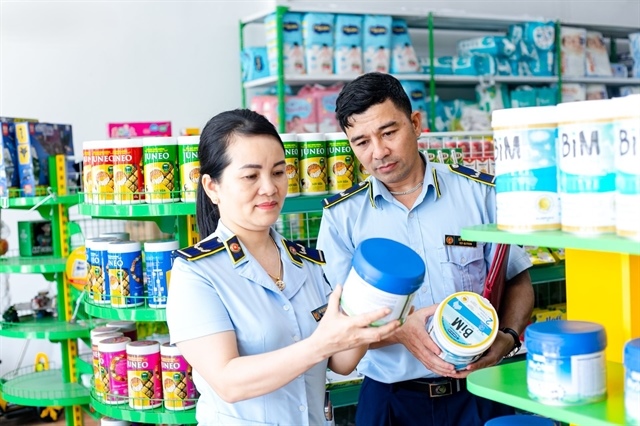
The Market Surveillance Force inspects milk products at a shop in Thanh Hóa Province. Photo thuonghieucongluan.com.vn |
Vietnamese businesses are calling for goods inspection reforms to focus on risk rather than paperwork, warning that tighter controls could otherwise add costs without improving the State's ability to monitor products.
A draft on coordination among agencies responsible for product and goods quality inspections, open for public comment in September, seeks to improve information sharing, risk alerts and the use of inspection results. But its success will depend on whether businesses actually have to submit fewer documents and face fewer duplicate checks.
The central issue is not how many goods are inspected, but how inspections are carried out. If agencies continue to collect and process the same information separately, businesses will remain burdened by repeated declarations, paperwork and waiting times even as the regulatory system is reformed.
Risk-based controls
The draft identifies risk management, post-market inspections, compliance records and electronic data as key tools for coordination. It also proposes that businesses should not have to resubmit information and documents that Government agencies are legally entitled to access, share and still use.
For imported goods, customs and quality inspection agencies could share data on declarations, shipments, owners, storage locations, inspection status, results and risk alerts. The framework would also cover goods produced domestically, circulated in the market and sold through digital platforms.
That approach could help shift resources away from blanket pre-market controls and towards businesses and products that present higher risks.
But data sharing alone will not deliver the promised savings if agencies do not use the information to decide when an inspection is necessary. Businesses could otherwise face a digital version of the same old bureaucracy.
A recent submission by the European Chamber of Commerce in Vietnam (EuroCham) on a draft amendment to the Food Safety Law illustrates the concern.
EuroCham warned that proposed rules could significantly increase the procedures and costs involved in registering, declaring and inspecting imported food products. Under proposed rules for registering and declaring new products, applicants could be required to submit up to 14 types of documents, 3.5 to seven times the number required under Decree 15.
For ordinary packaged foods, such requirements could make compliance difficult and in some cases threaten production, EuroCham said.
The association also warned that regulatory resources could remain concentrated on pre-market controls rather than stronger post-market monitoring.
A broader risk is that tighter regulation could increase compliance costs without delivering a matching improvement in enforcement. For smaller businesses in particular, requirements for scientific evidence, research and development or product stability could add significant pressure, according to EuroCham.
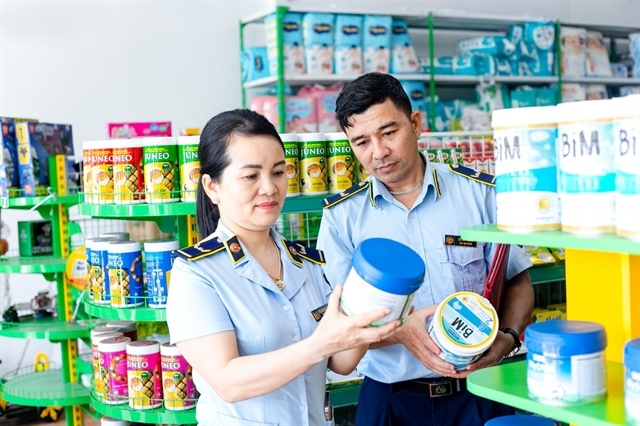
The Market Surveillance Force inspects milk products at a shop in Thanh Hóa Province. Photo thuonghieucongluan.com.vn |
Good compliance
The alternative is a system in which a company's compliance history determines the intensity of regulatory scrutiny.
Businesses with a strong record should face fewer repeat inspections, while products, shipments or companies showing signs of risk should receive more intensive checks.
That would allow regulators to concentrate scarce resources where they are most needed, rather than applying similar requirements to every business and product.
Economist Nguyễn Hoàng Dũng said effective regulation should rely more heavily on electronic data and targeted post-market inspections rather than creating additional licensing requirements.
"Valid inspection results that are still relevant must be reused. A good compliance record must help reduce inspections. Risk alerts must be quickly passed to the agency capable of taking action," Dũng told VnBusiness.
"If the same data still has to be declared multiple times, that is the cost of poor connectivity, not a necessary cost of risk control," he said.
EuroCham's latest Business Confidence Index highlights the scale of the problem. Some 53 per cent of surveyed businesses said regulatory and procedural issues were hindering their operations, while many reported having to provide the same information and documents to different Government agencies.
The cost is not limited to official fees. Repeated submissions consume staff time, create opportunity costs and can delay business operations.
Post-market checks
For the proposed model to work, however, Việt Nam will also need to clarify what post-market inspection means and how it differs from existing monitoring, inspection and specialised checks.
Nguyễn Như Tiệp, chairman of Minh Phú Seafood Group JSC, said post-market inspection remained a relatively new concept without a comprehensive legal framework. Authorities therefore needed to define its scope and its relationship with existing inspection mechanisms.
Without that clarity, post-market inspection would risk becoming another layer of bureaucracy rather than a replacement for unnecessary pre-market procedures.
The test for reform is straightforward: whether businesses submit less information, wait less and spend less on compliance while regulators gain better visibility of risks.
Stricter enforcement does not necessarily require more paperwork. A more effective system would inspect less where risks are low, inspect more deeply where risks are high and respond quickly when violations emerge.
That would turn data sharing and post-market inspection from administrative concepts into practical tools – reducing the compliance burden on businesses while strengthening the State's ability to control risk.
- 08:08 14/09/2026